

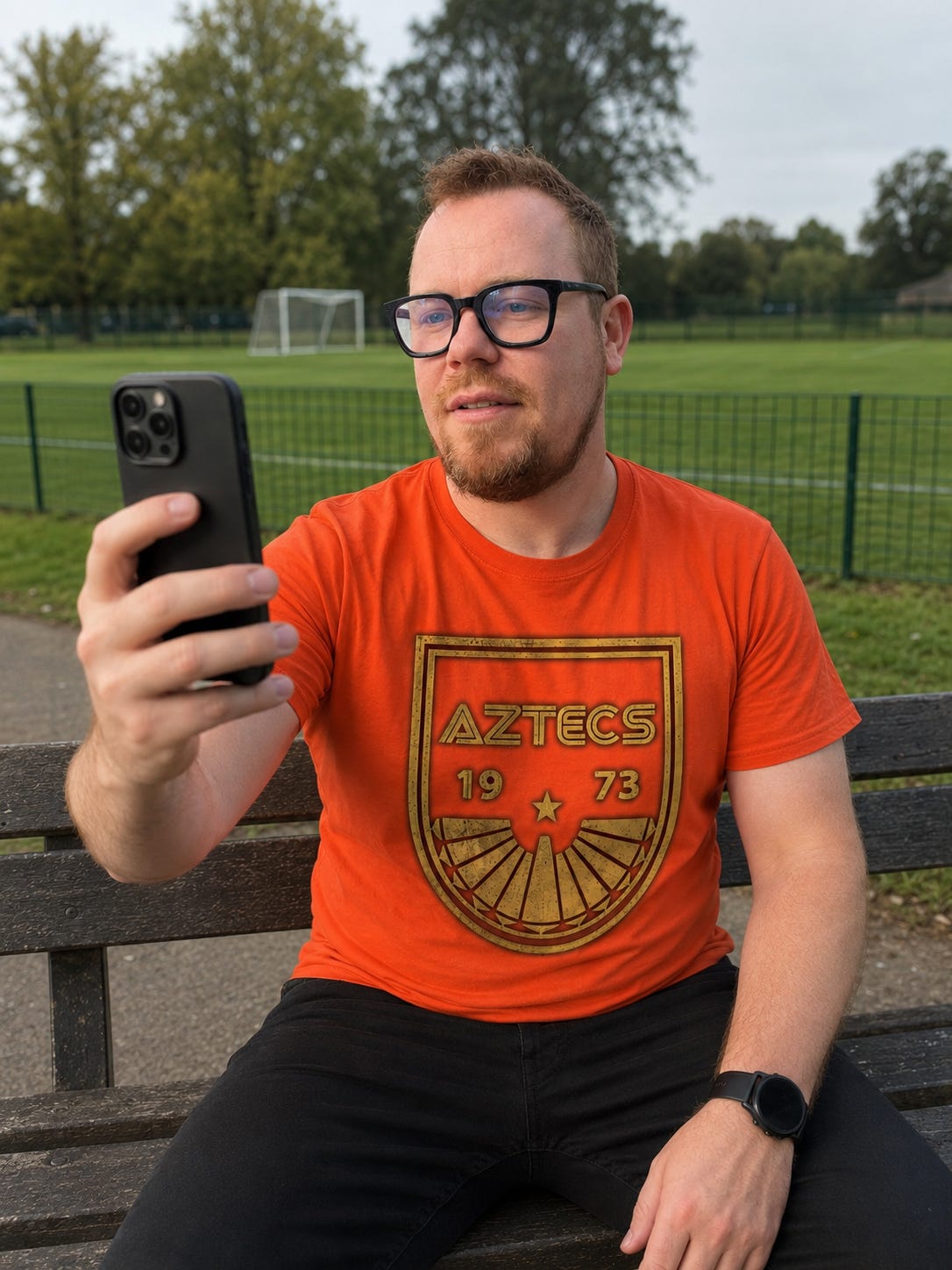
Yesterday I sat down on a WhatsApp video call with Rubén Heras González from RTVE, Spain’s national broadcaster.
We discussed the Los Angeles Aztecs, Johan Cruyff, George Best, fan ownership, football culture and the future of the game ahead of the 2026 World Cup.
As I ended the call, one thought stayed with me.
Why is a journalist from Spain interested in a football club that has not played a competitive match for decades?
The answer is simple.
Because this story is not really about a football club.
It is about football itself.
It is about what happens when a game built by supporters becomes increasingly controlled by investors, corporations and closed systems.
And it is about whether football can find its way back to the people who made it matter in the first place.
The Los Angeles Aztecs were never just another football club.
This was the club of Johan Cruyff.
The club of George Best.
A club connected to Rinus Michels, Wim Suurbier, Javier Aguirre and Liverpool legend Tommy Smith.
It sat at the crossroads of football, Hollywood, music, Latino culture and the American dream.
That is why the story still matters.
Not because nostalgia is fashionable.
Because football has lost something.
Before the billion-dollar stadiums, before the franchise valuations, before football became a corporate asset class, the game was built by dreamers.
Immigrants.
Families.
Volunteers.
Players.
Supporters.
People who believed in the game before it became profitable.
Football did not become great because billionaires bought it.
Billionaires bought it because football was already great.
That is the part modern football keeps forgetting.
Cruyff understood football as more than a sport.
He saw it as intelligence.
Movement.
Freedom.
Responsibility.
His influence still runs through Barcelona, Spain and the modern game.
But one of the most overlooked chapters of his story happened in Los Angeles.
That matters.
Because Cruyff saw possibility in American soccer before many people took it seriously.
George Best brought something different.
Magic.
Risk.
Personality.
The thing supporters cannot measure on a spreadsheet but feel in their bones.
Modern football produces incredible athletes.
But too often it trains the freedom out of them.
The risk out of them.
The individuality out of them.
That is why people love players like Lamine Yamal.
He reminds us that football is still supposed to surprise us.
Football needs structure.
But structure without imagination is just a prison with cones.
That was one of the biggest themes of the interview.
The Aztecs are not being brought back to recreate the 1970s.
That would be pointless.
You cannot rebuild yesterday.
You can only learn from it.
The aim is to take the best of that spirit and build something fit for today.
A football culture that values discipline without killing creativity.
A club that respects history without becoming trapped by it.
A platform that gives players personality, supporters a voice and communities a reason to care.
And that brings me to Los Angeles.
You cannot understand football in Southern California without understanding Latino football culture.
Long before the suits arrived, football was alive in parks, schools, neighbourhood leagues and family gatherings.
Those communities did not need football to become fashionable.
They were already living it.
Too often, modern football treats those people as customers.
I believe they should be participants.
That is why supporter ownership matters.
Through Football Is For The Fans, the mission is simple.
Football clubs should not exist only as assets for distant investors, private equity groups or closed franchise systems.
They should be cultural institutions.
They should carry memory.
Identity.
Belonging.
The long-term ambition for the Los Angeles Aztecs is to build meaningful supporter control inspired by the German model, where fans have a genuine voice in the future of the club.
Not a token survey.
Not a marketing campaign.
Real influence.
Because when supporters have no voice, clubs lose their soul.
And when clubs lose their soul, football becomes just another product sold back to the people who created it.
That is why we launched a public campaign on Wefunder.
Yes, it raises money.
But the bigger purpose is proof.
Proof that ordinary supporters still want a stake in football.
Proof that people want more than tickets, shirts and subscriptions.
Proof that football can still be built from the bottom up.
The campaign is not really about funding.
It is about belief.
It is about demonstrating that supporters still want ownership, connection and purpose.
The model we are building is different.
We are not trying to buy our way into the old system.
We are not trying to copy the closed franchise model.
The idea is to build a touring football and entertainment platform that can go directly to supporters.
Think football festival.
Think culture.
Think stories.
Think mavericks.
Think matchdays that feel alive again.
Not gimmicks.
Not novelty sport.
Not dancing for clicks.
Real football.
Great players.
Big personalities.
Rivalries.
Content.
Community.
A proper event.
The Aztecs are the perfect club to lead that because they were never dull.
They were born between football and entertainment.
They should not return as a spreadsheet in a tracksuit.
The 2026 World Cup makes the timing even more important.
The eyes of the world will be on North America.
Millions will discover football.
Millions more will rediscover it.
The corporate machine will talk about growth, sponsorship, media rights and expansion.
Fine.
But people do not fall in love with football because of a commercial strategy deck.
They fall in love with football because of stories.
Because of players.
Because of cities.
Because of communities.
Because of fathers and daughters.
Because of parks and pubs and shirts and songs.
Because for ninety minutes life feels bigger than whatever is waiting outside the stadium.
That is what football is.
Or at least what it should be.
What encouraged me most about yesterday’s interview was not simply that RTVE wanted to discuss the Aztecs.
It was that the conversation kept returning to bigger questions.
Football history.
Football culture.
Supporter ownership.
Creativity.
Community.
Authenticity.
That tells me something important.
People are searching for alternatives.
People are tired of being sold the game they already built.
They want football that feels human again.
The RTVE interview will not be the last conversation.
Over the coming months I will continue speaking with journalists, supporters, former players, club owners and football stakeholders about the Los Angeles Aztecs project and the wider mission behind Football Is For The Fans.
The objective is not simply to relaunch a historic club.
The objective is to start a bigger conversation about who football serves, how supporters can regain a meaningful voice and what the next generation of football culture could look like.
The game belongs to the people who built it.
It is time they were invited back into the room.
That is why this story matters.
The Los Angeles Aztecs are not important because they are old.
They are important because they remind us what football can become when it has courage.
Cruyff gave football intelligence.
Best gave it magic.
Los Angeles gave it theatre.
Supporters gave it meaning.
Now the question is whether we are brave enough to build something worthy of that history.
That is the work.
That is the fight.
And that is why the Los Angeles Aztecs still matter.