

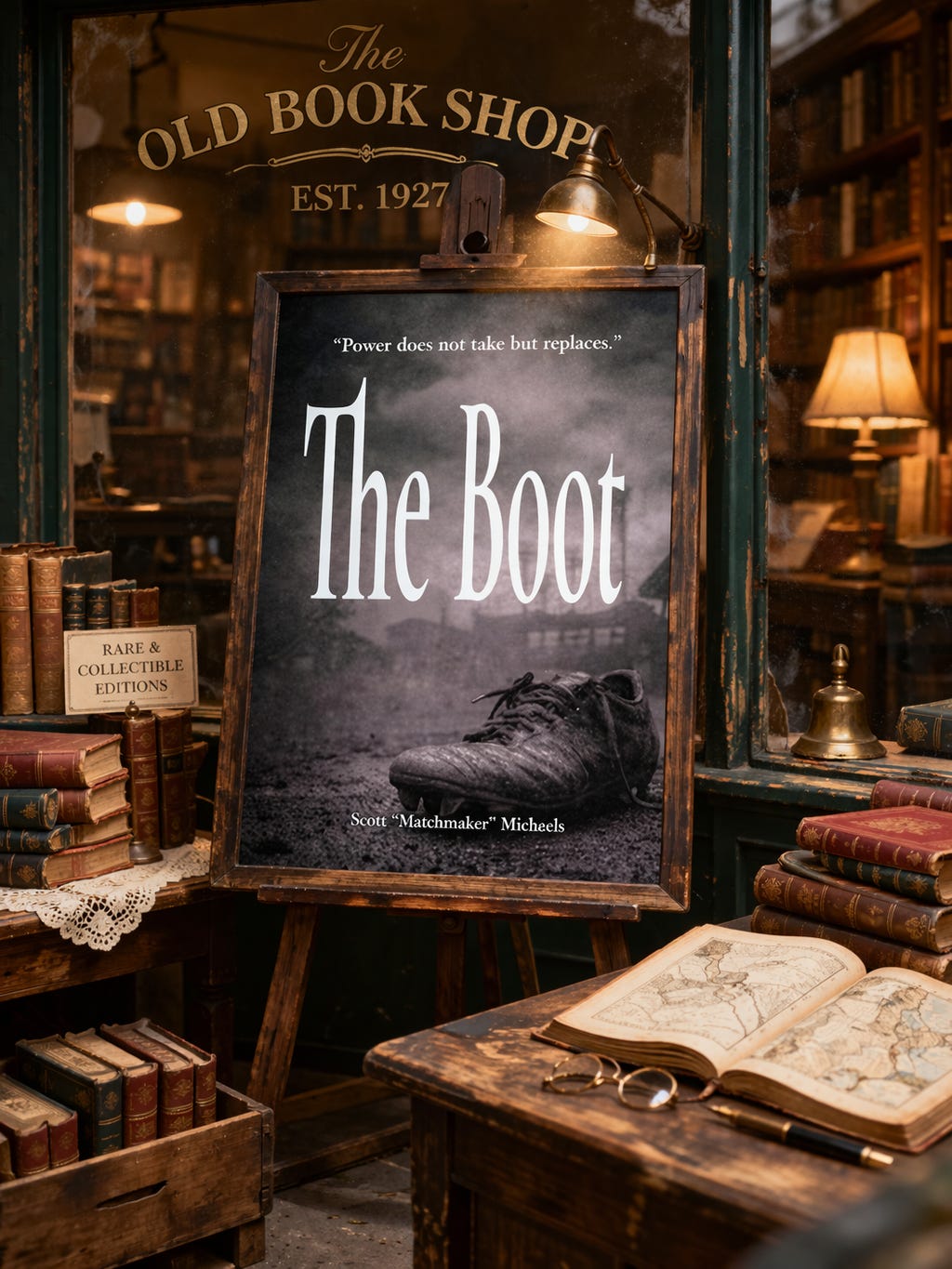
The full mastered version of The Boot is now available — refined, complete, and exactly as it was meant to be experienced. This isn’t a draft or a collection of posts, it’s the finished piece. And we’re not slowing down. The second book drops next week, continuing the story and expanding the world. If you’re in, you’re early.
The Boot:
Introduction
I didn’t set out to write a football
book.
I started writing The Boot during COVID
because everything stopped, and I
needed somewhere for my head to go.
I should say this upfront, too.
I’m dyslexic, and I’ve got ADHD, so
writing a full novel was never going to
be a smooth or polite process. It took
longer than it should have. I rewrote
sections more times than I can count.
Some days it felt impossible.
Which is exactly why finishing it
matters. COVID stripped the world back.
No travel. No meetings. No distraction.
Just silence and a mind that wouldn’t
switch off.
So I started writing. At first, it was
survival. Something creative to stay
sane. A place to put energy when there
was nowhere to spend it. But after a
few weeks, I realised I wasn’t only
writing fiction.
I was writing about something I’d been
watching for years.
Not corruption. Not scandals. Not the
loud stuff people argue about online.
Something quieter.
Power that doesn’t shout.
Power that doesn’t threaten.
Power that just rearranges your world
until you don’t recognise who’s making
the decisions anymore.
That’s what The Boot is really about.
It’s a story about craft turning into
process. Identity turning into output.
People being replaced by systems that
never announce themselves as enemies —
they arrive as “improvements.” And once
they arrive, the line doesn’t stop.
No binge. No rush. Just a slow,
deliberate story about how power works.
Scott “Matchmaker” Michaels
Disclaimer – The Boot is a work of
fiction. All characters, names,
businesses, locations, and events
portrayed in this story are either
products of the author’s imagination or
used in a fictionalized manner. Any
resemblance to real persons, living or
dead, or to actual events or
organizations is purely coincidental
and unintended. The narrative is
created solely for storytelling
purposes and should not be interpreted
as a depiction of real individuals or
factual occurrences.
The Boot: Episode
One
The Factory
Leeds always smelled of something. Oil.
Smoke. Rain. Old beer. You could
blindfold a man, drop him anywhere
between the station and the river, and
he’d know exactly where he was by the
air alone. It wasn’t romantic. But it
was honest. Leeds never pretended to be
anything else.
Arty Zee stood at the gates of the
Footshape Boot Works factory and
watched the men arrive.
Same ritual every morning. Bikes are
chained to the railings. Cigarettes
were lit before clocks were punched.
Coats shrugged off. Jokes shouted
across puddles. Nobody rushed.
Nobody smiled too much either. Work was
work. You showed up, you did your
hours, you went home, and tried to
forget the noise of machines drilling
into your skull.
The factory had been there longer than
any of them. Red brick. Three floors.
Tall windows blackened by decades of
soot. The sign above the door still
read ‘FOOTSHAPE LTD,’ even though
everyone in Leeds just called it ‘The
Boot Works.’ It had survived wars,
strikes, and rationing. Men came and
went. The building stayed.
So did Arty.
He wore a dark wool coat, Italian cut,
too expensive for this street. Not
flashy. Just wrong for the place.
He’d grown up here but never quite
belonged to it. His accent softened at
school. His posture is different. His
eyes were always scanning like he was
counting exits in rooms he technically
owned.
Arty sometimes wondered when the
factory stopped feeling like an
inheritance and began to feel like a
responsibility.
As a boy, it had felt permanent, like
the river or the weather.
Now he understood nothing stayed still.
Buildings survived because people
adjusted around them. The men on the
floor still believed work itself was
protection. Show up.
Do it properly. Go home. But Arty had
begun to notice something
uncomfortable.
The work no longer decides the future.
Decisions were being made somewhere
else, long before leather ever reached
the cutting table.
Inside, the machines were already
awake.
Presses hissed like angry animals.
Leather stretched, sliced, punched. The
smell hit first — glue, rubber, sweat.
It stuck to your clothes. Followed you
home. Women hated it. Dogs recognised
it. It was the smell of money if you
were lucky, and the smell of nothing if
you weren’t.
Ben Goodman was already shouting at
someone.
“You don’t cut it like that, you
absolute weapon. That’s not a sole,
that’s a bloody slipper.”
Former army. Former private school.
Kicked out of both. Ben ran production
like a man who trusted systems more
than people and people more than
himself. Swore constantly. Never
smiled. Deeply loyal to Arty, even when
he pretended otherwise.
Arty walked in behind him unnoticed.
“That batch goes to Newcastle,” Ben
said. “If those look like shite I’ll
personally—”
He turned and saw Arty.
“Oh. Morning, boss.”
The room didn’t go silent. It just
listened harder.
“How are we doing?” Arty asked.
Ben shrugged. “Same as always. Three
weeks behind. Machines older than my
mother. Half the lads think precision
is a suggestion.”
“And the orders?”
“Up.”
“Good.”
Ben hesitated. “Strangely up.”
Arty raised an eyebrow.
“Two contracts were cancelled last
month. Now three new ones appear out of
nowhere. Same quantities. Same margins.
Different names on the paperwork.”
“That’s business.”
Ben shook his head. “Feels like
someone’s moving pieces.”
Arty didn’t reply. He already knew. Not
from instinct — from letters.
A supplier in Northampton who’d worked
with them for fifteen years suddenly
couldn’t get rubber. A shipping firm
changed its terms overnight. The bank
had introduced “new oversight
procedures” that meant payments took
longer to clear, and nobody could
explain why.
Nothing dramatic. Nothing illegal.
Just small delays.
Small gaps.
Small silences.
The kind of things that made a man feel
like he was slowly being nudged out of
his own life.
He walked past the workers. Most had
known him since he was a boy running
through the factory in shorts, kicked
out of school early, and left here with
his father while lawyers figured out
what to do with him.
Ismail Zee believed in work. In
routine. In not attracting attention.
Ismail Zee also ran half of Leeds.
Not officially. Not on paper. But
everyone knew who to call when things
went missing. Or when they needed
protection. Or when someone needed
reminding of their obligations.
The factory was the front. Shoes went
out the front door. Other things moved
quietly through the back.
Arty tried not to think about that
part. But thinking had never really
saved anyone in his family.
The phone rang in the office.
Michelle answered it. Calm, as always.
Calm like someone who’d already lost
everything once and decided nothing
could surprise her again.
“It’s Roth.”
Of course it was.
Charles Roth never called unless
something was wrong. Financial advisers
didn’t ring to say things were fine.
They rang to tell you which part of
your world was about to collapse.
“Charles.”
“Arty. We need to talk.”
“Is this about cash flow or criminal
exposure?”
A pause.
“Both.”
The Boot: Episode
Two
Glasgow
The rain in Glasgow never fell
properly.
It just hovered like it was waiting.
Arty Zee stood on the pavement outside
the St Enoch Hotel and watched his own
breath cloud in the cold air. Ten
minutes early. Not because he was keen.
Because men who arrived late to see
Jimmy McBride didn’t usually get
another chance.
Inside, everything smelled faintly of
polish and old money. Deep carpets.
Brass fittings. Men in suits pretending
not to notice other men in suits
pretending not to notice them. The kind
of place where nothing illegal ever
happened except constantly.
Roth was already waiting.
“You look like you’re going to a
funeral,” Arty said.
Roth didn’t smile.
“In a way, you are.”
The lift hummed as it climbed.
No music.
No small talk.
Just machinery carrying two men toward
something neither of them could stop.
Jimmy McBride’s suite overlooked the
River Clyde, grey, thick, slow,
carrying the weight of a century’s
worth of deals nobody ever wrote down.
Jimmy sat at a small table, pouring
tea.
No rings.
No flash.
Just neat hair, clean cuffs, and eyes
that didn’t blink.
“Arty Zee,” he said. “Sit down, son.”
Arty did.
Jimmy poured the tea. Milk first. Like
a man who still believed rules mattered
as long as he wrote them.
“I knew your father,” Jimmy said.
“Careful, man. Didn’t dream too much.
That’s how he lasted.”
“And still owed you five million,” Arty
replied.
Jimmy smiled.
“Yes.”
Silence settled into the room.
“You don’t have the money,” Jimmy said.
“Nobody ever does. That’s not the
point.”
“What is?”
“I don’t want your factory,” Jimmy
said. “Too visible. Too many workers.
Too many stories. I want what you’re
becoming.”
Arty frowned.
“Football is changing,” Jimmy
continued. “Television. Colour
broadcasts. Advertising. European
tours. It’s no longer just clubs. It’s
images. Identities. Brands worn in
front of millions.”
“I make soles.”
“You make believe,” Jimmy corrected.
Roth shifted slightly.
“I’ll clear your father’s debt,” Jimmy
said. “Not because I’m kind. Because
you’re useful.”
“And in return?” Arty asked.
“A silent percentage of whatever you
become.”
Arty stared at the tea. The surface
barely moved.
“And if I say no?”
Jimmy shrugged.
“Then banks will find concerns.
Insurers will discover clauses.
Suppliers will experience delays. And
sometimes buildings catch fire.”
No threats.
No raised voices.
Just logistics.
“You’re not a criminal,” Jimmy said
softly. “That’s why this hurts you.
Criminals expect this. You still think
there’s a clean way through.”
Arty felt something snap, not fear, but
clarity.
“This isn’t a partnership,” he said.
“It’s ownership.”
Jimmy smiled.
“Everything is ownership, son. We just
argue about who admits it.”
What unsettled Arty wasn’t the threat.
It was how unnecessary the threat
sounded. Nobody needed to shout
anymore. Ownership had learned to speak
politely. Forms replaced force. Delays
replaced arguments.
By the time a man realised something
was being taken from him, the paperwork
already agreed it had never been his to
begin with.
That night, Arty stood on a bridge over
the Clyde, watching the water slide
past like money.
No loyalty.
No memory.
Just direction.
A newspaper blew against his shoe.
A headline about Leeds United’s
European run.
Another about George Best drinking too
much in Manchester.
Football everywhere.
Money everywhere.
Ownership is moving quietly underneath
both.
Back in Leeds, the attention arrived.
Fire inspectors.
Noise complaints.
Health and safety visits.
A factory that had been ignored for 30
years suddenly became fascinating.
“This is harassment,” Ben said.
“No,” Arty replied. “This is leverage.”
Orders kept rising.
So did the interference.
A rubber supplier in Hamburg vanished.
A Rotterdam distributor pulled out.
A broadcaster’s assistant asked who
really owned Arty’s new sole design.
Roth rang again.
“European firms are asking about you.”
“Which ones?”
“The kind that don’t introduce
themselves.”
Then Ginger Thompson rang from
somewhere in Leeds.
“I hear you’ve been making friends,” he
laughed.
“What do you want?”
“Just reminding you where you still
live.”
The line went dead.
Arty stood at the office window,
watching men clock in for the night
shift.
Everyone thought they owned him.
Glasgow.
Leeds.
Banks.
Corporations.
And somewhere else, quietly, someone
was deciding whether he was worth
keeping.
For the first time since his father
died, Arty didn’t feel trapped.
He felt priced.
The Call
The phone rang at 02:14.
Not Jimmy.
Too clean.
“Mr. Zee,” a woman said. “Northern
Industrial Insurance.”
“We’re reviewing your policy. Your
premises have been reclassified as a
brand asset.”
“And?” Arty said.
“Brand assets don’t qualify for
standard fire insurance.”
“So my cover is void.”
“It has been reinterpreted.”
“By who?”
“I don’t have that information.”
A pause.
“If the claim is denied, your lenders
will be informed.”
“How long do I have?”
“Until the paperwork finishes moving.”
“When will that be?”
“When it reaches the people who already
know the outcome.”
The line went dead.
No threats.
No shouting.
No violence.
Just a quiet administrative way of
saying:
You don’t own this story anymore.
Downstairs, a night shift worker
dropped a tool and swore.
Arty almost laughed.
Because that man still thought mistakes
were loud.
The Boot: Episode
Three
The
Reclassification
Footshape Boot Works woke before
sunrise.
Lights flickered on above the factory
floor. One machine started, then
another, until the building filled with
the familiar rhythm of presses and
stitching tables. Leather cut cleanly.
Rubber is heated and shaped—glue is
warming slowly in the cold air. The
smell of oil and heat settled into
everything.
Real work.
The kind that didn’t pretend to be
anything else.
Arty Zee stood on the upper walkway and
listened.
His father used to say factories had a
heartbeat. When things were right, the
sound became invisible. When something
was wrong, you felt it before you knew
why.
This morning, the rhythm felt
different.
Not broken.
Observed.
Ben appeared beside him with two mugs
of tea.
“You’ve not gone home.”
“No.”
Ben nodded toward the floor below.
Orders keep coming. Scotland again.
Holland. German distributor asking
about weight changes.”
That should have felt like success.
Instead, Arty felt exposed.
“They’ve changed the insurance,” he
said.
Ben frowned. “Changed how?”
“They say we’re not just manufacturing
anymore.”
“What else would we be doing?”
“They’ve reclassified us as a brand
asset.”
Ben laughed, waiting for the joke.
Arty didn’t smile.
“If this place burns,” he said quietly,
“nobody pays.”
The laughter stopped.
Below them, a press slammed down hard
enough to shake the railing. A worker
swore as steam escaped from the mould.
Normal noise. Ordinary mistakes.
But now Arty heard something else
underneath it.
Risk.
Success had stopped meaning safety.
It meant attention.
Roth arrived late morning, rain still
on his coat.
“You’re treating this like a debt
problem,” he said.
“It started as one.”
“Yes,” Roth replied. “And now it
isn’t.”
He placed a folder on the desk.
Inside were newspaper photographs. Not
boots. Not factories.
Athletes.
Arnold Palmer walking through crowds in
America. Rod Laver shaking hands at
Wimbledon. Pelé surrounded by
photographers in New York.
Arty frowned. “What’s this got to do
with me?”
“Nothing,” Roth said. “Yet.”
He tapped the photograph of Pelé.
“There’s an American behind this. Mark
McCormack. Lawyer. Represents Palmer.
Tennis players. Now footballers.”
Arty shrugged. “That’s America.”
Roth shook his head slowly.
“That’s next.”
The words stayed in the room.
“Football’s still football,” Arty said.
“Clubs. Supporters. Saturdays.”
“For now.”
The inspection came that afternoon.
A councilman in a grey coat. Polite.
Careful. Measuring distances that had
never mattered before. Writing notes
about ventilation, storage height, and
fire access.
Nothing serious.
Nothing immediate.
Just enough to slow things down.
By the time he left, three improvement
notices were pinned beside the clock-in
board.
Workers barely looked at them.
Arty did.
None of it closed the factory.
It simply made running it harder. More
expensive. More fragile.
Pressure without confrontation.
Someone is tightening screws slowly
enough that nobody could accuse them of
doing it.
That night, Arty found himself driving
toward Elland Road without planning to.
He’d been coming there since he was
young, back when his father repaired
boots for local clubs, and nobody
thought twice about a bootmaker walking
through the tunnel carrying leather and
studs.
That was where he’d first met Bobby
Collins.
Collins didn’t look like a footballer
at first glance. Too small. Too solid.
But once he spoke, people listened. He
cared about boots the way other players
cared about tactics. Balance. Weight.
Feel.
He’d sit after training, turning a pair
over in his hands.
“Boot’s wrong,” Collins once told him.
“Half a yard slower and nobody knows
why.”
Arty learned more in those
conversations than from any supplier.
Football, Collins said, was details.
Everything else was noise.
Through Collins, he met Don Revie.
Not formally. Revie didn’t do formal.
He appeared one afternoon in the boot
room, watching quietly while Arty
adjusted a sole. Revie’s presence
filled the space without effort. Leeds
didn’t just play football under him.
They operated.
“You, Ismail’s lad?” Revie asked.
Arty nodded.
Revie picked up a boot and weighed it
in his hand.
“Players trust what’s familiar,” he
said. “Change too much, and they lose
confidence. Confidence goes,
performance follows.”
He set the Boot down carefully.
“Football’s about control,” Revie
added. “Lose control, and someone else
takes it.”
At the time, Arty thought he meant
matches.
Now he understood he meant everything.
Inside the ground, lights still burned.
Late training. Preparation. Routine. A
world built on trust and repetition.
That was the football Arty understood.
Not paperwork moving quietly in
offices.
Not insurance being reinterpreted.
On the way back into the city, Arty
stopped at a newsagent’s window.
George Best stared back from the front
page.
Not scoring. Not celebrating. Just
walking through Manchester in a coat
that looked too expensive for football,
photographers around him, headlines
about nights out instead of matches.
Two boys stood nearby arguing, neither
mentioning Manchester United. Only
Best.
The way he played. The way he looked.
The way people watched him, even when
he wasn’t playing.
That was new.
Players used to belong to clubs.
Now some of them seemed to belong to
something else entirely.
Attention.
Arty realised there was nothing
different about Best’s boots.
Only did people notice them.
And once people started noticing,
things stopped being equipment.
They became symbols.
The call came the next morning.
The voice was calm. American. Certain.
“Mr. Zee. Mark McCormack.”
Arty said nothing.
“I represent several athletes you may
have heard of. Arnold Palmer. Rod
Laver. Recently Pelé.”
“And why are you calling me?”
“Because sport is about to change,”
McCormack said. “Not the games. The
meaning of them.”
Outside, the presses continued their
rhythm.
“You’re in a position most
manufacturers aren’t,” he continued.
“You’re close enough to players to
matter. Far enough from clubs to move.”
Arty watched the factory floor through
the office window.
“What’s coming?” he asked.
A pause.
“The player will become bigger than the
club,” McCormack said. “And soon people
won’t follow clubs. They’ll follow
people.”
Silence followed.
Because Arty understood exactly what
that meant.
“I’m not asking for anything today,”
McCormack said. “Just introducing
myself.”
The line clicked dead.
No threat.
No demand.
Just inevitability.
The factory had always grown in
response to need. Orders arrived, work
increased, and men adapted. But this
felt different.
Growth was now expected before it
happened. Planned by people who had
never stepped inside the building. Arty
realised the danger wasn’t failure
anymore. It was a success arriving on
terms he didn’t control.
That evening, Arty opened one of his
father’s old ledgers.
Names filled the pages. Suppliers.
Agents. Club officials. Men who owed
favours and men who collected them.
Ismail Zee had built protection through
balance. Nobody owed him enough to
destroy him. Nobody owned enough to
control him.
But this new world wasn’t built on
balance.
It was built on scale.
And scale didn’t care about loyalty.
Outside, the machines continued their
steady rhythm.
For weeks, Arty had been thinking about
survival. About defending what already
existed.
Now he understood the mistake.
They weren’t trying to take the
factory.
They were waiting for him to build
something bigger than a factory.
Something that could be owned.
He closed the ledger and walked back
onto the factory floor.
Heat hit him immediately. Noise.
Movement. Men working without thinking
about markets, ownership, or identity.
He picked up a finished boot from the
bench. Heavy. Solid. Honest.
For the first time, he understood that
changing first meant losing the safety
of being small.
“Change the mould,” he told the
foreman.
The man frowned. “Which one?”
“All of them.”
“For who?”
Arty looked across the factory,
listening to the machines.
“For the next player who matters.”
The foreman nodded, not understanding
but trusting.
The presses continued their rhythm.
Only now they were moving toward
something none of the men in the
building understood yet.
And somewhere far beyond Leeds, the
future had already started looking
back.
The Boot: Episode
Four
The Weight of
Attention
The first thing Arty noticed was the
noise.
Not inside the factory. That never
changed. Machines still started before
sunrise. Metal warmed slowly as heat
moved through the presses. Knives
struck leather in a steady rhythm.
Steam rose from moulds as rubber
softened and shaped itself into
something useful.
Work sounded the same as it always had.
Reliable. Predictable. Honest.
The noise came from outside.
Phones rang longer now. Not urgent,
just persistent. Voices asking
questions that sounded casual but
weren’t. Distributors want meetings
instead of deliveries. Journalists are
asking to “understand the story.”
Attention had arrived.
And attention didn’t behave like money.
Money moved quietly. Attention
multiplied.
Ben dropped a stack of letters onto the
desk.
“Half of these aren’t orders,” he said.
“They want to know who represents us.”
Arty flipped through them slowly.
Agencies. Retail groups. Foreign
distributors offering introductions
instead of contracts.
Intermediaries.
People who appeared once something
became visible.
“They’re not interested in boots,” Ben
said.
“No,” Arty replied. “They’re interested
in what happens after.”
Below them, a press slammed down hard
enough to shake the office window. A
worker swore. Someone laughed. The
rhythm continued, unaware that the
factory had already become something
else.
The changes were small at first.
Individual requests instead of club
orders. Players are asking for
adjustments. Different studs for
different pitches. Softer leather. Less
weight through the sole.
Names began appearing on order sheets.
Not teams.
People.
Arty noticed it in the returns. Boots
sent back not because they failed, but
because they felt wrong. Too stiff. Too
heavy. Not quite right for the way
someone moved.
Expectation had replaced acceptance.
“They used to wear what they were
given,” Ben said one morning.
“They don’t have to anymore,” Arty
replied.
Choice changed everything.
Choice created responsibility.
The first player arrived without
warning.
Young. Nervous. Mud is still on his
trousers—boots wrapped in newspaper.
“They said you fix things properly.”
Arty turned the boots in his hands.
Cheap leather. Factory standard. Built
to last, not to feel.
“What’s wrong with them?”
The player hesitated.
“They slow me down.”
Arty almost smiled.
“Boots don’t slow people down.”
The player shook his head.
“These do.”
It wasn’t arrogance.
It was a belief.
And belief, Arty realised, mattered
more than construction.
He adjusted the balance slightly.
Shifted weight forward. Nothing
dramatic.
When the player left, he looked
relieved.
Not because the boots were better.
Because someone had listened.
It started as a joke.
Most things did.
A winger returned weeks later,
grinning, saying he’d scored twice and
hadn’t thought about his feet once.
One of the older machinists laughed
across the floor.
“Zee’s not making boots,” he shouted.
“He’s making matches.”
The name lingered longer than the joke.
Players repeated it without knowing its
origin.
“You’re the one who matches them,
yeah?”
Matchmaker.
Arty ignored it. The factory didn’t
need names. It needed orders filled and
leather delivered on time.
But the word kept appearing.
Kit men asking if the matchmaker’s
boots were ready. Trainers sending
players north to see the lad in Leeds
who could match a boot to the way you
moved.
Not selling boots.
Matching players.
Ben noticed before Arty did.
“They’re not talking about the factory
anymore,” he said quietly. “They’re
talking about you.”
Arty didn’t like that.
Factories were safer than people.
Names travelled faster than work. That
was the new rule.
A reputation no longer belonged to the
person who earned it. It belonged to
whoever repeated it loudest.
Arty felt the shift before he
understood it. The boots still left the
factory the same way, but the story
around them was already moving without
him.
Later, Roth saw the word scribbled
beside an order.
“That’s how brands start,” he said.
“It’s just talk.”
Roth closed the ledger.
“No,” he said. “It’s identity.”
The second word arrived months later by
accident.
A supplier invoice stamped with the
Italian word Stilo — style, form,
presentation.
Ben misread it aloud.
“Stylo,” he said, laughing. “Sounds
better anyway.”
The two words sat together on the desk
longer than either of them admitted
noticing.
Stylo.
Matchmakers.
Not a company name.
Just something people said when they
meant boots that felt right.
Arty left the paper where it was.
Some things didn’t need deciding.
They just needed time to become true.
The decision looked small on paper. One
order was delayed, another pushed
forward because the margins were better
and the delivery mattered more. Ben
argued for keeping the original run.
The lads had already started cutting.
But Arty overruled him. The numbers
were clear. The future orders depended
on reliability, not sentiment.
When the change was announced, the
floor went quiet for a moment, not
angry, just surprised. Work resumed
quickly enough, but something shifted
in the way the men looked at him.
Later that night, Arty told himself it
was necessary. The factory came first.
Still, he knew he hadn’t protected the
place. He’d chosen who mattered less.
The journalist appeared two days later.
Polite. Curious. Asking about
innovation. About whether players
should have identities separate from
clubs.
Arty answered carefully.
Too carefully.
The article still ran with the
headline:
THE BOOTMAKER BEHIND FOOTBALL’S NEW ERA
Ben pinned it to the wall like a
warning.
“You didn’t say half of that.”
“I didn’t need to.”
Because once attention started, it
filled in its own story.
The first rumours came through the
agents, quiet at first, spoken like
advice rather than warning.
German manufacturers were offering
money that Footshape had never seen
before.
Cash up front. Guaranteed supply.
Players are flown in and treated like
investments rather than customers.
Boots built around them, they said.
Science. Precision. The future.
Soon, the language changed.
Stylo Matchmakers were old-fashioned.
Too heavy.
Too slow. Built for yesterday’s
football. Nobody said it directly to
Arty, but he heard it in hesitation. 4
Orders paused. Players arrived already
uncertain, turning the boots in their
hands as if looking for flaws they’d
been told were there.
It wasn’t a competition in the old
sense.
Nobody argued about quality. They
attacked belief. And once belief moved,
the work had to fight harder just to be
trusted.
The following week, a regular order
didn’t arrive.
No argument. No complaint. Just silence
where certainty used to be. Ben called
it timing. Arty knew better.
The story had already moved ahead of
the work.
The phone rang late that evening.
Glasgow.
Jimmy McBride sounded amused.
“You’re becoming visible, son.”
“That wasn’t the plan.”
Jimmy laughed softly. “Visibility’s
always the plan. Just not yours.”
Silence followed.
“You know what happens now?”
“No.”
“You stop being judged on what you do,”
Jimmy said. “You get judged on what
people think you might become.”
The line went dead.
Elland Road felt smaller than Arty
remembered.
Training finished. Floodlights humming
above empty grass. Groundsmen repairing
damage that would exist again by
Saturday.
Football still looked simple from here.
But even here, something had shifted.
Two boys argued near the tunnel. Not
about Leeds. About George Best. About
boots. About style. About who mattered
most.
Not which team.
Which player.
Arty watched them and felt the change
settle somewhere deep and
uncomfortable.
McCormack hadn’t predicted the future.
He’d recognised it early.
Back at the factory, another letter
arrived without a return address.
A distribution proposal. European
territories are already divided.
Production increases are calculated
down to numbers that Footshape couldn’t
realistically meet.
No threats.
Just assumptions.
Someone, somewhere, had already decided
how big the business would become.
And how it would be structured when it
did.
“They’re planning us without asking,”
Ben said.
“That’s how planning works,” Arty
replied.
That night, the factory felt different.
Not unsafe.
Observed.
He walked the floor long after the
machines stopped. Ran his hand along
finished boots waiting for shipment.
Solid. Honest. Built by men who didn’t
care about markets or narratives.
Only whether the stitching held.
His father used to say success made
people careless.
Arty realised now that success made
other people interested.
And interest attracted structure.
Structure attracted ownership.
He stood alone in the silence and
understood something he hadn’t allowed
himself to admit.
The factory wasn’t under pressure
because it was failing.
It was under pressure because it was
becoming useful.
And useful things didn’t stay
independent for long.
For the first time, the building didn’t
feel like a shelter.
It felt like a target.
Outside, a car slowed as it passed the
gates.
Didn’t stop.
Didn’t need to.
The future wasn’t coming to take
anything yet.
It was just making sure he was still
there when it arrived.
Arty switched off the lights and locked
the door behind him.
For years, he’d believed staying small
meant staying safe.
Now he understood the truth.
Small had never been a failure.
It had been protection.
And the moment people started paying
attention, protection disappeared.
Behind him, the factory sat in
darkness, machines cooling slowly.
Waiting.
And somewhere far beyond Leeds,
decisions were already being made about
the shape of his success.
This time, they wouldn’t wait for him
to understand.
The Injunction
Fulham didn’t call.
The order simply stopped.
No argument. No complaint. Just silence
where certainty used to be. Ben noticed
first because the line slowed for the
first time in months, not enough for
anyone else to see, but enough for him
to feel it.
“They’ve gone,” he said, placing the
ledger on Arty’s desk. “Whole
contract.”
Arty already knew why.
The photographs had been circulating
for weeks. German boots. Clean lines. A
bold mark down the side that cameras
picked up, even in bad light. Players
liked them because they looked modern.
Clubs liked them because they arrived
on time.
Visibility had replaced loyalty.
Then the letter arrived.
London solicitors. Heavy paper. Careful
language. A cease alleging
infringement, confusion, and protected
construction methods. The kind of
wording designed to slow a business
down rather than beat it outright.
Ben read it twice.
“They’re trying to push us out,” he
said.
Arty didn’t answer immediately. He’d
seen this before, just in different
industries. You didn’t destroy the
competition anymore. You buried it in
procedure until it stopped moving.
For the first time since Glasgow, he
didn’t wait.
Roth arrived the next morning and found
the papers already signed.
“You’ve issued proceedings?” Roth
asked.
“They’re interfering with supply,” Arty
said. “And they know it.”
Roth studied him for a moment,
surprised not by the decision but by
the speed of it.
“This won’t be quiet,” he said.
“It already isn’t.”
The application was filed with the High
Court within days. Not about quality.
Not about performance. About trademark
use and commercial interference. The
Germans had aggressively pushed their
branding into English contracts,
assuming no local party would challenge
it quickly enough to matter.
They misjudged.
The injunction came faster than anyone
expected.
Interim relief granted pending full
hearing.
The ruling was narrow but devastating
in practice. Until the dispute was
resolved, the German manufacturer’s
registered mark could not be displayed
in competitive fixtures within the
disputed supply arrangements.
No stripe.
No symbol.
Nothing identifiable.
On Saturday afternoon, Fulham walked
out onto the pitch wearing the new
boots.
The mark had been blacked out.
Thick polish across the side, uneven
where the kit men had rushed the job.
Television cameras caught it
immediately. Commentators didn’t
understand the legal detail, only that
something had gone wrong.
Boots designed to be seen suddenly
looked unfinished.
Back in Leeds, nobody celebrated.
Ben allowed himself half a smile.
“Serves them right.”
Roth closed the file carefully.
“This buys you leverage,” he said. “Not
victory.”
Arty understood that.
Fulham didn’t return out of loyalty.
Orders resumed quietly, partially,
through people who preferred certainty
over spectacle. The Germans stayed in
the market. The lawyers stayed busy.
Nothing really stopped.
That was the lesson.
Winning didn’t end anything. It only
changed the terms.
Later that night, Arty stood alone on
the factory floor, turning one of the
finished boots in his hands. Solid.
Balanced. Built properly.
No mark. No stripe. Nothing is shouting
for attention.
For years, that had been enough.
Now he understood why the Germans had
led with the symbol first.
The Boot mattered.
But recognition mattered more.
Across the floor, the machines waited
for morning. Orders already scheduled.
The line is ready to move again.
For the first time, Arty realised
something uncomfortable.
He hadn’t fought to protect the past.
He’d fought to stay in the future.
And the future never stayed still long
enough to win twice.
The machines had stopped an hour
earlier, but the heat still clung to
the brickwork. Steam drifted slowly
from the vents into the cold night air.
Leeds smelled of rain and oil, same as
it always had.
Ginger stood outside the factory gates,
coat open despite the cold, a cigar
burning slowly between his fingers, not
for show. He smoked like a man
thinking, letting it burn longer than
he drew from it.
Arty locked the door behind him and saw
the glow first.
“You’ll ruin your lungs,” he said.
Ginger smiled faintly without turning.
“Everything ruins something.”
They stood for a moment listening to
the quiet. The absence of machines felt
louder than the noise ever had.
“You handled the Germans well,” Ginger
said eventually. “Most would’ve backed
off once the lawyers got involved.”
“They pushed first,” Arty replied.
“They always do.”
Smoke drifted upward, catching the
yellow light above the gate.
Ginger watched the factory windows,
dark now, reflective. “Funny thing,” he
said, “places like this. People think
they survive because of loyalty.”
Arty didn’t answer.
“They survive because someone makes the
hard decisions before everyone else
realizes they’re necessary.”
“You mean Mick?” Arty said.
Ginger exhaled slowly. “I mean
everything.”
The cigar glowed again, briefly
lighting his face.
“Everyone’s still acting as if the old
rules matter,” he went on. “That if you
work hard enough, do things properly
enough, it protects you.”
“And you don’t believe that?”
Ginger shook his head.
“Protection comes from being useful,”
he said. “And useful changes.”
A car passed slowly at the end of the
street. Neither of them watched it.
“You ever think about what this
becomes?” Ginger asked. “Not the
factory. After.”
“It’s boots,” Arty said. “That’s
enough.”
Ginger smiled at that, not unkindly.
“It won’t be.”
He flicked ash onto the wet pavement.
“Football’s getting bigger. Companies
are getting bigger. Nobody’s waiting
for permission anymore. They move first
and argue about it later.”
Arty glanced at him. “And if moving
first means crossing a line?”
Ginger took his time answering.
“Depends who’s still standing when it’s
over.”
The words weren’t aggressive. Just
practical.
“I’m not saying break anything,” he
added, almost casually. “Just don’t be
the only one pretending everyone else
isn’t already doing what they need to.”
The night settled around them.
Somewhere in the distance, a train
passed, metal echoing through the city.
“You want the place to survive,” Ginger
said. “So do I.”
Arty looked at him. “That supposed to
reassure me?”
Ginger laughed quietly.
“No.”
He dropped the cigar, grinding it under
his heel.
“You still think survival and being
right are the same thing,” he said.
“They’re not.”
For a moment, neither man spoke.
Then Ginger nodded toward the factory.
“World’s changing, Arty. The best thing
you can do is make sure you’re standing
where it lands.”
He walked off without waiting for a
reply, hands in his pockets,
disappearing into the dark street as if
he belonged somewhere else already.
Arty stayed by the gate a while longer,
looking at the building.
For the first time, he realised Ginger
never talked about saving the factory.
Only about what came next.
And that unsettled him more than any
letter from a lawyer ever had.
The Boot: Episode
Five
The Quiet Removal
The first thing Arty noticed was the
clock.
White face. Black numbers. Perfect
time.
It hung above the clock-in board as it
had always been there, ticking loud
enough to hear between presses. The old
one had always been slow. Five minutes
behind on a good day. Nobody minded.
Work started when men arrived, not when
seconds said so.
This one didn’t drift.
It counted.
Ben walked beneath it, carrying order
sheets, pretending not to notice.
“Since when did we get that?” Arty
asked.
“This morning,” Ben said. “No one
asked.”
The factory woke around them. Leather
slapped against tables. Steam lifted
from moulds. Knives cut in a steady
rhythm. The smell of glue and heat
filled the air like it always had.
Work sounded the same.
The silence between noises didn’t.
Two men in grey coats moved slowly
between stations with clipboards and
stopwatches. Not inspectors. Inspectors
looked for faults. These men looked for
time.
They stopped behind Mick O’Hara’s
bench.
Mick didn’t look up.
He never did when he was cutting. The
blade moved through leather like it
remembered the path itself. Thick
hands. Short nails. A scar at the base
of his thumb from a mistake nobody
talked about anymore.
Thirty-two years on the same bench.
Married since I was seventeen. Same
wife. Same house. Same pub every
Friday. Pint. Cigarette. Betting slip
folded into his wallet. Football on
television on Saturday afternoons.
No speeches. No complaints.
Routine was enough.
A grey coat leaned forward.
“How long does one take?”
Mick finished the cut before answering.
“As long as it needs.”
The man smiled politely and wrote
something down.
The grey coats moved on.
Ben watched them go.
“They’re timing everyone,” he said.
Arty nodded, eyes still on the floor
below.
“If we don’t change,” he said, “we
don’t survive.”
Ben looked at him.
“Change who?”
Arty didn’t answer.
The orders kept coming.
That was the strange part.
The factory was busier than it had been
in years.
More shipments. More calls. More
requests for adjustments instead of
replacements.
Not clubs.
People.
Mick’s bench had never been important
on paper.
It didn’t increase output or reduce
waste.
But it held memory. Thirty-two years of
small decisions made by feel rather
than instruction.
When the machine was replaced, nothing
visibly worsened. That was the part
Arty couldn’t shake. Loss used to hurt
loudly. Now it arrived disguised as an
improvement.
The first was a young lad from
Southport. Peter Withe. Quiet, polite,
already built like a centre forward who
understood where goals came from, even
if nobody else did yet. He apologised
for bothering Arty, said the studs felt
wrong when he planted to shoot.
Small adjustments. Balance forward.
Heel tightened.
The boots came back a week later, caked
in mud.
Better.
Then came Robin Friday.
Hair too long. Shirt half untucked.
Talking fast, laughing at nothing. He
dropped the boots on the table.
“They make me think,” he said. “I don’t
want to think when I play.”
Ben didn’t like him.
Arty did.
Players like Friday didn’t follow
systems. They broke them.
Friday wanted the boots lighter.
Softer. Something that felt like
nothing at all.
After that, the pattern shifted.
Players stopped asking what clubs wore.
They asked what suited them, how they
moved, and how they struck a ball when
nobody was watching.
The factory floor didn’t notice the
change.
Arty did.
Mick was called upstairs just before
lunch.
No announcement.
One of the grey coats approached him
quietly.
“Mister O’Hara?”
Mick wiped his hands on a rag and
followed without asking why.
Ben swore under his breath.
Arty stood.
“Don’t,” Ben said. “If you go up there,
it becomes a scene.”
The office door closed.
Machines kept running.
The new clock ticked.
Ten minutes later, Mick came back down.
He didn’t return to his bench.
He walked past it slowly, as if it
already belonged to someone else.
Locker open. Coat on. Door shut
carefully.
That carefulness hurt more than anger
would have.
At the exit, Arty caught up with him.
“They’ve reclassified the cutting,”
Mick said.
“What does that mean?”
Mick shrugged.
“Means it’s not mine anymore.”
“They can’t just—”
“They already have.”
No bitterness. Just exhaustion.
“They said there’s another role,” Mick
added. “Temporary.”
The word sat there.
“I’ll speak to them,” Arty said.
Mick looked at him properly then.
“I’m not begging, lad,” he said
quietly.
He lit a cigarette, hands steady.
“Take care of the place.”
Arty watched the door close and
realised he already knew the factory
would keep moving without Mick.
That was the part he couldn’t forgive
himself for.
There had been a moment — small, almost
invisible — where he could have stopped
it and called him back—made it
difficult. Instead, he had chosen
smoothness—chosen continuation.
The line didn’t force the decision. He
had made it easier for everyone else by
not making it harder for himself.
Then he left.
Arty watched him go.
He almost called him back.
Instead, he looked at the line moving
behind him.
Orders had to go out.
There would be time later.
Arty stood in the office long after
Mick’s footsteps disappeared.
Arty watched the door close and felt
the urge to call him back.
Not to apologise. To undo it. The words
sat there, heavy and simple. Stay.
We’ll find another way.
But he didn’t say them. Because saying
them meant choosing Mick over the line,
and the line no longer belonged to him
alone.
For the first time, he understood the
difference between knowing something
was wrong and stopping it.
One cost pride. The other costs
everything.
So he turned back toward the office,
already telling himself the factory
needed saving more than one man did.
The paperwork sat open on the desk,
already signed by someone else, waiting
only for his approval to make it
permanent.
He knew what refusing would do. Delays.
Questions.
Attention the factory couldn’t afford.
For a moment, he imagined calling Mick
back, stopping the change before it
settled.
Instead, he signed. Not because he
agreed, but because the line couldn’t
stop. The pen felt heavier than it
should have.
When he finished, nothing changed
downstairs. That was the worst part.
The machines carried on as if loyalty
had never been part of the process.
That night, Arty went to the pub.
Smoke hung low. Football on television.
Normal noise. Normal life.
Ginger Thompson sat at the end of the
bar.
“Heard about Mick,” Ginger said.
“They called it restructuring.”
Ginger drank slowly.
“Men like Mick don’t restructure,” he
said. “They stop.”
Arty stared at his pint.
“You think it’s Jimmy?”
Ginger shrugged.
“Jimmy doesn’t push. He lets things
move.”
Silence settled.
“You’re visible now,” Ginger added.
“That changes who takes an interest.”
“And you?”
Ginger’s mouth twitched.
“I’ve always been interested.”
He finished his drink and stood.
“Tell Ben to keep his lads close,” he
said. “This is when people start
choosing sides without saying it.”
Then he left.
The call came the next morning.
Roth’s voice was quiet.
Mick’s wife had found him early.
A short note.
He couldn’t be temporary.
Arty sat with the phone in his hand
long after the line went dead.
Outside, the machines were already
running.
By midday, Mick’s bench was gone.
A machine stood in its place. Clean.
Efficient. Already working.
A young lad operated it.
“What’s your name?” Arty asked.
“Jamie.”
“Do you know who worked here
yesterday?”
Jamie shook his head.
“No.”
The machine hummed.
The line moved.
Arty stopped production.
The silence felt wrong.
“Mick worked here thirty-two years,”
Arty said.
No speech. No anger.
“He’s gone.”
Heads lowered.
“Start again in ten minutes.”
Later, alone in the factory, Arty stood
where Mick’s bench used to be.
The new machine vibrated softly under
his hand.
Cold. Precise. Indifferent.
He thought of the morning. Of the
clock. Ben asked who had to change.
He switched the machine off.
The hum faded into silence.
Arty turned out the lights and locked
the door behind him.
Outside, Leeds smelled the same as
always. Oil. Rain. Smoke.
A car rolled slowly past the gates.
This time, Arty didn’t watch it leave.
He walked away.
And the machine stayed off.
The Boot: Episode
Six
The New World
Doesn’t Ask
Permission
Football tells itself stories because
stories make change easier to ignore.
We talk about loyalty. Mud on boots.
Clubs belonging to towns. Players
belonging to the supporters. The past
feels stable because it’s already
finished.
The present never does.
Change rarely announces itself. It
arrives as an improvement—faster
production. Better distribution. More
attention. Each step is reasonable on
its own.
Until one day, things look different,
and nobody can agree on when it
happened.
Systems don’t ask permission. They move
when conditions allow it.
Most people only notice after movement
becomes normal.
Before the war, power was local.
Factories belonged to families. Clubs
belonged to communities. Authority came
from being known.
Reputation travelled through memory.
Decisions were personal and therefore
slow.
That world rewarded patience.
After the war, organisation replaced
personality.
Television arrived. Advertising
followed. Sport became something
watched as much as lived. Decisions
moved away from dressing rooms into
offices where nobody wore boots.
Football didn’t stop being football.
It just stopped belonging entirely to
the people inside it.
Some men never adjusted. They behaved
as if familiarity guaranteed survival.
It didn’t.
There are always people who recognise
this earlier than others.
They don’t look revolutionary. They
don’t make speeches. They simply stop
pretending the old rules still apply.
Ginger was one of them.
He sounded ordinary on purpose.
Northern. Unimpressed. Easy to
underestimate. But he watched
everything. Timing mattered to him.
Movement mattered more than loyalty.
“Everyone’s still acting like it’s
before the war,” he said once. “Problem
is, the war already happened.”
He never said whether that was good or
bad.
Only that it was true.
Jimmy belonged to the previous world.
Ownership through relationships. Debt.
Obligation. Influence built slowly and
was defended personally—power held by
men willing to hold it longest.
The new systems didn’t work like that.
They scaled. They standardised. They
removed friction. You couldn’t threaten
them because they didn’t feel
threatened. They only measured output.
Ginger didn’t try to control that.
He positioned himself where it passed
through.
Cleaner that way, he said once.
No sentiment getting in the way.
He smiled when he said it, as if it
were a joke.
It wasn’t.
Arty understood the change. That was
the problem.
He saw what was happening and told
himself he could manage it. Adjust
without losing the thing underneath.
Keep the factory alive long enough for
things to settle again.
So he made reasonable decisions.
He allowed the machine because orders
had to go out. Increased output because
wages had to be paid.
Accepted efficiency because failure
wasn’t an option.
Each decision solved a problem.
Together, they created something new.
He told himself he was protecting the
factory.
He didn’t notice when protection became
participation.
The first sign came quietly.
A delivery arrived late on a Thursday
afternoon. New leather. Different
supplier. Higher grade. More expensive.
Arty hadn’t ordered it.
The paperwork was already signed.
Arty signed the agreement without
reading the final page.
Not because he trusted it, but because
he already knew what it would say.
Exclusivity. Guaranteed volume.
Priority supply to players whose names
travelled further than clubs.
The numbers worked. Wages secured—
orders locked in for twelve months. Ben
would call it stability. Roth would
call it growth.
Arty told himself it was protection.
Only later, watching a smaller local
order pushed back to make space on the
line, did he realise protection for the
factory meant someone else no longer
mattered.
Ginger explained it simply.
Better margins. Faster turnaround.
Future orders secured.
“It keeps us competitive,” he said.
Us.
Arty nodded because the numbers made
sense.
That night, he realised nobody had
asked him first.
One evening, long after the machines
stopped, Michelle found him still in
the office.
The lights below were off. Only the
cutter remained powered, its standby
hum filling the silence.
“You’re still here,” she said.
“There’s always something.”
She stood beside him, looking down at
the floor.
“They think you chose it,” she said
quietly.
Arty didn’t answer.
The space where Mick’s bench had been
looked smaller now. Like it had always
been meant for the machine.
“I chose keeping the place open,” he
said eventually.
Michelle nodded, but didn’t agree.
“Sometimes things survive by becoming
something else.”
He laughed once. Short. Tired.
“That supposed to help?”
“No,” she said. “Just what happens?”
She looked at him then, properly.
“You don’t have to pretend you like
it.”
“You said you hated men like Jimmy,”
she said, her voice steady enough to
hurt more than shouting.
“Men who turn people into numbers.”
Arty didn’t answer. Below them, the
line kept moving, steady as breath.
Michelle didn’t look away. “That’s what
scares them,” she continued. “Not the
machines.
You. Because you know what it costs and
you do it anyway.” The words landed
harder than any threat he’d heard in
Glasgow.
For a moment, he almost argued.
Instead, he realised he didn’t know how
to defend himself without admitting she
was right.
“You know what frightens them?” she
said quietly.
“It’s not the machines. It’s that you
stopped arguing. You used to fight for
things being right. Now you explain why
they have to change.”
Arty looked back at the floor, at the
steady movement he’d convinced himself
was survival.
Michelle didn’t raise her voice.
She didn’t need to. “You’re not losing
control,” she said. “You’re handing it
over because it’s easier than being the
one who says no.”
For a long time after she left, Arty
stood looking down at the floor. The
machines ran the same whether he agreed
with them or not.
Ben crossed below, checked the line,
and spoke to the lads without looking
up. He nodded when their eyes met, the
same way he always had. But something
had shifted.
Ben wasn’t waiting for direction
anymore. He was keeping things moving.
The work no longer needed belief—only
continuation.
For a moment, neither of them moved.
Not romance. Recognition. Two people
understanding something neither could
fix.
When she left, the factory felt larger
than before.
And emptier.
When the door closed behind her, the
silence felt different.
Not empty. Accusing.
He tried to tell himself she didn’t
understand the pressure, the numbers,
the responsibility of keeping men paid.
But the argument sounded rehearsed even
in his own head.
The truth sat underneath it,
uncomfortable and simple — he had
stopped fighting because fighting meant
risking everything, and somewhere along
the way, survival had started to matter
more than being right.
The office felt warmer once Michelle
left, though the heating hadn’t
changed.
Arty stayed where he was, hands resting
on the edge of the desk, waiting for
the feeling to pass. It had started
happening more often lately. Not pain
exactly. Pressure. As if something
behind his eyes had tightened a
fraction too far.
He closed them for a moment.
The machines below kept moving, steady
and mechanical, the rhythm travelling
up through the floorboards. Years ago,
that sound had settled him. Proof that
work was happening. Those things were
moving forward.
Now it followed him home.
Sleep came in short stretches. Two
hours, maybe three, before his mind
started again. Orders. Numbers.
Conversations replayed differently in
the dark. Decisions that had felt
reasonable during the day felt heavier
at night, as if they belonged to
someone else.
He rubbed his hands together and
noticed the stiffness first. Small
things. Fingers are slower than they
used to be. A hesitation where instinct
had once lived. He picked up a finished
boot from the desk, turning it over
automatically, waiting for the familiar
certainty to arrive.
It didn’t.
The Boot was correct. Balanced. Exactly
as the specifications required.
Still, something felt absent. Not
wrong. Just… finished too cleanly.
He set it down again.
Ben used to joke that Arty could feel
problems through leather before anyone
else saw them. Half a yard lost because
the weight sat wrong. A stitch too
tight. A sole that would hold today and
fail next month. It wasn’t science—just
years of doing the work properly.
Lately, the feeling came later.
Sometimes not at all.
He told himself it was tiredness. Too
many hours. Too much thinking. The
factory needed decisions now more than
hands. That was what growth meant.
Responsibility moving upward.
Still, he noticed how often he stayed
upstairs.
The floor exhausted him now. The noise
was sharper than he remembered.
Conversations are harder to follow. Men
asking questions he used to answer
without thinking. He found himself
nodding instead, trusting the line to
correct itself.
It usually did.
That was the strange part.
The place no longer needed him to feel
right. Only to keep moving.
He pressed his fingers against his
temples until the pressure eased
slightly. Outside, a lorry door
slammed. The sound echoed through the
yard, sudden and loud enough to make
him flinch.
For a moment, he wondered when work had
stopped ending at the factory gates.
His father used to leave everything
behind at night. Home was home. Work
was work. The separation kept a man
steady.
Arty wasn’t sure when that line
disappeared.
Or whether he had crossed it willingly.
Downstairs, the machines continued
their rhythm, indifferent to who
listened.
He straightened his jacket, picked up
the paperwork waiting on the desk, and
forced himself back into motion.
There was always something that needed
to be decided.
Later that week, Ginger sat across from
him in the pub.
Football is played on television.
Nobody watched.
“You’re fighting the wrong thing,”
Ginger said.
Ginger watched the match on the
television without really seeing it.
“You still think this is about
machines,” he said.
Arty didn’t reply.
Ginger took a slow drink.
“It’s not,” he continued. “It’s scale.”
Arty frowned.
“Football got bigger than the people
inside it,” Ginger said. “Clubs,
factories, players. Doesn’t matter.
Once that happens, everything has to
become repeatable.”
“That’s not football,” Arty said.
Ginger smiled faintly.
“No,” he said. “That’s business.
Football just caught up.”
Silence settled between them.
“You think someone took this from you,”
Ginger added. “They didn’t. You just
stopped being small enough to keep it.”
He stood, finishing his drink.
“The world doesn’t ask permission,
Arty. It just moves. The question is
whether you move with it or get
remembered by it.”
“I’m not fighting anything.”
“That’s worse.”
Arty frowned.
Ginger drank slowly.
“This isn’t about machines.
Everything’s getting bigger. Faster.
The old way doesn’t die because someone
kills it. It dies because it can’t keep
up.”
“And you’re fine with that?”
Ginger shrugged.
“Doesn’t matter if I am. It’s happening
anyway.”
He leaned forward slightly.
“You just need to decide whether you
want to be part of it or underneath
it.”
No threat. No pressure.
Just certainty.
That was what unsettled Arty most.
The factory still ran.
The boots still got made.
From the outside, nothing looked
different.
Orders arrived on time.
Deliveries are left earlier than
before.
The numbers improved. That was what
everyone said. Improvement.
Inside, things moved faster than
conversations.
Decisions were already made. Suppliers
already agreed—timelines already fixed—
problems solved before reaching his
office.
The system worked.
That was the problem.
One afternoon, Arty walked the floor
and realised nobody was waiting for
him. The line moved without
instruction.
Adjustments happened automatically. Men
spoke less. The machines filled the
spaces where conversation used to live.
For the first time since Footshape
began, he wasn’t needed to keep it
moving.
He stood there listening to the rhythm.
Efficient. Professional.
Wrong, somehow.
At the far end of the line, a young lad
hesitated over a cut, knife held too
tight. The leather split slightly along
the edge. Not ruined. Just imperfect.
The kind of thing Mick would have seen
immediately.
The lad looked up at Arty.
Waiting.
Arty stepped closer, turning the Boot
in his hands. He could feel it straight
away. A weakness that wouldn’t show
now, but might later.
The old instinct rose automatically.
Stop the line. Fix it. Do it properly.
Behind him, the press continued to
cycle. Boxes stacked—orders building
toward morning.
The new rhythm didn’t stop for small
things.
“How bad?” the lad asked.
Arty hesitated.
One pair out of hundreds.
The order had to go out.
“Leave it,” Arty said finally. “It’ll
pass.”
The first complaint arrived quietly. A
player returned a pair, saying the
balance felt wrong and that something
had changed.
The Boot looked perfect. Identical to
every other pair leaving the line. Arty
turned it in his hands longer than
necessary, feeling for the small
difference he used to notice
immediately.
He found it eventually — a stiffness
where instinct used to live. He could
have stopped production and adjusted
the mould.
Slowed everything down. Instead, he
signed the replacement slip and sent
out another identical pair.
Consistency, Ginger called it. The
player would adjust.
The orders doubled in a week. Paperwork
arrived already approved.
Ginger said it was temporary. Ben
stopped asking questions. A supplier
changed without warning. The line ran
through the night.
By the time Arty realised he hadn’t
signed the last agreement himself, the
boots were already on the lorry.
The relief on the lad’s face came
instantly. The Boot moved forward.
Stitched. Pressed. Boxed.
Finished.
Good enough.
The line never slowed.
The decision barely registered in the
moment. One pair among hundreds.
Sensible. Necessary. But later, walking
the empty floor,
Arty understood what had changed.
The factory no longer aimed in the
right direction. It aimed for
acceptability. And once acceptable
became normal, nobody remembered where
the line used to be.
Across the floor, Ginger glanced over.
Not surprised. Just acknowledging
something inevitable.
No words passed between them.
None were needed.
Later, when the machines powered down
one by one, the silence felt different.
Not peaceful. Scheduled.
Arty walked through the empty floor
slowly. Mick’s old space no longer
looked like a loss. It looked efficient
now. Logical.
That disturbed him more than the
machine ever had.
For years, he had believed the factory
survived because he protected it.
Because he knew what mattered.
Now it survived because it worked.
With or without him.
He switched off the last light and
stood in the doorway.
Tomorrow, the orders would go out. The
numbers would look good. Everyone would
say things were improving.
And they would be right.
That was the part he couldn’t escape.
The new world hadn’t forced its way in.
He had opened the door himself.
That night, alone on the factory floor,
Arty stood where Mick’s bench had once
been and tried to remember the last
time a boot left the building because
it felt right, not because it was
finished.
The machines hummed softly in standby,
waiting for morning.
For the first time, he understood that
nothing had been taken from him by
force.
He had traded it, piece by piece, for
certainty.
The factory was safer now.
Stronger. Harder to break. And
somewhere in that strength, the part of
it that needed him had quietly
disappeared.
He locked up anyway.
Because morning would come, and the
line would start again.
And this time, it wouldn’t need asking.
The Boot: Episodes
Seven & Eight
What Survives
At Footshape Boot Works, it came as the
absence of problems.
The problem with things running well
was that problems stopped announcing
themselves.
They just stopped being solved.
The order came in on a Tuesday
afternoon. Local side. Semiprofessional. Same manager who’d been
coming up since Arty’s father ran the
place. Boots are adjusted every season.
Nothing complicated. Just small
changes. Personal work.
Ben left the file on the desk.
“They’re asking for you,” he said.
Arty nodded without opening it. The new
contracts lay spread across the table,
numbers already agreed, delivery
schedules fixed months ahead. The line
finally had certainty. No gaps. No
guessing.
It had taken years to get here.
Downstairs, machines ran without
hesitation. The rhythm was clean now.
Predictable. Efficient.
Safe.
He opened the file eventually.
Handwritten measurements. Notes in the
margin. A name he recognised
immediately.
He remembered the lad as a teenager.
Nervous. Grateful. The kind of player
who noticed when boots felt right.
There was a time he would have gone
straight downstairs.
Now he closed the folder.
When Ben came back, he already knew the
answer.
“Where do you want it?”
Arty didn’t look up.
“Slot it in next month.”
Ben hesitated. “They’ve already
waited.”
“They’ll wait again.”
The words came out flat. Practical. The
way decisions sounded now.
After Ben left, Ginger appeared in the
doorway, lighting a cigarette he wasn’t
supposed to smoke inside.
“You did the right thing,” he said.
Arty frowned. “Didn’t ask.”
Ginger shrugged. “You didn’t need to.”
He nodded toward the floor below, where
boxes moved in steady lines toward
loading bays.
“That,” Ginger said, “is survival.”
Arty watched the line for a long time.
“They trusted us.”
Ginger smiled faintly.
“They trusted what you were,” he said.
“Not what this is.”
Silence settled between them.
“You can’t build the future around
everyone who remembers the past,”
Ginger continued. “The world doesn’t
work like that anymore.”
Arty didn’t answer.
Later that evening, walking the empty
floor, he saw the smaller order pushed
to the side. Not cancelled. Just
waiting. Leather is drying slightly at
the edges.
No urgency attached to it anymore.
For a moment, he considered moving it
back himself, slowing the line, making
space the way he used to.
He didn’t.
Upstairs, the numbers worked. Wages
secured. Orders guaranteed—no arguments
waiting in the morning.
The factory was stronger than ever.
That was what he told himself.
Still, as the lights went out one by
one, he realised something
uncomfortable.
The decision hadn’t been forced on him.
No pressure. No threat.
Just a choice between what worked and
what mattered.
And for the first time, he hadn’t
chosen the same thing.
Deliveries stopped running on time.
Orders no longer gather in corners
waiting for decisions.
The machine settled into rhythm, its
sound becoming part of the factory’s
natural noise.
Urgency faded into predictability.
The numbers improved first.
Then everything seemed to happen at
once.
Orders increased faster than
conversations could catch up.
Deliveries arrived already agreed.
New suppliers appeared with better
terms nobody remembered negotiating.
Paperwork moved ahead of decisions. The
line ran later into the night, and by
the time Arty realised how quickly
things were changing, the changes
already felt normal.
Improvement, everyone called it. No one
could say when it had stopped feeling
like a choice.
Waste reduced. Margins tightened. Clubs
returned with larger orders. New
enquiries arrived from places that had
never called before.
Efficiency, Ginger called it.
Ben arrived at Elland Road on a grey
afternoon that felt heavier than it
should have.
Brian Clough had only been in the job a
short time, but the place already felt
divided. Not openly. Nobody argued in
the corridors. Nobody raised their
voice.
But conversations stopped when certain
doors opened. Players trained hard,
then left quickly.
The laughter that used to follow
sessions never quite started.
Revie’s Leeds was still there.
Just without Revie.
Ben had seen it before. Places that
worked because everyone understood the
rules without needing them explained.
Change didn’t break those places
immediately. It created hesitation.
Doubt. Small fractures nobody admitted
to seeing.
He carried the box of boots through the
tunnel.
A couple of players glanced at him,
then back at each other. One of them
muttered something about “another
change.” Not angry. Tired.
Clough stood alone near the touchline,
hands in pockets, staring at the pitch.
He didn’t look like a man enjoying
success. He looked like a man arguing
with something invisible.
“You’ve brought them then,” Clough said
without turning.
Ben set the box down.
Clough lifted one of the boots,
pressing the sole into the grass.
“Good,” he said. “Simple. Players don’t
need reminding what’s on their feet.”
He glanced toward the dressing room.
“They don’t like much else at the
moment.”
Ben said nothing.
Clough smiled faintly.
“They think I’m trying to change
everything,” he said. “Truth is,
everything already changed when Revie
left. I’m just the one standing here
when they notice.”
A whistle blew in the distance—training
finishing.
Players walked off in small groups, not
looking toward the manager.
Ben watched them go.
“Feels tense,” he said.
Clough laughed quietly.
“That’s because it is.”
He wiped mud from the studs with his
thumb.
“Success creates habits,” he said.
“Habits become identity. Then someone
comes along and tells you identity
isn’t enough anymore.”
He shrugged.
“They don’t hate me. Not really. They
just don’t want to stop being who they
were.”
Ben understood that.
Back in Leeds, the factory floor had
started to feel the same. Machines
faster. Decisions already made. Men
worked without arguing because arguing
slowed things down.
Everything improving.
Something disappearing.
“They say football’s moving forward,”
Ben said.
Clough nodded.
“It is.”
“And if people don’t want it to?”
Clough looked at him properly for the
first time.
“Doesn’t matter.”
The answer came without cruelty—just
certainty.
“That’s the mistake,” Clough continued.
“Thinking change asks permission. It
doesn’t. It arrives. Then everyone
decides too late what they should have
protected.”
He handed the Boot back.
“These work because someone cared
enough to get them right,” he said.
“Not because they were efficient.”
He looked back at the empty stands.
“Same with teams.”
For a moment, neither of them spoke.
“You know what the problem is here?”
Clough said eventually.
Ben waited.
“They won everything playing one way,”
Clough said. “Now they think that way
is permanent.”
He smiled, but there was no humour in
it.
“Nothing is.”
Ben closed the box slowly.
As he turned to leave, Clough added
quietly:
“If the work stops meaning something,
people won’t fight you. They’ll just
stop believing.”
Outside, the air smelled of rain and
cut grass.
On the drive back to Leeds, Ben
realised something that unsettled him
more than the tension at Elland Road.
Clough wasn’t failing because he was
wrong.
He was failing because change had
arrived faster than trust.
Back at the factory, the machines would
still be running.
And for the first time, Ben wondered
whether the same thing was happening
there.
The word spread easily because it
sounded sensible. Necessary.
Men went home on time. Pay arrived
regularly. Suppliers stopped chasing
invoices.
From the outside, Footshape looked
stronger than it ever had.
That was what made it difficult to
question.
A player arrived late in the afternoon,
long after deliveries had gone out.
Older. Mud is still on his socks. The
kind of player who carried wear in his
knees before anyone mentioned age. He
placed a pair of boots on the table
without speaking.
“I used to get these done here,” he
said eventually. “Before.”
Arty turned them over in his hands. The
leather was worn soft, shaped by years
rather than design. The sole is
slightly uneven. Not wrong. Personal.
“What’s the problem?” Arty asked.
“They don’t feel right anymore,” the
player said. “New ones feel the same.
Too same.”
Arty nodded slowly. Once, he would have
known immediately what to change. The
weight shifted half an inch. Stitch
loosened slightly. Something small that
made the Boot disappear when the player
moved.
He looked toward the line.
Boxes moving. Orders stacked. Timelines
already fixed.
“I can adjust them,” he said.
The words sounded automatic.
He sat down with the tools, hands
moving from memory rather than
instinct. The work was clean. Precise.
Correct.
When he finished, the boots looked
perfect.
The player tried them on. Walked a few
steps. Stopped.
“They’re good,” he said.
But he didn’t sound convinced.
After he left, Arty sat alone with the
tools still in his hands.
For the first time, he realised he
hadn’t adjusted the Boot.
He’d corrected it.
And correction wasn’t the same thing.
Arty watched the change the way a man
watches the weather shift. Slowly
enough that resistance felt
unnecessary. Each improvement solved a
problem he remembered fighting only
months earlier.
He should have felt relief.
Instead, he found himself upstairs more
often, looking down at the floor rather
than standing on it. Reports replaced
conversations. Decisions arrived
already processed.
The factory no longer needed guiding.
It only needed continuing.
The visit came on a grey afternoon.
Ginger mentioned it casually.
“Got someone coming through.”
Arty heard the noise before he saw the
cars—voices outside the gates. Camera
shutters snapping. Laughter that didn’t
belong to the place.
There were people gathered on the
pavement—mostly young women, waiting,
calling out when the car door opened.
George Best stepped out smiling, the
attention moving with him.
Inside, the machines kept running.
The doors closed, and the noise
disappeared.
Best picked up a finished boot, turning
it in his hands.
“Light,” he said.
He asked how many pairs could be made
in a week.
Not how they were made.
How many.
Mark McCormack watched the line instead
of the boots. Watching pace. Watching
volume. Watching how easily the work
moved forward without interruption.
Football was changing, he said later.
Players travelled now. Names travelled
with them. Attention followed.
Consistency mattered.
Supply mattered.
Reliability.
The language sounded familiar.
After they left, the factory felt
smaller somehow. Not physically. Just
part of something larger now.
The line never slowed.
Best brought noise with him. Cameras.
Laughter.
Attention that bent the air around him.
For a moment, the factory felt alive
again, as if personality still
mattered. But when he left, the
machines sounded louder than before.
Fame moved on. Production stayed.
The system didn’t care who wore the
boots, only that the next order arrived
on time.
Photographers walked backwards to keep
him in frame. Someone shouted his name.
The argument started over nothing.
A batch returned, balance slightly off,
the kind of flaw that once would have
stopped the line immediately.
Ben said they should pull the order.
Ginger said it would cost too much. The
men stopped working without meaning to,
waiting.
Arty snapped before he realised he’d
raised his voice, accusing Ben of
thinking small, accusing everyone of
clinging to a world that didn’t exist
anymore.
The silence that followed was worse
than shouting. Ben stared at him like
he didn’t recognise him.
The order went out anyway.
Only later, alone in the office, did
Arty understand what he’d done. He
hadn’t defended the factory. He’d
defended the machine.
Ben didn’t argue again. That was worse.
He just nodded once and went back to
the floor, speaking to the lads without
looking at Arty. The trust between them
didn’t break loudly.
Ben didn’t slam doors or raise his
voice.
That would have been easier. Instead,
he carried on working, the same as
always, and that was worse.
Arty realised trust didn’t disappear in
arguments.
It disappeared in acceptance. At the
moment, someone stopped believing you
would choose them when it mattered.
Watching Ben walk back to the floor, he
understood that the machine hadn’t
taken anything yet — but it had started
deciding who stood where.
It thinned. Michelle felt it too when
she passed through later, the way
conversations stopped half a second
earlier than they used to.
Nobody said anything outright, but the
decision hung in the air. Arty realised
they weren’t angry at the machines.
They were waiting to see whether he
still belonged on their side of them.
The call came weeks later.
Late afternoon. The floor is beginning
to quieten.
“Bill Shankly here.”
The voice was direct, warm, without
softness. Don Revie had mentioned the
boots. Said the work was honest.
Players trusted them.
“At Liverpool,” Shankly said, “we’ve a
boot room full of men who care about
details. They like what you’re doing.”
He spoke about standards. About small
advantages. About doing things properly
without fuss.
He mentioned Jock Stein. Matt Busby.
Conversations between managers about
things that mattered over seasons
rather than matches.
Bob Paisley, he said, was particularly
fond of the boots.
“We’ll get something sorted,” Shankly
said. “Nothing complicated.”
The call ended simply.
Years earlier, it would have meant
everything.
Now it felt like confirmation.
Behind him, the line continued moving.
Orders increased again after that.
Larger quantities. Shorter timelines.
Expectations are built around
reliability rather than individuality.
The factory absorbed it without effort.
Nothing strained. Nothing broke.
As if it had been waiting for this
version of itself all along.
During an inspection near the loading
bay, Arty opened a box at random.
The Boot inside was good. Strong
leather. Clean stitching. Identical to
the rest.
Too identical.
He turned it in his hands, searching
for something familiar.
There was nothing.
Just consistency.
Across the floor, Ginger spoke quietly
with one of the younger lads. The
conversation brief. Efficient. Already
finished.
The lad nodded and returned to work.
The line moved on.
Arty closed the box.
Michelle noticed before he admitted it.
He stayed later now, but his hands
stayed clean.
Paper replaced leather. Conversations
shortened when he walked the floor.
One evening, she found him watching the
machines.
“You don’t look happy,” she said.
“I’m not unhappy.”
“That’s not the same thing.”
Below them, the line moved steadily.
After a moment, she said quietly, “You
used to know everyone’s name.”
He watched the work instead of
answering.
The changes continued because nothing
stopped them.
Another older worker left. Retirement,
officially. His bench filled before the
week ended.
The factory didn’t slow down.
Once, every departure had left a gap.
Now the gaps are closed immediately.
Efficiency again.
One afternoon, a young worker stopped
Arty on the floor.
“How did Mick use to do this cut?”
Arty looked at the leather.
He remembered exactly. Slower. Done by
feel.
The old way.
Behind him, the press cycled again.
“Like this now,” Arty said, showing the
quicker method.
The lad nodded and carried on.
The cut was clean. Faster.
Only afterwards did Arty realise he
hadn’t even considered explaining the
old way.
The thought passed.
The line didn’t stop.
Football changed, too.
Players talked less about feel and more
about consistency. Clubs wanted
reliability. Identical pairs delivered
on schedule.
Footshape fit the moment perfectly.
That should have felt like success.
Instead, it felt inevitable.
The factory grew quieter over time.
Not physically. The machines were
louder than ever. But the conversation
faded. Breaks shortened. Work flowed
continuously.
The rhythm belonged to production now.
Not people.
One evening, long after everyone had
gone home, Arty walked the floor alone.
Rows of finished boots lined the
shelves, identical in shape and colour.
Ready to leave.
He picked one up.
The leather was strong. The stitching
is exact.
Good work.
He set it back down.
The next morning, the line started
again without hesitation.
Orders moved through the factory with
quiet precision. Problems resolved
themselves before becoming visible.
Ginger nodded once as deliveries left
the yard.
Michelle watched from the doorway,
saying nothing.
Arty stood at the edge of the floor,
listening to the rhythm he had once set
himself.
The work no longer needed guiding.
It simply continued.
By then, the factory rarely needed him
late.
That was the strange part.
The line ran on time. Deliveries left
without argument. Problems resolved
themselves before reaching his desk.
The work continued whether he watched
it or not.
Everyone called it an improvement.
Arty stayed anyway.
Paperwork spread across the office
table, numbers moving in ways that made
sense without feeling right. Down
below, the machines carried on in a
steady rhythm, predictable now, almost
calm.
Michelle stood in the doorway for a
while before he noticed her.
“You’re still here,” she said.
He nodded. “Just finishing up.”
She didn’t move further into the room.
The lights from the factory floor
reflected faintly in the glass behind
him.
“I’m going to my sister’s for a bit,”
she said.
The words landed quietly.
“How long?” he asked.
“I don’t know.”
He waited for more explanation. None
came.
“Is this about work?” he said
eventually.
Michelle shook her head.
“It’s about everything being work.”
The machines below cycled again, the
sound rising and falling like
breathing.
“You remember when this place used to
scare you?” she asked. “When every
decision mattered?”
He frowned slightly. “It still does.”
“No,” she said gently. “Now everything
just continues.”
There was no accusation in her voice.
That made it worse.
“You don’t need anyone to tell you
what’s right anymore,” she continued.
“The system does it for you.”
Arty looked down at the floor, at rows
of finished boots waiting to leave in
the morning.
“That’s progress,” he said, though the
words sounded tired even to him.
Michelle smiled faintly.
“Maybe.”
She picked up her coat from the chair.
“I’m not leaving,” she added. “I just
need to be somewhere that isn’t moving
all the time.”
He nodded, unsure what he was agreeing
to.
At the door, she stopped.
“You used to come home talking about
people,” she said. “Now you talk about
whether things worked.”
The silence stretched between them.
“I think you’re tired,” she said
softly. “You just don’t know it yet.”
Then she left.
The office felt unusually quiet after
the door closed. Not empty. Finished.
Arty stood at the window for a long
time, watching the factory floor below.
The machines ran perfectly. No
hesitation. No correction needed.
Everything he’d fought for.
Everything working.
And for the first time, he realised
nobody would notice if he went home
early.
The thought should have felt like
relief.
Instead, it felt like something ending
without anyone saying so.
Outside, the night settled over the
yard. Steam lifted slowly from the
vents into the cold air.
Morning would come. The line would
start again.
With or without him.
The real relief came later, and that
was what unsettled him most. The
factory no longer needed convincing.
Decisions arrived already justified.
Nobody argued.
Nobody waited. For the first time in
years, the responsibility of being
right disappeared. The system decided,
and he only had to agree.
He told himself it was progress.
Efficiency. Survival.
But somewhere underneath, he recognised
the truth he didn’t want to admit — the
machine hadn’t taken control from him.
It had freed him from having to choose
who lost.
The machines ran smoothly.
The boots moved forward, identical,
reliable, finished.
Arty waited for the feeling he used to
have when the work was right.
It didn’t come.
He tried to remember the last decision
that had felt difficult.
Not complicated. Difficult. The kind
that kept you awake because you knew
someone else would pay for it.
Lately, every choice arrived already
justified. Efficient.
Sensible. Necessary. Somewhere along
the way, he had stopped asking whether
the work still meant anything beyond
continuing.
The factory had survived.
The men were paid. The orders kept
coming. And still, standing there, he
understood that survival and victory
had quietly stopped meaning the same
thing.
He picked up one last Boot from the
bench, turning it slowly in his hands
the way he used to when the work still
meant something.
The leather felt right. The stitching
is clean. Years ago, he would have
known immediately whether it was
finished or not.
Now he hesitated.
For the first time, the certainty
didn’t come. Somewhere along the way,
the instinct had been replaced by
process, and process didn’t need him to
decide anything.
He set the Boot back with the others,
identical and ready to leave, and
understood that even if the line
stopped tomorrow,
He no longer knew how to return to the
man who would have stopped it.
Arty realised too late that nothing had
been stolen.
Not really. Every change had made sense
at the time. Every decision had solved
a problem.
That was how systems won. Not by
breaking things, but by improving them
until the people inside no longer
recognised what they had built.
He tried to remember the last time the
work had frightened him, when every
decision felt heavy because someone
might lose if he chose wrong.
Back then, the fear meant the work
mattered. Now everything functioned
without resistance. Cleaner. Safer.
Easier. And standing there, he
understood that certainty had replaced
instinct, and certainty didn’t need
courage.
Somewhere between improvement and
survival, he had stopped being the man
the factory once depended on.
The line carried on anyway.
The factory smelled different in the
mornings now.
Cleaner. Less oil. Less heat. The air
moved better through the building.
Someone had fixed the ventilation
months ago.
Arty stood just inside the doors and
listened.
The machines were already running.
Once, men used to look up when he
walked in. A nod. A question. Something
needs to be decided.
Now the line moved without
interruption.
Efficient. Certain.
He walked slowly along the floor, past
rows of finished boots identical in
shape and colour. Good work. Strong
work. Work that would never cause
problems.
At Mick’s old space, the machine ran
smoothly, its rhythm perfectly timed
with the presses further down the line.
No hesitation. No correction.
He realised he could leave for a week
and nothing would change.
The thought should have felt like
success.
Instead, it felt like an absence.
Somewhere in the noise, he tried to
remember the sound the factory made
when decisions were difficult.
When stopping the line meant something
mattered enough to risk being wrong.
He couldn’t hear it anymore.
The line carried on.
And for the first time, Arty understood
that survival hadn’t required him to
lose the factory.
Only to become unnecessary to it.
He turned out the office light.
The machines kept running.
The End
Author’s Note
Before anything else, I want to
acknowledge the people who made this
book possible without ever sitting in
the room while it was being written.
Thank you to everyone who has supported
my writing over the years — the readers
who subscribed, shared, argued,
disagreed, and kept coming back.
What began as words published online
gradually found an audience far larger
than I ever expected, and I remain
grateful to the many hundreds of
thousands of people who have read my
work across different platforms.
Writing can often feel like a solitary
act, but the response to these stories
has never made it feel that way. The
conversations, messages, and reactions
shaped this project more than most
people realise.
I didn’t write The Boot as nostalgia.
It isn’t a longing for lost factories,
a complaint about modern football, or a
claim that things were better before.
Every generation tells itself that
story.
Memory edits reality, and hindsight is
always kinder than the present. What
interested me was something quieter
and, in many ways, more uncomfortable.
Not decline, but improvement.
Not collapse, but progress. The slow,
reasonable decisions that make sense
individually, yet collectively change
something fundamental.
The story asks how improvement actually
arrives. Rarely as conflict. Rarely as
a single moment anyone can point to.
More often it comes as a series of
sensible choices — efficiencies,
optimisations, better systems, smarter
structures.
Nobody intends to lose anything. Nobody
sets out to erase craft or instinct or
identity. And yet, over time, something
disappears anyway. The factory
continues. Production improves. The
numbers make sense. From the outside,
survival looks like success.
That is where the discomfort sits.
Because the real question isn’t whether
the machine was wrong.
The question is whether anyone notices
the moment they stop being needed by
the thing they helped build. Change
rarely announces itself. It simply
becomes normal.
The Boot began during a period when the
world slowed down just enough for
people to notice details that usually
pass unnoticed.
Like many projects, it started as a way
to occupy the mind — something to focus
on when everything else felt uncertain.
But as the writing developed, it became
something else entirely.
The story grew into an exploration of
work, identity, and the quiet way
systems reshape people long before
those people realise the ground beneath
them has shifted.
This is not a football story in the
traditional sense. Football provides
the setting, the rhythm, and the
emotional backdrop, but it is not the
subject. The real theme is transition.
Craft becoming process.
Individuals becoming roles. Industries
evolving faster than the people inside
them can comfortably adapt. Much of
what appears in these pages comes from
observing how progress rarely feels
threatening at first.
It feels helpful. Logical. Necessary.
Only later does anyone ask what was
traded away in the process.
While writing, I found myself returning
to authors who understood power not as
spectacle, but as atmosphere.
George Orwell’s exploration of language
and control, John le Carré’s
understanding of institutions and quiet
pressure, and Alan Sillitoe’s portrayal
of working-class life all influenced
the tone more than any single plot
point.
The industrial tension and
psychological weight present in the
work of David Peace also shaped the
rhythm of the story, particularly the
idea that places themselves hold memory
— that environments remember even when
people move on.
The football world of the 1960s and
1970s also sits in the background of
The Boot. In that era, football still
lived close to industry, community, and
labour. The game had not yet fully
separated from the people who built and
supported it. Success existed, but it
often carried consequences that were
only understood years later.
That intersection between sport, work,
and identity provided the emotional
landscape for the story, even when
football itself remains at the edge of
the frame.
Ultimately, The Boot is about change
and what survives it.
Not everything does. Some things fade
quietly, replaced by something more
efficient, more scalable, or easier to
manage. And sometimes the hardest truth
to accept is that nothing was taken by
force.
No villain arrived. No single decision
destroyed anything. It was simply
replaced — one sensible improvement at
a time.
Scott “Matchmaker”
Michaels