

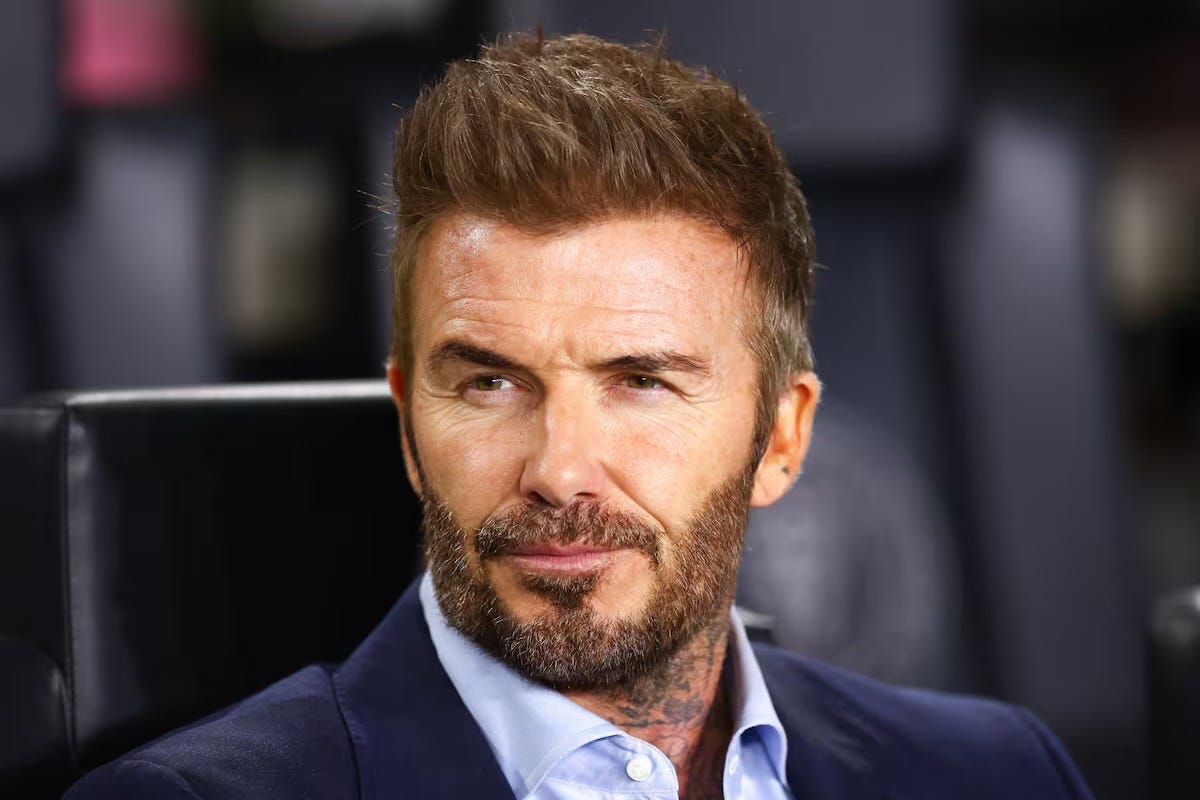
David Beckham was a great footballer.
That part is not up for debate.
Right foot like a sniper.
Delivery that changed games.
Big-moment nerve.
So this is not about tearing down his football career.
This is about something far more important:
We have turned a footballer into a moral symbol — and that is a lie that damages people.
The Beckham myth isn’t a man. It’s a product.
Beckham didn’t just become famous.
He became useful.
Useful to brands.
Useful to leagues.
Useful to governments.
Useful to British soft power.
He never embarrassed power.
Never challenged FIFA.
Never challenged Qatar.
Never challenged the economics of football.
Never stood up for exploited players or workers.
He smiled.
He sold.
He stayed safe.
That’s why he became untouchable.
Not because he was brave —
but because he was non-threatening.
Money became the moral standard
Here’s the poison nobody wants to name:
Football now teaches children that being rich is the same as being right.
Beckham didn’t become a hero because he helped people.
He became a hero because he became valuable.
Valuation replaced virtue.
“How much is he worth?”
“How big is his brand?”
“How many millions?”
This is how greed hides — it pretends to be success.
When Beckham turned a $25m MLS clause into a billion-dollar club, people didn’t ask whether that made football better.
They just applauded the number.
And that is how extraction becomes admired.
MLS wasn’t brave. It was protected.
Beckham didn’t take risk.
He got:
• A closed franchise
• No relegation
• No competition pressure
• Guaranteed asset growth
Inter Miami isn’t a football club in the old sense.
It’s a financial vehicle.
Messi isn’t there for romance.
He’s there to inflate the valuation so investors can cash out.
Beckham didn’t challenge football’s economics.
He stepped inside them.
Qatar revealed the truth
Beckham sells “values.”
Then he took millions from Qatar — a state that criminalises gay people, restricts women, and used exploited migrant labour to build World Cup stadiums.
Did he speak?
No.
Because his values are brand settings — not beliefs.
They switch off when the cheque clears.
That isn’t leadership.
That’s reputation laundering.
Rebecca Loos and Brooklyn exposed the myth
Rebecca Loos cracked the “perfect husband” image.
Brooklyn cracked the “perfect family” image.
Families fall out all the time.
Your cousin not speaking to your aunt because a new wife didn’t get along is normal life.
What isn’t normal is pretending perfection is real.
Beckham isn’t spotless.
He’s curated.
Every rough edge smoothed.
Every awkward truth managed.
Because Beckham isn’t just a man.
He’s a brand.
Why he became “Sir”
Knighthoods are not awarded for kindness.
They are awarded for usefulness to the establishment.
Beckham:
• Made Britain look glamorous
• Sold Premier League power
• Promoted British brands
• Never embarrassed those in charge
That’s what the system rewards.
Now look at Lou Macari
Manchester United.
Stoke City legend.
1970s footballer.
After football, he built homes for homeless people in Stoke.
Not for PR.
Not for branding.
For dignity.
No knighthood.
Because helping the homeless makes the country look honest, not glamorous.
This is the truth people don’t want to hear
The system doesn’t love footballers.
It loves assets.
When Beckham stops being useful, it will find another Beckham.
A younger face.
A safer image.
A more profitable version.
That’s how power works.
So who should kids really look up to?
Not the man who extracted billions.
The man who gave people somewhere to sleep.
Beckham built valuation.
Macari built lives.
Money is not morality.
Wealth is not virtue.
And football will only heal when we remember the difference.