

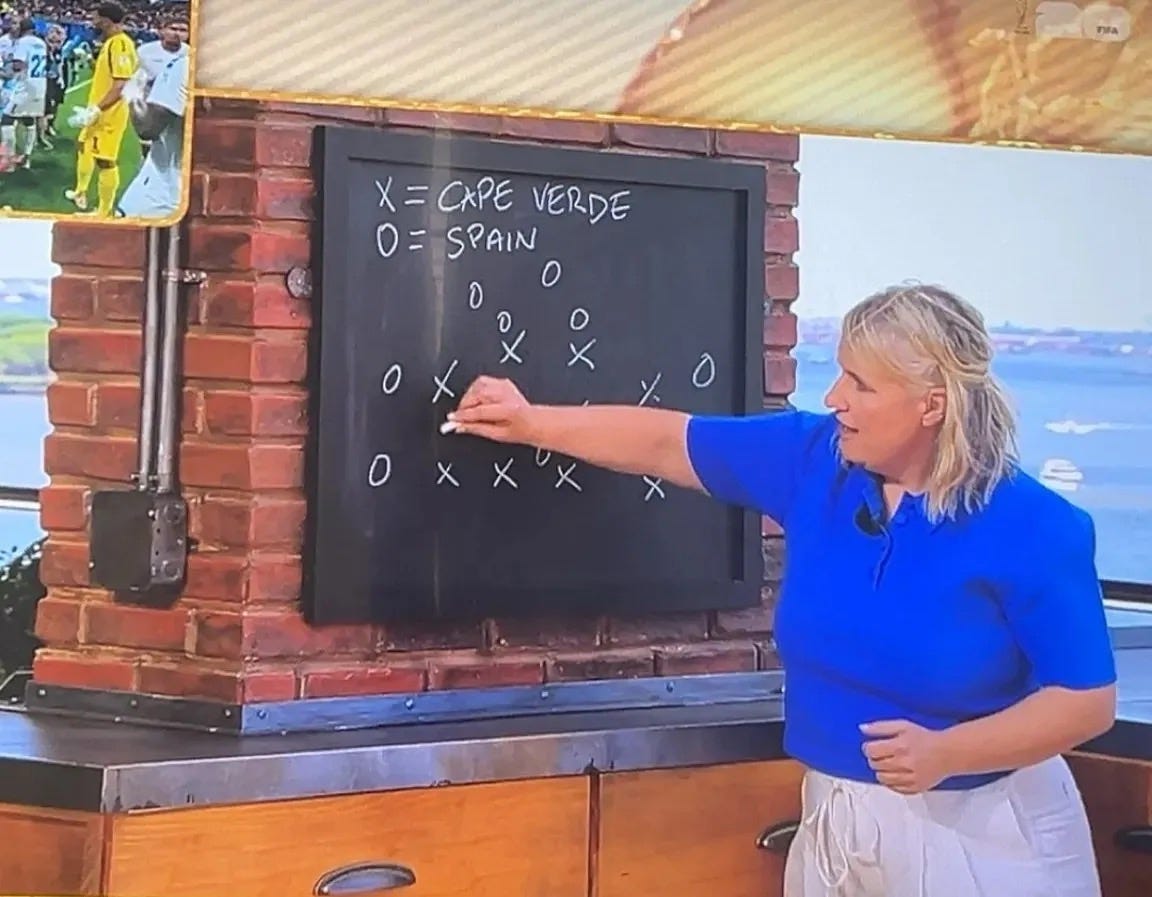
Emma Hayes described Cape Verde’s draw with Spain as “a victory for immigration.”
That comment has lingered in my mind.
Not because it was outrageous.
Not because she was not entitled to say it.
But because it captured something many football supporters have been feeling for years.
A growing gap between football broadcasters and football supporters.
Most fans watched Cape Verde hold Spain and saw football.
A tiny nation standing up to a giant.
Organisation.
Discipline.
Courage.
National pride.
One of the stories of the tournament.
Hayes saw something bigger.
A social story.
A cultural story.
A broader message.
That is her right.
But it also raises a question.
Why does modern football broadcasting increasingly seem uncomfortable with football simply being football?
Why does every result have to become a lesson?
Why does every moment have to carry a wider meaning?
Why does every discussion feel like it is trying to guide the audience toward a preferred conclusion?
That is where the frustration begins.
Not with Emma Hayes alone.
With the mindset.
Because football television increasingly feels like it no longer trusts the audience.
It does not just explain the game.
It explains what the game should mean.
And supporters can feel it.
The irony is that football television has never had more expertise.
Never had more former managers.
More analysts.
More data.
More tactical tools.
More technology.
Yet somehow many fans feel less connected to football coverage than ever before.
Why?
Because modern broadcasting has become trapped between two weak extremes.
On one side, banter punditry.
Noise.
Laughter.
Viral clips.
The game reduced to reaction shots and social media moments.
On the other side, classroom punditry.
Chalkboards.
Leadership language.
Over-structured explanations.
Football presented as if viewers have accidentally enrolled on a coaching course.
One treats supporters like children.
The other treats them like students.
Neither treats them like supporters.
The best football analysis does neither.
It translates.
It explains what changed.
Why it changed.
Who saw it first.
Who failed to react.
Then it lets the audience decide what they think.
That is real punditry.
Insight without arrogance.
Knowledge without performance.
Intelligence without self-importance.
Insight with mud on its boots.
This is where Hayes becomes part of a much bigger story.
The issue is not that she understands football.
She clearly does.
The issue is that broadcasters increasingly elevate certain voices into symbols.
The modern voice.
The progressive voice.
The tactical voice.
The authority voice.
And once somebody becomes a symbol, criticism becomes difficult.
Question the analysis and people assume you are questioning the person.
Question the person and people assume you are questioning progress itself.
That is unhealthy.
Because football should never have untouchable figures.
Not players.
Not managers.
Not pundits.
Not broadcasters.
The strange thing is that even the people many fans claim to prefer have fallen into the same trap.
Roy Keane has become a meme.
Gary Neville has become a clip.
Micah Richards has become a laugh track.
Emma Hayes has become a lesson.
Different roles.
Same machine.
The television industry reduces everyone to a character because characters are easier to sell than ideas.
The result is that football discussion becomes less about the match and more about the personalities discussing it.
That is backwards.
The match should always be bigger than the pundit.
The World Cup should always be bigger than the panel.
The supporters should always be bigger than the broadcaster.
And that is why the Cape Verde game mattered.
Because the football story was already rich enough.
Spain had the ball.
Cape Verde had the nerve.
Spain had the names.
Cape Verde had the structure.
Spain had the possession, the rhythm, the pressure, the shots.
Cape Verde had a 40-year-old goalkeeper called Vozinha standing in the middle of it all like a man refusing to let history pass him by.
He made seven saves.
Seven.
Against Spain.
At forty.
That is not a footnote.
That is the story.
Spain had 27 shots and still could not break them.
Cape Verde spent the match living on the edge of their own box, defending space, closing gaps, blocking lanes, chasing shadows and trusting one another.
That is not just romance.
That is tactics.
That is discipline.
That is coaching.
That is suffering.
That is football.
Mikel Oyarzabal reportedly went the first half hour without touching the ball.
Think about that.
A Spain forward, in a World Cup match, against Cape Verde, unable to get a touch for thirty minutes.
That is not luck.
That is a plan.
That is a team denying Spain the areas they wanted to play in.
That is a small nation forcing a football superpower to feel uncomfortable.
Then there was Vozinha.
Not just a goalkeeper making saves.
A man carrying his country, his family, and his own story.
His mother missed the game because of travel and visa issues.
Afterwards, the story moved people enough that help arrived to get her to the next match.
That is human.
That is emotional.
That is political if you want it to be.
But first, it is football.
A son.
A mother.
A World Cup.
A clean sheet.
A country crying into the night because one old goalkeeper refused to be beaten.
That is why supporters get frustrated when the first instinct is to reframe the moment as a wider message.
The wider meaning was already there.
It was in the saves.
It was in the blocks.
It was in the legs burning after seventy minutes.
It was in the players looking at the clock and realising Spain still had not found a way through.
It was in the final whistle.
Football does not need to be dragged into meaning.
Football creates meaning on its own.
That is what broadcasters keep forgetting.
A World Cup audience is not a boardroom.
It is not a conference.
It is not a strategy session.
It is millions of ordinary people giving their attention to something they care about.
People in pubs.
People in living rooms.
People finishing shifts.
People sitting with their families.
People carrying memories of matches, players and clubs that matter to them.
They are not looking to be managed.
They are not looking to be corrected.
They are not looking for permission to enjoy football.
They are looking for insight.
Honesty.
Humour.
Perspective.
Emotion.
The things that made them love the game in the first place.
Hayes chose to talk about the wider social meaning.
Fine.
That is her interpretation.
But supporters are entitled to prefer the football story.
And broadcasters should be careful before assuming that preference needs correcting.
Because football does not belong to broadcasters.
It does not belong to pundits.
It does not belong to social media departments.
It does not belong to people building personal brands.
It belongs to the people who watch.
The people who travel.
The people who sing.
The people who care.
That has always been football’s superpower.
Its connection to ordinary life.
Its ability to matter deeply without needing permission from experts.
That is why supporters become frustrated when they feel the game is being filtered through too many layers of messaging, branding and performance.
Not because they reject intelligence.
Not because they reject different viewpoints.
But because they recognise something important.
Football does not need to be made more meaningful by television.
Football is already meaningful.
A tiny nation holding Spain.
A last-minute winner.
A missed penalty.
A packed away end.
A father watching with his son.
A mother watching with her daughter.
A city holding its breath.
A country erupting with joy.
A 40-year-old goalkeeper making seven saves while his mother waits for the chance to see him.
That is the meaning.
That is the story.
And sometimes the smartest thing a broadcaster can do is simply let football speak for itself.