

Football didn’t die.
It was sold.
Not all at once.
Not in one dramatic moment.
But slowly.
A little every year.
Ticket prices crept higher.
Community clubs disappeared quietly.
Kids who once played in the streets began watching the game through screens instead of living inside it.
The stadiums are still full.
The television deals are bigger than ever.
But ask enough supporters and they’ll tell you the same thing:
Something inside football changed.
Something that once belonged to the people now feels like it belongs to the system.
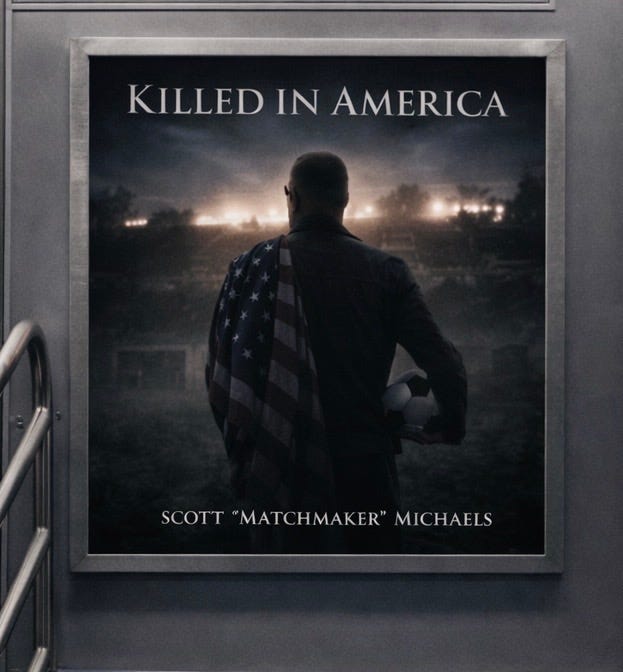
That quiet feeling is where Killed In America came from.
Six rock songs about football history, forgotten clubs and the communities that built the game long before it became a global entertainment industry.
These songs are not nostalgia.
They’re stories.
Stories about football when it still felt alive.
Last Minutemen
The Forgotten Army
Every football country has clubs that history quietly leaves behind.
In the 1970s American soccer was full of ambition and imagination. Cities across the United States were building teams and dreaming about creating a football culture of their own.
One of those clubs was the Boston Minutemen.
For a short moment the Minutemen represented the hope that football could grow into something unique in America.
Supporters gathered in stadiums that had never seen the sport played at that level before.
There was excitement.
Possibility.
Belief.
But football history is fragile.
When the league collapsed, clubs like the Minutemen vanished almost overnight.
What remains are memories.
Old photographs.
Supporters who still remember what it felt like when American soccer first tried to build something real.
Last Minutemen is for those supporters.
The last people still carrying the memory of that dream.
Big Dips
The Rise and Fall
Football never travels in a straight line.
It rises.
It crashes.
And sometimes it disappears completely.
The Washington Diplomats lived through one of those dramatic rises.
For a brief moment the club attracted one of the most intelligent footballers the game has ever seen.
Johan Cruyff.
Watching Cruyff play in Washington felt surreal. One of football’s greatest thinkers guiding a young sporting culture that was still learning what the game could become.
But even moments like that couldn’t save the league when financial reality caught up with ambition.
The Diplomats disappeared.
Another club erased from the official history of the sport.
Big Dips is about those moments when football feels unstoppable — and the sudden collapses that remind supporters how fragile the game can be.
Little Hugo
The Kid Outside the Gate
Every stadium has a story happening just outside the turnstiles.
Little Hugo is fifteen.
He loves football.
He should be playing every evening with a ball at his feet.
Instead he works at a burger van parked outside a stadium.
He hears the crowd roar.
He watches supporters walk past wearing scarves and shirts.
But the game on the other side of the gate feels like it belongs to someone else now.
Football used to belong to kids like Hugo.
It was played in streets, parks and empty car parks until the sun went down.
Now Hugo flips burgers for supporters who can afford the ticket.
The game still exists.
But the distance between the stadium and the street has grown wider.
Little Hugo represents a generation that football quietly left behind.
Bees Still Sting
Champions That Vanished
Some clubs prove football can thrive anywhere.
Even in cities where the sport was never expected to survive.
The Chicago Sting were one of those clubs.
Chicago is one of the toughest sports cities in the United States.
Baseball. Basketball. American football.
Yet somehow soccer carved out its own place.
The Sting won championships and built a real following in a city that demands success.
For a moment it looked like American soccer had found one of its permanent homes.
But when the league collapsed, even champions weren’t safe.
The Sting disappeared like so many others.
Yet supporters still remember the yellow shirts.
The packed stadiums.
The feeling that soccer had finally arrived.
That’s why the song is called Bees Still Sting.
Because even when the club disappears, the memory still bites.
Aztec Gold
When the Game Was Wild
The Los Angeles Aztecs represented something rare in football.
Imagination.
The 1970s era of American soccer was colourful and unpredictable.
Players arrived from all over the world.
Crowds filled stadiums not just to watch football but to experience something new.
The Aztecs became part of a golden moment when the sport felt experimental and full of personality.
Before modern sports structures turned everything into rigid corporate systems.
Aztec Gold remembers that era.
A time when football still felt wild.
When Football Was Alive
The final song is quieter.
More reflective.
It’s about the older supporters who still sit in stadiums today.
They watch the matches.
They cheer the goals.
But sometimes they pause and look around.
And they realise something has changed.
The game still exists.
But the atmosphere feels different.
More controlled.
More corporate.
Less connected to the communities that once carried it.
When Football Was Alive isn’t just about the past.
It’s about asking whether the game can ever feel like that again.
Why This Record Exists
Rock music has always told the stories of working people.
Factories closing.
Towns changing.
Communities fighting to keep their identity.
Artists like Bruce Springsteen built entire careers telling those stories.
Football belongs in that tradition.
Because for millions of people football was never just entertainment.
It was belonging.
It was identity.
And sometimes the best way to explain what’s happening to the world around us is not through politics or journalism.
Sometimes it’s through a song.
Killed In America
Six songs.
Six football stories.
And about a game that once belonged to the people.
Scott “Matchmaker” Michaels
Now streaming on Apple Music, Spotify and YouTube.