

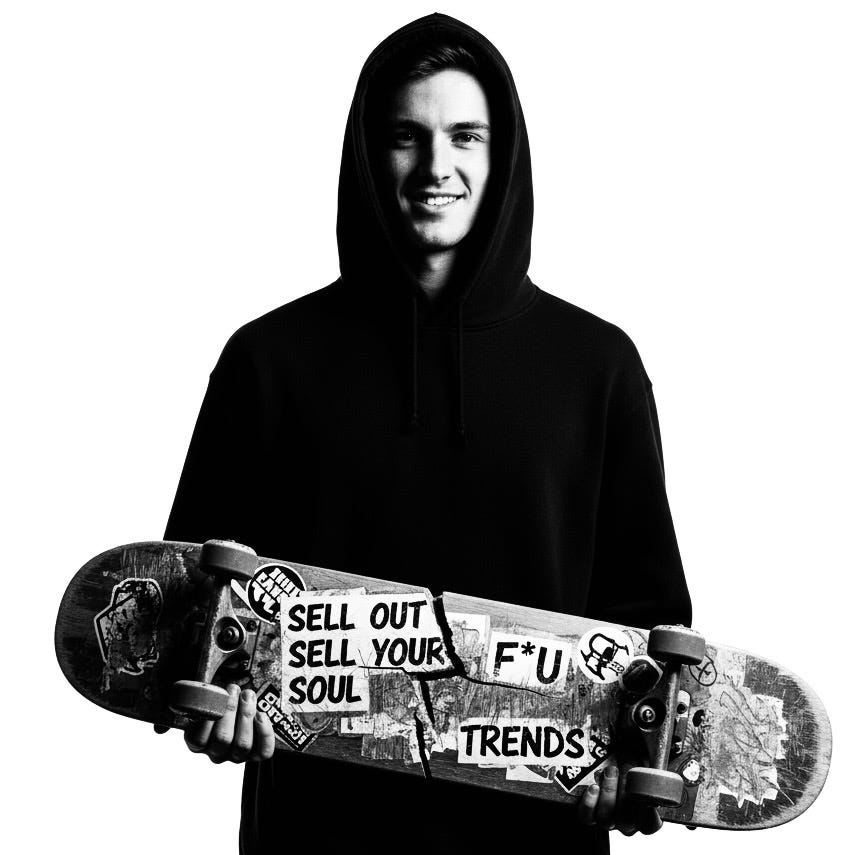
People in boardrooms talk about sport like it’s a market.
A product.
A category.
A revenue stream.
But for millions of kids growing up, sport is something very different.
It’s an escape route.
For me growing up, two things shaped my youth more than anything else:
skateboarding and football.
Without them, a lot of us would have been standing on street corners doing nothing good.
Bored teenagers with energy and nowhere to put it.
That’s how trouble starts.
But give kids a board or a ball and something powerful happens.
They stop drifting.
They start building something.
Skill.
Confidence.
Community.
Sport didn’t just entertain us.
It kept us straight.
The Street Was the First Stadium
Before corporations arrived, both sports belonged to the same place.
The street.
Football meant jumpers for goalposts and games that lasted until it was too dark to see the ball.
Skateboarding meant stair rails, supermarket car parks, cracked pavement and friends filming tricks on cheap cameras.
No memberships.
No subscriptions.
No paywalls.
You just showed up.
And that freedom mattered.
Because when young people have somewhere positive to go, they don’t end up somewhere destructive.
The Day the Culture Became Retail
Recently I walked through the Trafford Centre looking for skate shoes.
I stepped into Vans expecting to feel something familiar.
Instead it felt sterile.
Perfect lighting.
Perfect shelves.
Rows of identical shoes.
It honestly felt like walking into a Chinese factory outlet mall.
Different logos.
Same machine.
That moment tells you everything about what has happened to skate culture.
What once grew from car parks and concrete has been turned into a global retail template.
Clean.
Controlled.
Mass produced.
The same thing happened to football.
When Corporations Arrive
Once something becomes culturally powerful, corporations move in.
Companies like
They didn’t build these cultures.
Kids did.
But corporations recognised something valuable:
Authenticity sells.
So they sponsored the athletes.
They built product lines.
They packaged rebellion and sold it back to the people who created it.
And slowly the culture got polished until it looked perfect in a shopping centre.
The Brand That Understood Skating
One brand that truly understood skateboarding was Savier.
When Savier launched around 2000 it approached skate shoes differently.
They weren’t fashion.
They were equipment.
Built for the abuse of real skating.
Grip tape destroys shoes.
Hard landings destroy shoes.
Concrete destroys shoes.
Savier was built to survive it.
Durable.
Technical.
Built for skaters.
But like many authentic brands, Savier disappeared.
Not because skaters rejected it.
But because the industry shifted toward lifestyle retail and mass production.
The underground got replaced by the mall.
Why I Want to Bring Savier Back
That’s exactly why I want to help build Savier into a true skate brand again.
Not a lifestyle logo hanging under perfect lighting in shopping centres.
A real skate brand.
Built around the spirit that made skating matter in the first place.
Concrete.
Community.
Freedom.
Because skateboarding was never supposed to be polished.
It was supposed to be alive.
Sport Should Be Free
Here’s the bigger truth.
Sport isn’t just entertainment.
It’s social infrastructure.
Skateboarding kept kids out of trouble.
Football kept kids out of trouble.
They gave young people somewhere to go when the alternative was standing on street corners.
Society understands healthcare should be accessible.
But movement, community and sport are just as important for long-term wellbeing.
Kids should be able to play football for free.
Kids should be able to skate for free.
Pitches.
Parks.
Skate spaces.
These things should exist everywhere.
Not behind paywalls.
Not controlled by corporations.
Concrete Still Belongs to the Kids
Somewhere tonight a kid will step onto a skateboard for the first time.
Another will kick a football against a wall.
They won’t be thinking about brands.
They won’t be thinking about corporations.
They’ll be thinking about landing the trick.
Scoring the goal.
Feeling that moment where effort turns into joy.
And that moment should always belong to them.
Because the truth is simple.
Skateboarding and football didn’t come from corporations.
They came from kids on concrete.
And if we ever forget that, we don’t just lose a culture.
We lose the thing that kept a lot of us out of trouble in the first place.