

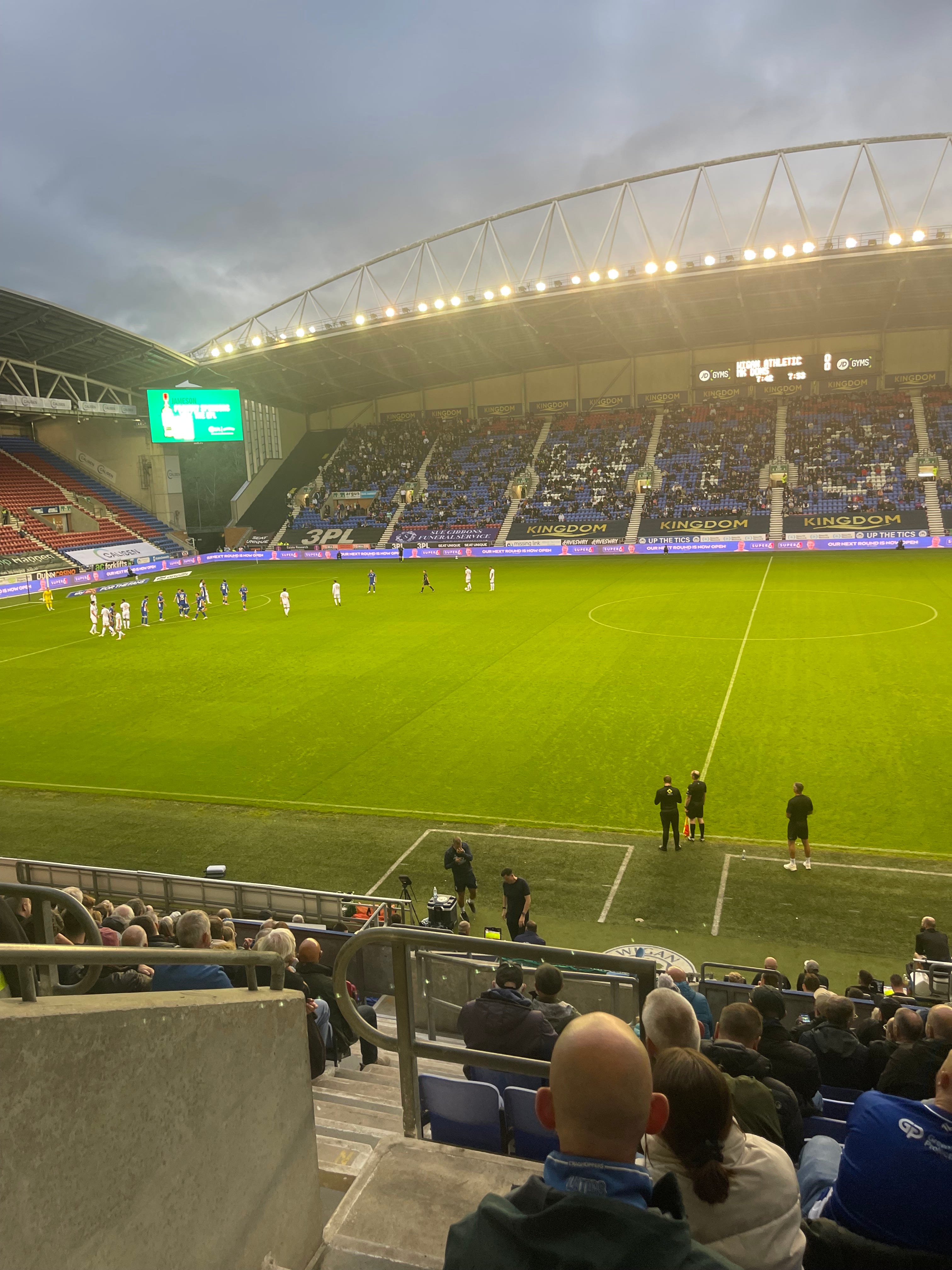
I was at Wigan against MK Dons tonight.
Wigan won.
But I left thinking about the striker.
He kept coming short.
Wide players came inside.
There was not enough running beyond.
Not enough of a winger taking a full-back on, reaching the line and whipping one across the box.
Too much football in front of the opposition.
Too many players asking for it to feet.
I kept looking at the space behind the defence.
Who is going the other way?
That question has followed me through this entire transfer window.
Because at one end of football I am watching a League One game with too little threat behind the back line.
At the other, Premier League clubs have just spent £3.46 billion and are still looking for the same things.
Goals.
Creativity.
Someone who can break the shape.
That is the real transfer story.
Not who spent the most.
What has become hardest to find.
For spending, this window is 10/10.
For theatre, 9/10.
For value, 6/10.
For solving the shortage of strikers and creators?
5/10.
Because after all that money, clubs are still asking the same questions.
Where is the number nine?
Where is the winger who can beat someone?
Where is the No.10 who sees the pass nobody else sees?
This is not a shortage of money.
It is a shortage of player types.
A PLAYER DOESN’T HAVE A PRICE. HE HAS A SITUATION
This is where people misunderstand transfer value.
A footballer is not worth £50 million because somebody has calculated that his left foot, lungs and brain equal £50 million.
He is worth what the situation makes him worth.
Four years left on his contract. Three clubs want him. Selling club does not need the money. Deadline approaching.
£60 million.
One year left.
£35 million.
Club needs cash.
£25 million.
Player wants out.
£20 million.
Nobody else bids.
£15 million.
Same player.
Different market.
That is the Matchmaker view of value.
Value lives in the gap between ability and circumstance.
And scarcity blows that gap wide open.
Right now, the market is screaming that goalscorers and creators are scarce.
EVERYBODY WANTS A 15-GOAL STRIKER
Listen to recruitment people now.
“He’ll get us 15.”
Fifteen.
And suddenly you have a £40 million or £50 million conversation.
I am not pretending every striker thirty years ago scored 40 goals.
They did not.
But the great ones chased 20, 25, 30.
The exceptional ones could go higher across a season.
More importantly, football had more specialists.
More players whose job was obvious.
Score.
Now a striker who can reliably get 15 is treated like a rare commodity.
Everton showed it perfectly.
Beto went.
Their move for Folarin Balogun collapsed.
They finished the window desperately thin in the one position that decides tight games.
Leeds have had their own version of the problem.
Other clubs too.
Everyone wants goals.
Not enough players supply them.
That is basic economics.
THE NUMBERS SAY THE POSITION REALLY HAS CHANGED
Two decades ago, recognised strikers scored around 41.6% of Premier League goals.
By 2025/26, that figure had fallen to 25.9%.
That is not a small tactical adjustment.
It is a major change in who football expects to score.
The goals have not disappeared.
They have moved.
To wide forwards.
Inside forwards.
Attacking midfielders.
False nines.
And some of that has been brilliant.
Modern coaching has improved pressing, athletic standards, positional intelligence and game control.
Inverted wingers and false nines have helped produce some of the greatest attackers of the era.
Pure poachers could be passengers.
Elite football now demands more.
All true.
But progress creates trade-offs.
And one trade-off appears obvious.
The specialist striker has become rarer.
FOOTBALL GETS WHAT FOOTBALL TRAINS
Take a talented 12-year-old number nine.
What do we teach him now?
Drop in.
Link play.
Press.
Counter-press.
Rotate wide.
Receive between the lines.
Help build.
Be comfortable everywhere.
All useful.
But when does he learn the dirty stuff?
How to lose a centre-half.
How to attack a near post.
How to disappear at the back.
How to finish first time.
How to read a rebound.
How to make ten runs knowing the pass may only arrive once.
How to become obsessed with the six-yard box.
That is not primitive football.
That is a craft.
And crafts disappear if nobody protects the time needed to learn them.
Football spent years making the striker more complete.
Then acted surprised when fewer of them became lethal.
THE POACHER HAS ALMOST GONE
The poacher would struggle in a modern recruitment meeting.
Too few touches.
Not enough involvement.
Not enough pressing.
Not enough contribution outside the box.
Some of that criticism is fair.
But the poacher knew something many players never learn.
Where the next goal was going to happen.
Keeper spills it.
He is there.
Bad clearance.
He is there.
Ball ricochets.
He is there.
Three yards.
Goal.
Tight games are still decided by moments exactly like that.
A rebound.
A second ball.
A defender losing concentration for half a second.
We have become very good at measuring involvement.
Sometimes we forget to measure consequence.
If my striker has fifteen touches and two of them are goals, I am not opening the dashboard before I congratulate him.
HAALAND IS THE GREAT EXCEPTION
That is why Haaland matters.
He is not literally the last number nine.
But he is the clearest elite reminder of what the position used to mean.
He works.
He presses.
He understands one of the most sophisticated systems in football.
But he does not need the ball constantly.
He stays high.
He runs away from possession.
He attacks space.
He makes centre-halves turn.
He understands where football’s most valuable piece of land is.
In front of goal.
That sounds obvious.
It should.
Football has become so clever that sometimes it treats the obvious like stupidity.
Haaland knows better.
The goal is still where it always was.
WE HAVE CONFUSED MOVEMENT WITH MOVEMENT TOWARDS THE BALL
This is the bit I keep seeing.
Striker comes short.
Winger comes inside.
Full-back moves in.
Midfielder drops.
Everyone wants connection.
Everyone wants a triangle.
Fine.
But then the opposition steps up.
The pitch shrinks.
Twenty players end up squeezed into the same area.
We call it control.
Sometimes it is.
Sometimes it is congestion dressed up as sophistication.
The run behind changes that.
It makes the centre-half turn.
It pushes the defensive line back.
It creates room for everybody else.
The player might never receive the pass.
It does not matter.
Threat creates space before the ball ever arrives.
That is football intelligence too.
THE WINGER HAS GONE INSIDE
The same thing happened wide.
The old winger had one simple thought.
Can I beat him?
Outside.
Run.
Reach the line.
Whip it in.
Now so many wide players receive and come inside.
That can be brilliant.
Some of the greatest attackers of the modern era have done it.
The problem is not inverted wingers.
The problem is everybody looking for the same answer.
The hardest attack to defend is one that can beat you more than one way.
Inside.
Outside.
Over.
Through.
Cross.
Dribble.
Run behind.
Modern football has improved control.
It may have reduced chaos.
I am not sure that is always a good trade.
CREATIVITY HAS BECOME EXPENSIVE TOO
The striker shortage gets attention because goals are obvious.
I think the shortage of genuine creators is just as important.
Not tidy players.
Football produces those brilliantly.
I mean the player who changes the picture.
The dribbler.
The old No.10.
The one who sees the pass nobody else sees.
The one who tries something difficult.
Five times it fails.
The sixth wins the match.
Modern football hates the first five.
Fans remember the sixth.
That is where the maverick has become awkward for the modern game.
Pressing numbers.
Recovery running.
Counter-presses.
Defensive shape.
Work rate.
All legitimate.
But eventually somebody in the recruitment room has to ask:
Can he beat the bloody man?
Can he open the game?
Can he create something that is not on the whiteboard?
Because the maverick was not there to make your structure perfect.
He was there to break theirs.
DATA IS GOOD. CONSENSUS IS DANGEROUS
I am not anti-data.
That would be daft.
Data has made recruitment better.
But when every club buys similar information, every club starts valuing similar players.
Then ten teams want the same striker.
The bargain disappears.
The real recruitment edge is not finding the player everybody already agrees is good.
It is finding the player the market has misunderstood.
The low-touch striker.
The winger considered too direct.
The No.10 who loses possession because he keeps attempting difficult passes.
The player trapped in the wrong system.
That is where the Matchmaker lives.
Where ability is being priced badly.
Not where everyone already agrees.
THE PREMIER LEAGUE IS PRICING ITSELF
A huge amount of this summer’s money stayed inside the Premier League.
That creates another premium.
You are not only buying talent.
You are buying certainty.
He knows the league.
The speed.
The physicality.
The opposition.
The data is comparable.
The resale market exists.
That pushes prices up.
The player has not suddenly become twice as good.
The market has become twice as comfortable paying.
Again, price and value are not the same thing.
MONEY DOES NOT REMOVE SCARCITY
Newcastle are a useful example.
When the ownership changed, some people imagined huge wealth meant global superstars would simply arrive.
Football does not work like that.
Players choose too.
So do agents.
So do selling clubs.
There are wages.
Champions League.
Contracts.
Competition.
Squad rules.
Career path.
Location.
Money matters.
It does not remove scarcity.
And when several rich clubs want the same rare player, money often does the opposite.
It makes scarcity more expensive.
WHAT SHOULD FOOTBALL DO?
The answer is not to turn the clock back.
It is to stop throwing useful old skills away.
Protect specialist finishing sessions.
Keep proper No.9 development pathways.
Let strikers learn the penalty box.
Let wingers go outside.
Let creators lose the ball sometimes.
Recruit for impact, not just involvement.
Use two strikers occasionally.
Cross early.
Put somebody on the shoulder.
Give defenders different problems.
Not because old football was automatically better.
Because predictable football is easier to defend.
THE MARKET IS NOT BROKEN
Football has spent twenty years making players more complete.
Better athletes.
Better technicians.
Better pressers.
Better tacticians.
That is progress.
But somewhere along the way, we made the specialist scarce.
The poacher.
The winger.
The No.10.
The runner.
The maverick.
Then the transfer window opens.
And everybody wants one.
That is not irrational.
That is exactly what markets do.
They put the highest price on what is hardest to find.
So if clubs do not like paying £50 million for a 15-goal striker, perhaps they should stop asking why the transfer market is broken.
They should look further back.
At the academies.
At the coaching.
At the selections.
At what football chose to reward.
Because the market did not create this shortage.
It is simply sending football the bill for what football stopped producing.
— Scott “Matchmaker” Michaels