

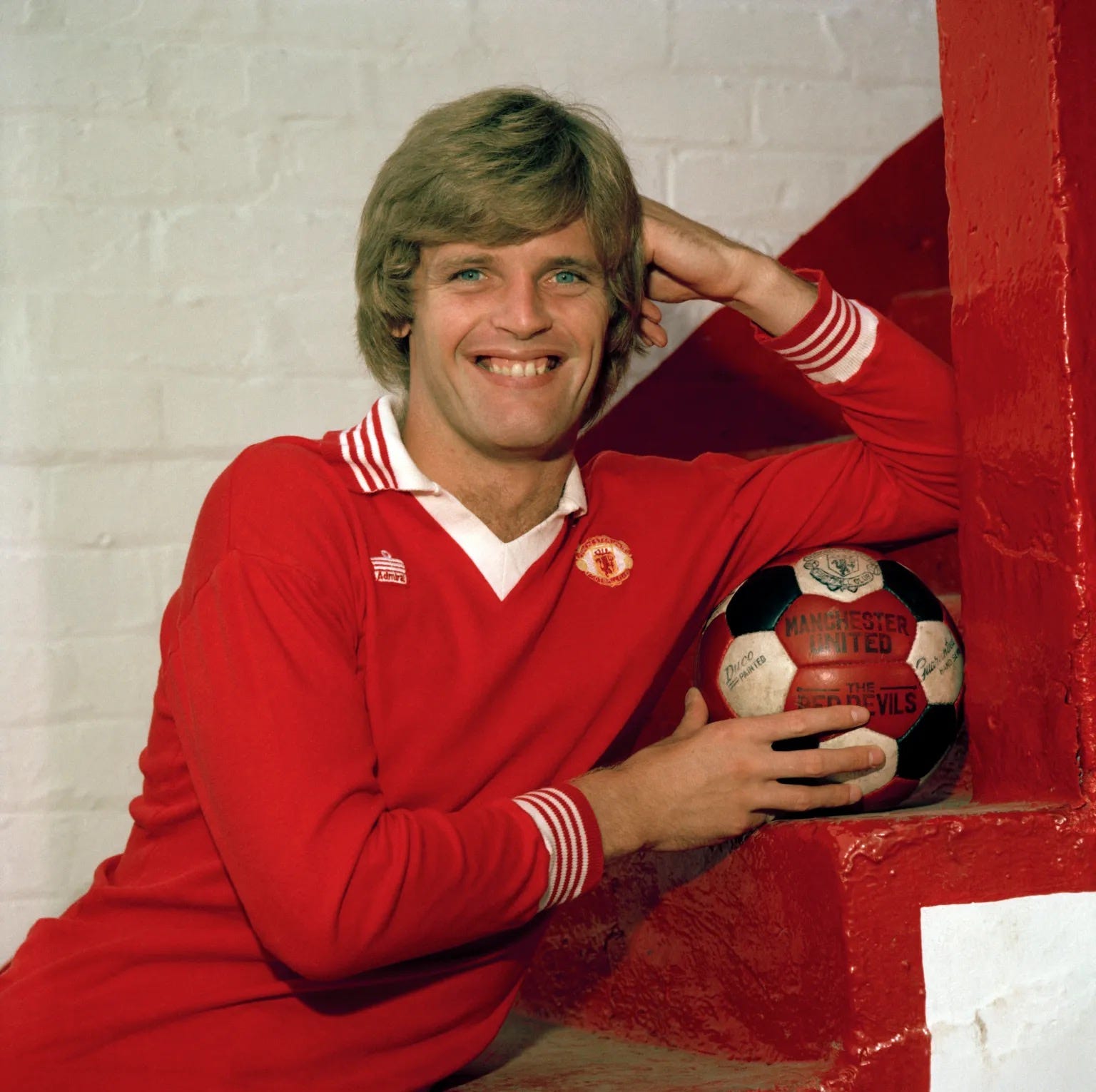
This week, a coroner said something football has spent decades avoiding.
That repeatedly heading a football was likely to have contributed to the brain disease that played a part in the death of Gordon McQueen.
Not a campaigner.
Not a journalist.
Not a pressure group.
A coroner.
On the balance of probability, Gordon McQueen developed chronic traumatic encephalopathy (CTE) because of repetitive head impacts sustained during his playing career. Combined with vascular dementia, it led to pneumonia. He died aged 70.
This is no longer a debate about tradition or opinion.
It’s a matter of record.
The type of player football demanded
Gordon McQueen was exactly the kind of footballer the game used to celebrate.
A central defender.
Dominant in the air.
Brave. Dependable. Reliable.
Nearly 350 appearances across St Mirren, Leeds United and Manchester United.
30 caps for Scotland.
A career built on doing what the game asked of him.
Heading wasn’t optional.
It was the job.
Players of his era wore the boots of the time — leather, heavy, uncompromising.
Boots like Stylo Matchmakers, made for grip, power, contact.
Built for the football that existed then.
What those players were never told was the cost.
“Football took him in the end”
Outside court, McQueen’s daughter Hayley said something football still doesn’t know how to respond to:
“Dad absolutely loved everything about football, but ultimately, it took him in the end.”
Not metaphorically.
Literally.
She spoke about personality change.
Balance problems.
Difficulty swallowing.
Symptoms that didn’t resemble “normal” dementia.
The family’s lifetime savings were wiped out paying for care.
Charities stepped in where football never planned to.
This is what “player welfare” looks like after the applause stops.
We’ve known who is most at risk
Medical evidence now shows:
-
Goalkeepers: risk similar to the general population
-
Outfield players: higher risk
-
Defenders: highest risk
Why?
Not one big collision.
Not a dramatic knockout.
Repetition.
Clearances.
Training drills.
“Win your headers.”
Day after day. Year after year.
Most of the damage doesn’t even happen on matchday.
It happens in training — the part of the game fans don’t see and governance barely enforces.
I knew something was wrong as a kid
Long before inquests and studies, I felt it instinctively.
I was about seven years old when an adult first shouted at me:
“Get your head on it.”
“Attack it.”
“Be brave.”
I remember standing there thinking: why would I do that?
It never felt natural.
It never felt clever.
It never felt like football.
I loved the ball on the floor. Passing. Movement. Angles. Intelligence.
Heading always felt ugly — something bolted onto the game and defended by tradition rather than logic.
Even then, I didn’t “get it”.
And the thought never left me:
It’s called football. Not headball.
Football governance: delay dressed up as caution
This is where the system fails.
The FA understood concussion risks in the early 1980s.
The Jeff Astle case in 2002 confirmed the link between heading and brain disease.
The FIELD study in 2019 showed footballers are 3.5 times more likely to die from neurodegenerative illness.
And yet:
-
Youth heading bans arrived decades later
-
Training limits are poorly understood
-
Only 1% of EFL clubs knew the FA’s own heading guidelines
This isn’t uncertainty.
It’s institutional hesitation — the kind that protects reputations while families absorb the damage.
Football governance has perfected one skill above all others:
Doing just enough to look responsible, while avoiding responsibility.
Heading is not essential to football
Here’s the truth no one wants to say out loud.
You can remove heading and still have:
-
passing
-
pressing
-
movement
-
tactics
-
goals
-
drama
What you lose is:
-
hopeful punts
-
aerial chaos
-
“lump it forward” football
Is that really what we’re protecting?
The best football has always been played on the floor.
With feet.
With intelligence.
With imagination.
Heading isn’t beautiful.
It survives because it’s familiar — not because it’s necessary.
Tradition is not a defence
Football hides behind nostalgia because it’s scared of what comes next.
Scared of liability.
Scared of compensation.
Scared of admitting it got something fundamentally wrong.
But no tradition is worth this.
Not a header from 1974.
Not a myth about “hard men”.
Not a highlight reel that ends in a care home.
If a rule costs lives, it isn’t tradition.
It’s negligence.
My position is simple
Ban heading.
At all levels.
In matches. In training. Completely.
Redesign the game around what it does best:
-
feet
-
movement
-
skill
-
brains that last beyond retirement
Protect kids instead of conditioning them for damage.
Protect players instead of honouring them too late.
Gordon McQueen loved football.
The game should have loved him back better.
It’s called football
Not headball.
Not skullball.
Not “sacrifice your brain for the badge” ball.
Football.
And the ball belongs on the floor.
Final line
Football doesn’t need another study.
It needs the courage to change.