

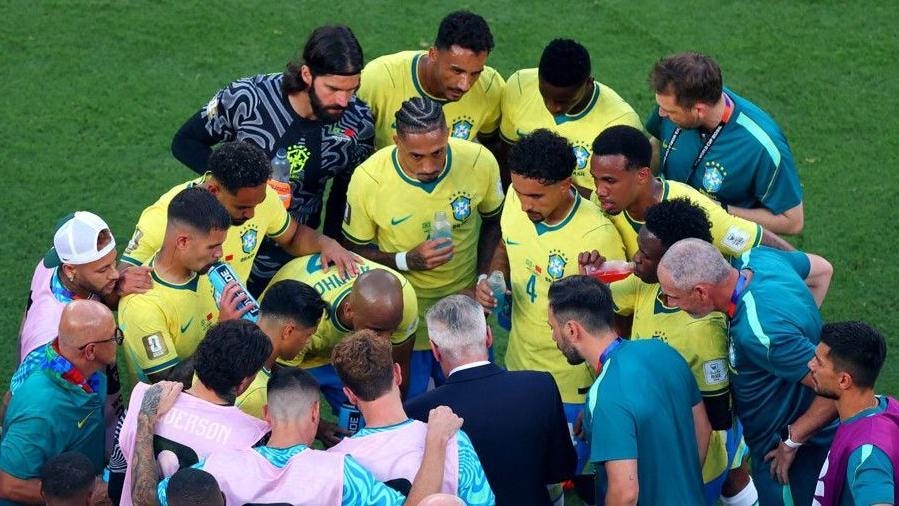
Football used to have one sacred advantage.
It flowed.
No timeouts.
No commercial pauses.
No manufactured reset button.
Forty-five minutes.
Half-time.
Forty-five minutes.
That was the rhythm.
That was the spell.
Then came the 2026 World Cup.
FIFA confirmed before the tournament that every match would include a three-minute hydration break midway through each half.
Not only in extreme heat.
Not only when a referee judged the conditions dangerous.
Not only when a medical threshold was crossed.
Every match.
No weather condition attached.
That is the shift.
This is no longer just an emergency heat measure.
It is now built into the format of the tournament.
And format changes matter.
Nobody serious is against player welfare.
Nobody wants players dizzy, dehydrated, cramping, or collapsing in brutal summer heat.
That is not the debate.
The debate is what happens when a genuine welfare measure becomes a permanent commercial window.
Because modern football never wastes a pause.
Once the game stops, the machine arrives.
The players drink.
The coaches coach.
The broadcasters reset.
The sponsors appear.
The adverts roll.
And football pretends this is all just common sense.
Let’s do the maths.
The expanded World Cup has 104 matches.
Each match has two hydration breaks.
Each break lasts three minutes.
That is 208 stoppages.
That is 624 minutes.
More than ten hours of scheduled interruption inside a sport that built its global appeal on continuous drama.
That is not a small change.
That is a new rhythm.
A new product.
A new doorway.
And once a doorway exists, commercial football will walk through it wearing polished shoes and carrying a rate card.
This is why supporters are right to be suspicious.
The problem is not that players need water.
The problem is that football has created a system where every solution becomes inventory.
Every risk becomes a sponsor asset.
Every welfare measure becomes another chance to monetise attention.
FIFA can say player welfare.
And it may be sincere.
But broadcasters can still sell the pause.
Sponsors can still benefit from the pause.
Coaches can still use the pause as a timeout.
Opponents can still lose momentum because of the pause.
Two things can be true at once.
The players may need protection.
And the game may still be getting carved into commercial pieces.
That is where the real story lives.
Because football was never meant to feel like a broadcast product built around stoppages.
It was not designed for constant interruption.
It did not need forced breaks to hold attention.
The beauty of football was pressure.
A team could suffer.
A team could chase.
A team could pin another side back for ten minutes and slowly squeeze the life out of them.
There was nowhere to hide.
No timeout.
No commercial breather.
No tactical rescue package wrapped in a water bottle.
Momentum mattered.
Now momentum has a scheduled enemy.
Minute 22.
Minute 67.
Whistle.
Water.
Tactics.
Adverts.
Reset.
That matters tactically.
A team under pressure can regroup.
A manager can change shape.
A tired defence can breathe.
A dominant team can lose rhythm.
A match can tilt without the ball moving.
That is not just a hydration break.
That is a tactical timeout with better PR.
And this is where football has to be honest with itself.
If the breaks are about extreme heat, link them to extreme heat.
Use temperature.
Use humidity.
Use medical thresholds.
Use common sense.
But when the break happens in every match, in every climate, in every stadium, it stops being only a safety protocol.
It becomes part of the entertainment format.
And format changes are never neutral.
They alter the feel of the game.
They alter the broadcast product.
They alter what future generations think football is supposed to be.
This is not just football becoming “more American.”
That phrase is too lazy.
The real issue is football moving closer to the logic of American broadcast sport, where stoppages are not accidental gaps but planned commercial inventory.
The NFL does not merely tolerate television timeouts.
It is built around them.
Basketball is built around them.
American television sport has long understood that a pause is not dead air.
It is sellable air.
That is the road football must be careful not to walk down.
Football’s greatest invention was continuous drama.
Once you break that rhythm, you do not just create a drinks break.
You create a habit.
Then a precedent.
Then a business model.
That is the slow creep.
Not revolution.
Not one dramatic betrayal.
Just three minutes.
Then another three minutes.
Then adverts.
Then tactical boards.
Then everyone gets used to it.
That is how football changes.
Quietly.
Commercially.
With the language of care.
The hydration break is not the disease.
It is the symptom.
The disease is a football industry that keeps expanding the calendar, increasing travel, chasing hotter markets, demanding more games, more sponsor exposure, more television value, and then acting surprised when the human body starts waving a white flag.
The players are the engine.
The supporters are the fuel.
The broadcasters own the road.
The sponsors pay the tolls.
And when the engine overheats, the same people who pushed it too hard sell the cooling break.
That is modern football.
Create the pressure.
Sell the relief.
Call it progress.
This is why the hydration break matters.
Not because water is bad.
Water is not the villain.
The villain is a system that can turn even a drink into an advertising asset.
The question is not whether hydration breaks are justified.
Sometimes they clearly are.
The question is whether football can solve real problems without slowly becoming the very sport it once differentiated itself from.
Because if every welfare measure becomes a commercial opportunity, then supporters are not paranoid.
They are paying attention.
The players drink water.
The sponsors drink exposure.
And the game loses a little bit of its soul in three-minute instalments.