

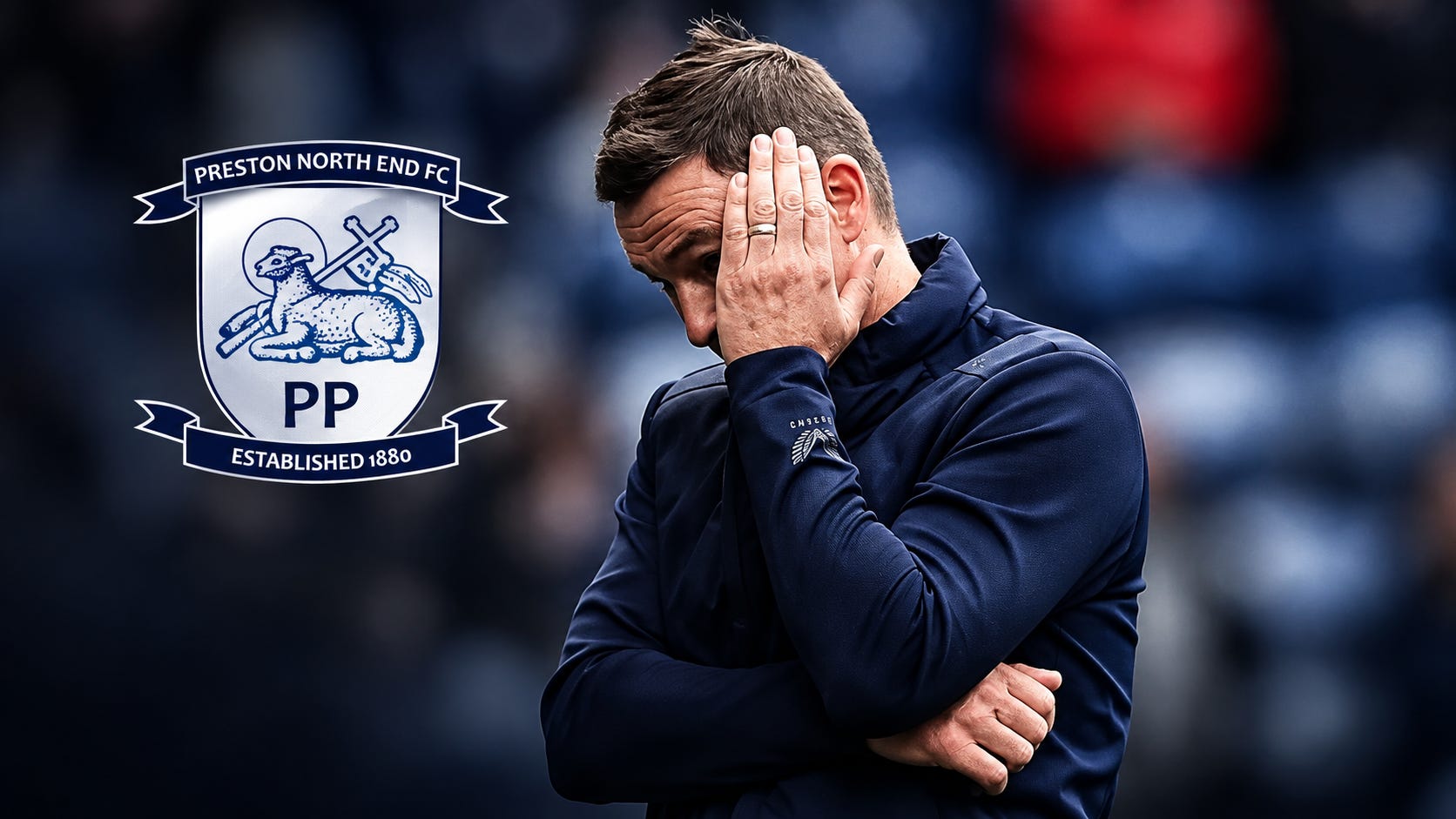
Paul Heckingbottom was dismissed by Preston North End on 13 September 2026 after six defeats in the opening seven Championship matches left the club 23rd.
One phrase in the club’s reasoning matters far beyond the manager.
There had been “significant investment in the playing squad.”
That should make everybody interested in Preston stop for a moment.
Because the obvious response is to debate the next manager.
I think the bigger question is considerably more important.
What happens to all that investment when the manager who helped assemble the squad disappears?
Does the next manager want those players?
Does he play the same way?
Does Preston spend again?
Do £3m and £5m assets suddenly become tactical misfits?
Does another rebuilding cycle begin?
That is where I believe Preston North End needs a fundamental rethink.
I live close to Preston.
I know the club, the area and the football culture around it.
I’ve been around football, players, transfers and agents for years.
And I don’t look at Preston and see a club that needs somebody promising Premier League football.
I see a football business that could become considerably smarter.
My model is simple:
Preston should be built to break even in the Championship, survive League One if necessary and retain an outside chance of reaching the Premier League.
The Premier League should be the jackpot.
It cannot be the business plan.
Preston Is A Championship Business With Premier League Upside
This isn’t defeatism.
It is the starting point for sensible ownership.
One of football’s most dangerous sentences is:
We’ll make the money back when we’re promoted.
A new owner arrives.
The wage bill rises.
Another £5m player arrives.
Then another.
A manager gets sacked.
The replacement wants different players.
January comes.
Spend again.
Eventually the business model becomes dependent upon finishing in the top six of one of the most competitive divisions in Europe.
That isn’t sustainable ambition.
It’s gambling.
I would start with the opposite assumption.
Assume Preston doesn’t get promoted.
Can it still work?
Can the club compete in the Championship without requiring huge annual shareholder injections?
Can one relegation to League One be survivable rather than catastrophic?
Can the football department produce enough player value to support the business?
If the answers become yes, then you have something powerful.
Because you can still try to get promoted.
You just aren’t betting the club on doing it.
The Financial Reality
Preston’s 2024/25 financial results explain why the question matters.
Revenue increased by 21% to a club-record £20.5m.
Broadcasting generated around £11.8m.
Matchday income reached approximately £5.4m.
Commercial income rose to around £3.3m.
But wages climbed to approximately £26.4m.
Player amortisation reached around £3.6m.
And the pre-tax loss increased to approximately £17.7m.
Most relevant of all to my argument:
Preston made effectively nothing from player sales that year.
Put the numbers beside each other:
Revenue: £20.5m
Wages: £26.4m
Player amortisation: £3.6m
Pre-tax loss: £17.7m
Player-sale profit: essentially £0
The wage bill alone exceeded turnover.
Selling a few more hospitality boxes won’t close that structural gap.
Nor will another shirt sponsor.
Commercial growth matters enormously, but one of the biggest pools of economic value inside Preston North End walks into training every morning.
The players.
That is why player trading should not be an occasional event.
It should become one of Preston’s core business functions.
The Real Game: Amortisation Versus Appreciation
This is where the financial argument gets interesting.
If Preston buys a player for £4m on a four-year contract, the transfer cost is normally recognised as an intangible asset and written through the accounts over the contractual period.
Simplifying the example:
Purchase price: £4m
After two years, the remaining accounting value might be approximately:
£2m.
But that says nothing about what another club might pay.
If Preston has developed the player into a £10m footballer, there is now a large difference between:
book value
and
market value.
That gap is where player-trading profit can be created.
So my philosophy would be:
Accept the amortisation. Create the appreciation.
Amortisation isn’t the enemy.
Bad capital allocation is.
A £1m annual accounting charge attached to a player becoming worth £10m can be excellent business.
The problem is taking the amortisation, paying the wages and then allowing the asset to depreciate commercially until he walks out of Deepdale for nothing.
And Preston has seen both sides of this.
I Saw Preston Get It Right With Jordan Hugill
I was with Peter Ridsdale at Preston the day after Jordan Hugill was sold to West Ham.
He looked like he’d won the lottery.
I remember it clearly.
And financially, you could understand the reaction.
West Ham paid a reported £10m for a player Preston had developed after his route through non-league football and Port Vale.
It was fantastic business.
Preston effectively:
found value
→ developed value
→ gave it a Championship shop window
→ created demand
→ sold into the Premier League
→ realised a huge return.
There was nothing wrong with selling Hugill.
Quite the opposite.
The problem is that a deal like that should not feel like winning the lottery.
Because:
One £10m player sale is a windfall. A system that repeatedly produces valuable player sales is a business model.
That’s the transformation I would want at Preston.
Preston’s Problem Isn’t That It Has Never Created Value
It has.
That’s actually what makes the opportunity interesting.
The problem is that Preston has not consistently captured enough of the value it creates.
Consider some of the different ways value has leaked.
Ben Pearson: The Contract Clock
Ben Pearson played 165 games for Preston.
He became an established Championship midfielder.
Then Bournemouth bought him in January 2021.
Pearson was in the final year of his contract and BBC Radio Solent reported the fee as “minimal.”
That’s not necessarily proof somebody made an idiotic decision.
Football value matters.
Maybe Preston needed Pearson’s performances.
But it illustrates a basic principle.
A player’s transfer value isn’t just about football ability.
It is also:
ability × age × demand × contract control.
If you have developed a valuable player, the decision cannot begin six months before his contract expires.
At 24 months remaining, there should already be a conversation:
Renew?
Sell?
Hold deliberately?
But never simply drift.
Ben Davies: Preston Created The Footballer, Liverpool Captured More Of The Transaction
Ben Davies may be an even cleaner example.
He came through Preston’s system.
He became Preston’s Player of the Year.
Then Liverpool wanted him.
But Davies was approaching the end of his contract.
Liverpool paid only £500,000 upfront, with potential add-ons.
He never made a competitive first-team appearance for Liverpool.
Yet around eighteen months later Liverpool agreed to sell him to Rangers for just over £3m upfront, potentially reaching £4m.
That’s fascinating.
Preston did much of the hard part:
developing the footballer.
Liverpool subsequently captured a much larger transaction.
The lesson isn’t:
never let anybody’s contract run down.
The lesson is:
contract strategy is part of player development.
Emil Riis: 46 Goals And Then Free
Emil Riis spent five years at Preston.
He scored 46 goals in 186 appearances.
In 2025 his contract expired and Bristol City signed him without a transfer fee.
Even several months before his departure, Heckingbottom publicly acknowledged Riis had not yet been offered another contract despite reaching 10 goals that season.
Again, every case has circumstances.
Players have agency.
Maybe there was no acceptable bid.
Maybe the football contribution justified holding him.
But a club losing £17m cannot shrug when proven Championship players reach zero transfer value.
Every one of these cases should become an internal audit.
What did we know 24 months earlier?
Josh Brownhill: Somebody Else Captured The Upside
Josh Brownhill is a different lesson.
He started his professional career at Preston.
He eventually moved to Bristol City.
Bristol developed him into its captain.
Then Burnley bought him for around £9m.
Hindsight is easy.
Young players develop unpredictably.
Every football club has players it wishes it had kept.
But a sophisticated football operation studies these cases without ego.
Why did the appreciation happen somewhere else?
Was it minutes?
Coaching?
Position?
Physical development?
Contract structure?
Opportunity?
Recruitment mistakes become far more valuable when they are turned into institutional knowledge.
Tyrhys Dolan: Another Development Path That Went Somewhere Else
Tyrhys Dolan also spent time at Preston before joining Blackburn.
Blackburn gave him Championship football.
He made 211 appearances there before moving to Espanyol in La Liga.
Again, this doesn’t mean Preston should have possessed a crystal ball.
But it tells you why the academy cannot operate independently of player trading.
The question should not only be:
keep or release?
There are more possibilities:
develop
loan
extend
sell
retain a sell-on
monitor
potentially reacquire.
Youth development and asset management should belong to the same machine.
Preston’s Current Recruitment Is Younger. Good.
The current approach isn’t without positives.
Alfie Devine is an interesting example.
Preston first had him on loan.
He made 48 appearances, scored eight goals and won Young Player of the Year.
Only after seeing him inside their own environment did Preston activate the option to buy him permanently.
That’s good risk management.
You knew the player.
You knew the personality.
You knew how he handled Championship football.
The reported fee is around £6m.
But now another question has to be asked.
Where is the upside?
If Devine costs £6m and eventually leaves for £7m, Preston hasn’t produced an extraordinary transaction.
If he becomes a £12m–£15m footballer, completely different story.
That is why I think Preston may now have moved into the right age market but still be shopping in the wrong price window.
Preston Is Shopping One Window Too Late
This is probably the biggest recruitment change I would make.
By the time a talented young footballer costs £4m, £5m or £6m, a lot of his easy appreciation has already happened.
The market already believes.
Preston needs to become better at buying before everybody believes.
I’d rather see:
£500k → £4m
£750k → £6m
£1m → £7m
than repeatedly:
£5m → hopefully £7m.
That doesn’t mean never spending £5m.
The exceptional player will justify it.
But the core portfolio should sit upstream.
My Preston Recruitment Window: 18–21, £500k–£2m
I would deliberately build a large portion of recruitment around 18-to-21-year-olds costing roughly £500,000 to £2m.
Not because young automatically means good.
It doesn’t.
Not because every player needs resale value.
They don’t.
But Preston needs asymmetric upside.
If a £750,000 player fails, the loss can be managed.
If one becomes worth £7m, he can pay for several mistakes.
That is portfolio economics.
And I’d search much wider.
Ireland.
Scotland.
League One.
League Two.
Premier League academies.
Scandinavia.
Belgium.
The Netherlands.
Eastern Europe.
The Balkans.
North America.
Appropriate African pathways.
Selected South American markets where regulations make deals practical.
The edge isn’t foreign recruitment.
The edge is mispricing.
The player could come from Stockholm or Stockport.
I don’t care.
The question is:
Can Preston recognise Championship ability before the player has a Championship price?
Don’t Shop Where The Premier League Shops
This would become one of my recruitment principles:
Preston shouldn’t shop where the Premier League shops. Preston should shop where the Premier League will be shopping in two years.
That’s what Peterborough understood.
They weren’t buying finished assets.
They were buying players one or two moves before everybody wanted them.
Peterborough: The Model Preston Should Study
Under Darragh MacAnthony and Barry Fry, Peterborough turned player trading into institutional behaviour.
The Guardian calculated from reported transfer fees in 2017 that Peterborough had produced around £21m in player-trading profit across the previous decade. Fry believed the true figure was substantially higher.
This wasn’t built on one Ivan Toney.
There were repeated examples.
Craig Mackail-Smith.
Dwight Gayle.
Britt Assombalonga.
Conor Washington.
George Boyd.
Jack Marriott.
Toney.
The specific players matter less than the pattern:
identify → develop → showcase → sell → reinvest.
Peterborough accepted where it sat in football’s economic ecosystem and turned that into an advantage.
That isn’t lacking ambition.
It’s understanding your business.
Ivan Toney: What Player Trading Actually Looks Like
Barry Fry negotiated Ivan Toney’s arrival from Newcastle for around £650,000.
Two years later he negotiated the sale to Brentford.
Sky Sports reported that the overall profit to Peterborough could ultimately exceed £14m.
But one detail is even more interesting.
Toney wanted an earlier move to Barnsley.
Peterborough believed he could go significantly higher.
They held.
They were right.
That demonstrates something important.
Player trading isn’t:
SELL PLAYERS.
It’s:
understand what you own.
Sometimes the correct trading decision is to sell.
Sometimes it’s to hold.
Sometimes it’s to renew.
That’s why I think Barry Fry was effectively performing another job before football gave it a name.
Head Of Player Trading
I would create the position at Preston.
Football clubs have professionalised buying.
Sporting director.
Technical director.
Head of recruitment.
Scouts.
Data analysts.
Recruitment analysts.
Yet who has explicit accountability for maximising outgoing player value?
The Head of Player Trading would not wait for Manchester United or Brentford to ring.
He would already know the market.
If Preston owns an outstanding 20-year-old midfielder:
Which clubs have watched him?
Which clubs need that profile?
Which clubs are about to sell somebody in his position?
Which Belgian clubs recruit Championship players?
Which Bundesliga clubs track England’s second tier?
Which MLS teams have the budget and roster requirement?
Which agents control access?
Which comparable players recently moved?
At what price?
When does Preston’s contractual leverage begin deteriorating?
And crucially:
who replaces him?
That’s the job.
One Bid Isn’t A Market
This is basic selling.
One bidder says:
£3m.
If Preston has nobody else interested, the bidder has leverage.
But imagine five clubs have been cultivated.
Three have watched repeatedly.
Two have made informal contact.
The player has three years remaining.
Comparable deals suggest £5m.
Suddenly:
£3m doesn’t set the price.
That’s what I mean by proactive player trading.
Don’t wait for markets.
Create them.
Contract Traffic Lights
Every valuable Preston player should effectively sit on an internal traffic-light system.
Green — 3+ years
Develop.
Give minutes.
Increase value.
Amber — approximately two years
Decision point.
Renew?
Sell?
Deliberately hold?
Red — final 12–18 months
Act.
Do not accidentally arrive at six months remaining with a £6m footballer and £600,000 worth of negotiating power.
Pearson.
Davies.
Riis.
Different circumstances.
Same economic lesson:
time matters.
The Bigger Problem Is The Manager
This is where the Heckingbottom sacking becomes central to the argument.
Preston has just made significant squad investment and changed the head coach seven matches into the Championship season.
Now what?
If the next manager arrives saying:
“I don’t like these players.”
Preston has a serious problem.
Because the club may have purchased four- and five-year assets around the preferences of somebody employed for a fraction of that period.
That’s economically backwards.
A manager may last 18 months.
A £4m player may remain on Preston’s books for four years.
So:
The club must own the football.
Not the manager.
The Preston Way
I would establish a club-owned playing identity.
Not a rigid formation.
That would be absurd.
Managers need tactical freedom.
Opponents change.
Football evolves.
But the fundamental characteristics should remain.
Preston players should generally be:
athletic
intense
technically secure
progressive
comfortable under pressure
capable of pressing
capable of carrying or progressing the ball
positionally adaptable
physically capable of Championship football
and, importantly:
developable.
The next manager then inherits footballers who broadly fit the club.
He doesn’t arrive and request a completely different squad.
Preston Should Recruit Managers Like Players
This is where most clubs get managerial succession wrong.
They sack somebody.
Then start looking.
Why?
You don’t wait until your striker leaves before beginning to scout strikers.
Manager succession should work exactly the same way.
Preston should maintain an active list of coaches whose football:
fits the club’s principles,
develops young players,
improves individual performance,
uses data intelligently,
and can operate within the club’s recruitment model.
Then when a manager goes:
replace the person.
Don’t replace the philosophy.
The line I’d use internally is:
Preston shouldn’t change its football every time it changes manager. It should change the manager when he can no longer deliver Preston’s football.
The Manager-Trader DNA Contract
There is an incentive problem in football.
Owners may want development.
Managers need Saturday’s points.
Play an 18-year-old.
He makes a mistake.
You lose 1-0.
Supporters are angry.
Manager fears losing his job.
So the manager plays the 29-year-old instead.
Completely rational.
Unless the club deliberately aligns the incentives.
I would evaluate Preston managers on two broad outcomes.
Sporting Performance
League results.
Cup performance.
Underlying football metrics.
Asset Development
Development-player minutes.
Academy integration.
Individual improvement.
Player-value progression.
Ability to improve marketable characteristics.
That doesn’t mean paying a manager 5% of transfer fees.
That would create terrible incentives.
But a Preston manager should understand from interview one:
Your job is to win football matches and improve our footballers.
If a coach doesn’t want to develop young players, don’t hire him.
He doesn’t fit the machine.
Make The Players Look Great
People may recoil at the phrase.
They shouldn’t.
I want Preston to create a football environment where its players’ best qualities are highly visible.
Buy a progressive centre-back?
Let him progress the ball.
Buy an explosive winger?
Create situations where he isolates defenders.
Buy an attacking midfielder?
Give him possessions in dangerous areas.
Buy a mobile striker?
Create enough attacking football for him to score.
That helps Preston win games.
And simultaneously it creates market value.
Deepdale becomes the showroom.
The Championship is the shop window.
The football model is the lighting.
And the Head of Player Trading makes sure the appropriate buyers are watching.
There’s no conflict between good football and player appreciation if recruitment is intelligent.
They reinforce one another.
System-Agnostic Recruitment
This matters because managers still need tactical flexibility.
Suppose Preston spends £1.5m on a winger who can only function as a touchline winger in one specific 4-3-3.
Manager leaves.
Next coach wants something different.
Asset value collapses.
That’s poor portfolio construction.
I would prioritise transferable qualities:
pace,
repeat sprinting,
press resistance,
progressive carrying,
progressive passing,
duel success,
mobility,
scanning,
decision-making,
spatial intelligence,
ability to operate in multiple positions.
The football system can change.
The underlying qualities retain value.
That’s how you make recruitment more manager-proof.
The 60/40 Rule
There is an obvious danger in all this.
Fill the squad with 19-year-olds and Preston could end up in League One very quickly.
Development needs protection.
So I would establish roughly a:
60/40 squad architecture.
60% — The Spine
Players largely around 25–30.
Championship-hardened.
Durable.
Reliable.
Leaders.
The centre-half who loves defending his box.
The midfielder who understands game management.
The forward who knows the division.
The players capable of grinding out the ugly February Tuesday-night result.
40% — The Upside
Academy talent.
18–21-year-old acquisitions.
£500k–£2m investments.
High-ceiling players.
Loans with attractive purchase options.
Assets with genuine appreciation potential.
The 60% protects the 40%.
The 40% finances the future.
Loans: Who Owns The Upside?
Current Preston recruitment gives us two useful examples.
Jusef Erabi joined from Genk on loan this summer.
Crucially, Preston has an option to buy him permanently.
That’s interesting.
If Erabi fails, Preston hasn’t necessarily committed permanent capital.
If he develops into an excellent Championship striker, Preston has a contractual pathway to own the asset.
That’s optionality.
Compare that with Caleb Wiley.
Chelsea’s official announcement confirms Wiley joined Preston on a season-long loan. It does not announce a purchase option.
That doesn’t make Wiley a bad signing.
Perhaps he significantly improves Preston.
That’s valuable.
But financially:
if Preston helps Wiley become worth substantially more, Chelsea owns that appreciation.
So my rule would be:
Loans without options should solve immediate football problems. Loans with options can potentially solve football and financial problems.
Use both.
Just understand what you’re buying.
Or renting.
The Academy Must Join The Machine
Academies are too often treated as separate kingdoms.
I wouldn’t.
A Preston academy prospect entering the first-team pathway should immediately become part of the same strategy.
Minutes.
Contract position.
Physical development.
Technical development.
Loan destination.
Likely role.
Market interest.
Potential exit.
Potential sell-on.
The academy should not merely produce footballers.
It should produce Preston footballers capable of contributing sporting value and, occasionally, enormous economic value.
A £5m academy sale has different economics from a £5m sale of a player Preston originally bought for £4m.
That matters.
Recruit Backwards From The Exit
Every development signing should come with a simple question:
Who buys him from Preston if we’re right?
Not because you want him gone.
Because it forces the investment thesis to make sense.
If Preston pays £1m:
What makes the player unusual?
What’s his ceiling?
Which richer leagues value those characteristics?
Is his contract long enough?
How quickly can he play?
How tactically adaptable is he?
What is the likely downside?
What happens if he succeeds?
Who needs that player in 24 months?
That is how recruitment and trading stop being separate departments.
Succession Before Sale
Suppose Preston has developed a player into a £10m asset.
Great.
Now another rule:
Do not sell him until the replacement pathway already exists.
Maybe the replacement is in the academy.
Maybe Preston bought him twelve months earlier.
Maybe the scouting department has three options.
But don’t bank £10m on Friday and start googling midfielders on Saturday.
Because everyone knows you’ve got money.
And everyone knows you’re desperate.
Then the £1m replacement suddenly costs £3m.
Proper trading works years ahead.
What Breakeven Actually Means
I wouldn’t demand Preston produces £0.00 profit every financial year.
Football transfers don’t work that way.
Player trading is lumpy.
One season:
£1m profit.
Next season:
£10m.
Then:
£3m.
That’s fine.
The target should be breakeven across a rolling three-year cycle.
I’d eventually want something broadly resembling:
recurring revenue: £23m–£25m+
wage discipline: substantially below today’s £26.4m
player-trading profit: averaging roughly £4m–£6m annually across a cycle
owner subsidy: dramatically reduced
Those are my strategic targets, not Preston forecasts.
Some years the owner may still have to inject money.
But the direction changes.
Instead of:
owner funds losses → spend → hope
you get:
develop players → create trading profits → reinvest → compete.
What Is Preston Worth?
This obviously affects what a buyer should pay.
Ian Penrose has confirmed there are parties whose offers have been acceptable to the Hemmings family, although the financial terms have not been disclosed publicly.
My own rough starting valuation would be around:
£15 million.
That’s my opinion.
Not Preston’s stated asking price.
Not a formal valuation.
And I wouldn’t put £15m on the table without opening everything.
You need to understand:
debt,
cash,
working capital,
player instalments,
contingent transfer liabilities,
contracts,
property,
stadium arrangements,
tax,
and exactly what comes with the transaction.
The most important point is this:
the purchase price is only the admission fee.
The real question is how much additional capital the club consumes after you’ve bought it.
That is why the operating model matters more than the headline valuation.
I Wouldn’t Buy Preston To Throw Money At It
If somebody buys Preston and announces:
£30m transfer war chest
I’d worry.
Immediately.
Agents notice.
Selling clubs notice.
Supporters’ expectations explode.
Instead I’d invest in the machinery:
scouting,
data,
coaching,
academy,
contract management,
international recruitment,
medical/performance,
player trading,
and succession planning.
Money should accelerate intelligence.
It should not replace it.
The Preston Machine
Put the whole thing together and this is the model.
1. Club-Owned Football
Preston determines its playing principles.
Managers inherit them.
2. Manager-Trader DNA
Coaches must win while developing the club’s assets.
3. 60/40 Squad Architecture
Experienced spine + appreciating assets.
4. £500k–£2m Upstream Recruitment
Buy talent before everybody agrees on the price.
5. Global Mispricing
Find Championship talent before Championship pricing.
6. System-Agnostic Profiles
Buy adaptable qualities that survive managerial change.
7. Academy Integration
Home-grown talent joins exactly the same development and trading pipeline.
8. Contract Traffic Lights
Never accidentally surrender leverage.
9. Head Of Player Trading
Build buyers before Preston needs to sell.
10. Replacement Before Exit
Selling a star should trigger a plan, not panic.
11. Intelligent Loans
Rent performance selectively; secure upside where possible.
12. Rolling Three-Year Breakeven
Judge sustainability over a football cycle.
And finally:
13. Attack Promotion When The Opportunity Appears
Not because the financial model requires it.
Because the football team earned the chance.
The Manager Is Not The Machine
That is the lesson I would take from Heckingbottom’s departure.
A manager has gone seven league games into a season after substantial squad investment.
The answer cannot simply be another managerial revolution.
If the next coach needs another new squad, something deeper is broken.
The club should be bigger than the coach.
The philosophy should survive him.
The recruitment should survive him.
The valuable players should survive him.
The Head of Recruitment should know what Preston needs.
The Head of Player Trading should know what Preston owns.
The sporting director should know what comes next.
And the next manager should understand the assignment before he enters Deepdale.
The manager is an important part of the machine. He isn’t the machine.
The Hugill Deal Should Stop Feeling Like Winning The Lottery
I keep coming back to being with Peter Ridsdale the day after Jordan Hugill was sold.
He looked like Preston had won the lottery.
And in one sense, Preston had.
A huge return had been created from an asset developed brilliantly.
But imagine building a club where that feeling changes.
Not because £10m stops mattering.
It absolutely matters.
But because the organisation knows why it happened and knows how to try to do it again.
The replacement has already been identified.
Three more young players are being developed.
Potential buyers already know them.
Contracts are protected.
The next market is being built.
Part of the £10m strengthens the business.
Part funds the next generation.
Then Preston does it again.
That isn’t the lottery anymore.
That’s competence.
Why Preston Could Be Interesting In The Right Hands
Preston already possesses something extremely useful.
A Championship shop window.
Peterborough built an extraordinary player-trading reputation largely from League One.
Preston can potentially do it from a higher platform.
Imagine being an excellent 19-year-old in Ireland, Sweden or League Two.
Preston’s pitch becomes:
Come here.
We’ll develop you.
You’ll play if you’re good enough.
We’ll put you in a system that exposes what you’re good at.
You’ll play Championship football.
And if you become too good for Preston, we will not destroy your career.
We will sell — for the right price.
Young players understand that.
Agents understand that.
Buying clubs understand that.
Eventually scouts come to Deepdale because Preston players are worth watching.
That becomes reputation.
Reputation becomes recruitment advantage.
Recruitment advantage becomes asset value.
Asset value becomes player-trading profit.
Player-trading profit finances competitiveness.
And competitiveness gives you more chances at promotion.
That’s the flywheel.
My Preston North End
I wouldn’t promise supporters Premier League football.
Nobody can.
What I would promise is a coherent strategy.
Buy value.
Develop value.
Showcase value.
Protect value.
Sell value.
Reinvest value.
Control wages.
Break even across the cycle.
Keep competing.
Then maybe one season it all clicks.
The young striker becomes brilliant.
The £800,000 midfielder suddenly looks like a Premier League player.
The manager improves everybody.
Deepdale gets momentum.
Preston finishes sixth.
The play-offs arrive.
And now you go for it.
Not because promotion is required to stop the accounts collapsing.
Because a sustainable football club has earned itself a shot.
That is the difference.
The Championship is the business.
Player appreciation finances the ambition.
The Premier League is the upside.
And after the events of the last few days, there may never have been a better time for Preston North End to decide what it wants to be.
Not another manager’s project.
A Preston project.
A machine.
And eventually, perhaps, a very valuable one.