

Britain is spending billions trying to fix problems it helped create.
Loneliness.
Mental health.
Dating.
Social isolation.
The crisis facing young men.
Every year there are more reports, more initiatives, more campaigns, and more experts explaining why people feel disconnected.
Yet almost nobody asks the obvious question.
Where are people supposed to meet?
For generations, Britain had an answer.
The local pub.
Not because of the alcohol.
Because of the people.
The pub was one of the last places where society mixed naturally.
The apprentice sat next to the business owner.
The pensioner sat next to the student.
The football supporter sat next to the musician.
The bloke going through a divorce sat next to someone who had survived one twenty years earlier.
Nobody planned it.
Nobody organised it.
Nobody charged a subscription.
It simply happened.
And that is precisely why it mattered.
Britain Is Losing More Than Pubs
The British Beer and Pub Association said around two pubs closed a day in the first three months of 2026, with about 161 closures and roughly 2,400 jobs affected. (Beer and Pub)
That is not just a hospitality problem.
It is a social problem.
When a pub closes, the government sees a failed business.
The community loses a room.
A listening post.
A meeting place.
A pressure valve.
A place where somebody might notice you have gone quiet.
That matters.
Especially for men.
Young Men Cannot Be Raised By Screens
One of the biggest lies modern society tells itself is that social skills happen automatically.
They do not.
Confidence is learned.
Conversation is learned.
Humour is learned.
Relationships are learned.
Resilience is learned.
Everything that makes someone socially capable requires practice.
Repetition.
Failure.
Embarrassment.
Growth.
No reps. No confidence. No movement.
The problem is simple.
We have removed many of the environments where those reps used to happen.
Young men spend more time online than any generation in history.
More connected.
More entertained.
More distracted.
Yet increasingly alone.
You cannot learn social confidence through a screen.
You learn it by walking across a room.
Starting a conversation.
Making mistakes.
Looking foolish.
Trying again.
That process built generations of socially capable men.
Not perfect men.
Not flawless men.
Just men who could handle a room.
And society needs men who can handle a room.
Before Tinder, People Met In Real Life
Before dating became an industry, it was called life.
People met through football.
Work.
Friends.
Parties.
Community events.
And pubs.
Millions of people met their future wife, husband, girlfriend, boyfriend, best mate, or business partner because they happened to be in the same room at the same time.
No algorithms.
No profiles.
No subscriptions.
No swiping.
You met somebody.
You talked.
You took a chance.
Sometimes it worked.
Sometimes it did not.
But people learned.
That is the point.
The Rejection Deficit
There is a phrase we should use more often.
The rejection deficit.
But let’s be clear.
The problem is not that young men are soft.
The problem is that we have built a terrible environment for learning resilience.
Real-world rejection has context.
You see a face.
You hear a tone.
You read the room.
You know if someone is being cruel, kind, awkward, nervous, uninterested, or simply having a bad night.
You learn from it.
You adjust.
You improve.
Digital rejection gives you almost none of that.
No reply.
No match.
Blocked.
Ghosted.
Silence.
That is not normal human feedback.
That is emotional static.
A young man can handle rejection far better when it happens in a human setting.
A pub.
A party.
A football club.
A workplace.
A community.
There are friends nearby.
There is humour.
There is perspective.
There is a room that keeps moving.
You get knocked back.
You laugh.
You recover.
You try again another day.
That is not weakness.
That is training.
Dating apps removed much of that training ground.
They turned courtship into a screen-based marketplace where people are judged quickly, rejected silently, and given almost no feedback.
That does not build confidence.
It often corrodes it.
The issue is not that men cannot take rejection.
The issue is that digital rejection is a poor teacher.
It gives pain without wisdom.
It gives comparison without community.
It gives access without connection.
It gives options without intimacy.
The pub gave people something apps struggle to provide.
Context.
Body language.
Mutual friends.
Social feedback.
Consequences.
Humanity.
Today many women say they cannot meet decent men.
Many men say they cannot meet women.
Both are probably telling the truth.
Because the places where men and women naturally met have disappeared, become too expensive, or been replaced by platforms that monetise loneliness.
Dating apps did not replace the pub.
They replaced the room.
And the room was where people learned how to become socially brave.
The Mental Health Conversation Is Too Clinical
Mental health matters.
But we talk about it too clinically.
We act as if every solution must come through a professional, an app, a campaign, or a government scheme.
Sometimes it should.
But many men do not open up that way.
Men often open up sideways.
Watching football.
Playing darts.
Talking about work.
Sharing a joke.
Sitting with a mate.
The conversation rarely starts with:
“I am struggling.”
It starts with:
“Been a rough week.”
That small sentence has probably saved more lives than many people realise.
NHS England’s Health Survey for England 2024 found that 22% of adults felt lonely at least some of the time, with younger adults more likely to report loneliness; 29% of those aged 16 to 24 felt lonely at least some of the time. (NHS England Digital)
That is not just a mood.
That is a warning light.
The pub did not fix every problem.
But it gave people a place to be seen.
And being seen matters.
Government Says It Cares About Community
This is where the contradiction becomes impossible to ignore.
Government says it wants stronger communities.
Then it taxes and regulates the hell out of one of the few places that creates them.
Beer duty.
Business rates.
VAT.
Energy costs.
Employment costs.
Licensing pressure.
Regulation.
Individually, each policy can be explained.
Collectively, they create a slow strangulation.
The pub closes.
The regulars scatter.
The building becomes flats.
The young lads lose somewhere to go.
The older men lose somewhere to belong.
The community loses one more place where people could meet without needing permission.
Then government spends money trying to fix isolation.
Classic Britain.
Burn down the shed.
Commission a report into why everyone is standing in the rain.
My Own Tribute: I Love This Pub

This is personal for me.
That is why I wrote I Love This Pub with Backroom Saints.
The song is not about alcohol.
It is about belonging.
The characters.
The stories.
The football.
The music.
The laughter.
The familiar faces who become part of your life.
The people who make a place feel like home.
A good pub does not fix your life.
But it can stop you feeling like you are carrying it alone.
That is not a small thing.
Weekend Alcoholic And The Other Side Of The Story
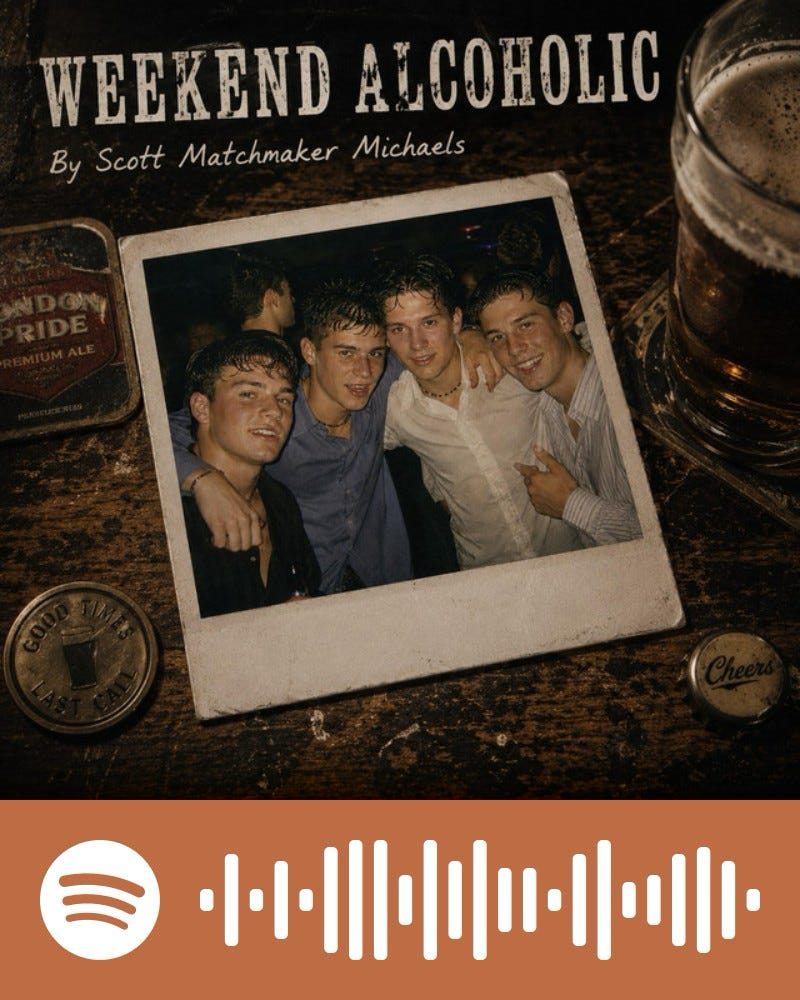
I also wrote Weekend Alcoholic.
That one comes from a different place.
Around the year 2000, when I was part of that culture, Britain had a different energy.
Work all week.
Escape all weekend.
Pubs.
Bars.
Clubs.
Music.
Chaos.
Bad decisions.
Great stories.
It was not all romantic.
Some of it was unhealthy.
Some of it was escapism.
Some of it was people trying to outrun pressure, boredom, debt, heartbreak, dead-end jobs, and the feeling that life had become a treadmill with lager on Friday as the only reward.
That is why this argument has to be honest.
Pubs were never perfect.
Alcohol can destroy lives.
Some pubs were rough.
Some families suffered because of drinking.
Ignoring that would be sentimental nonsense.
But destroying pubs is not the solution.
The answer is protecting what pubs do best.
Connection.
Community.
Belonging.
The problem was never the pub.
The problem was when the pub stopped being community and became pure consumption.
That distinction matters.
We Privatised Social Life
Modern Britain has quietly privatised social life.
Want to meet people?
Pay for a dating app.
Want community?
Pay for a gym.
Want networking?
Pay for an event.
Want confidence?
Pay for a coach.
Want mental health support?
Join a waiting list or download an app.
Everything has a subscription.
Everything has a funnel.
Everything has a brand strategy.
The pub was different.
You bought a drink and entered a living social network.
For many working-class people, it was one of the few affordable ways to stay connected.
This is why pub closures hit harder than the numbers suggest.
They remove low-cost social infrastructure.
Then society tries to rebuild it at ten times the price through government schemes and private platforms.
That is not progress.
That is bad accounting.
Marriage, Dating, And The Collapse Of Real-World Meeting
This is bigger than pubs.
Marriage and relationship formation are changing fast.
ONS figures show there were 231,949 marriages and civil partnerships in England and Wales in 2023, down 8.6% from 2022. (Office for National Statistics)
Live births in England and Wales fell to 585,396 in 2025, while the total fertility rate fell to 1.39 children per woman. (Office for National Statistics)
Of course, pubs are not the sole reason.
Housing costs matter.
Wages matter.
Work insecurity matters.
Childcare costs matter.
But social infrastructure matters too.
People cannot build families if they cannot even meet.
We have built a society where millions of men and women are technically available but socially unreachable.
That is not liberation.
That is isolation with better branding.
What Young Men Actually Need
Young men do not need more lectures.
They need places to go.
They need older men around them.
They need responsibility.
They need friendship.
They need football teams.
Music rooms.
Barbershops.
Boxing gyms.
Workshops.
Pubs.
Places with life in them.
Places where they can fail socially without being destroyed.
Places where women and men meet naturally.
Places where generations mix.
Places where someone says:
“Get yourself out, lad.”
That sentence has probably saved more men than half the campaigns ever written.
We did not raise weak men.
We removed the places where strength was built.
Final Word
The pub was never just somewhere to buy a drink.
It was where young men learned confidence.
Where women and men met naturally.
Where friendships were formed.
Where business ideas were born.
Where football was debated.
Where communities stayed connected.
Where life happened.
The tragedy is not only that Britain is losing pubs.
The tragedy is that we no longer understand what they were really for.
Britain keeps asking why young men are lonely.
Perhaps the better question is this:
Why did we spend thirty years closing the places where they learned confidence, friendship, courtship, resilience, humour, rejection, and belonging?
We did not create a generation of weak men.
We created a society with fewer places to become strong.