

When The People’s Club Entered The System
In 1991 an Everton ticket cost £26.50.
Adjusted for standard UK inflation, that figure would land far lower than where it stands today.
Instead it sits 151% above inflation.
That is not nostalgia.
That is arithmetic.
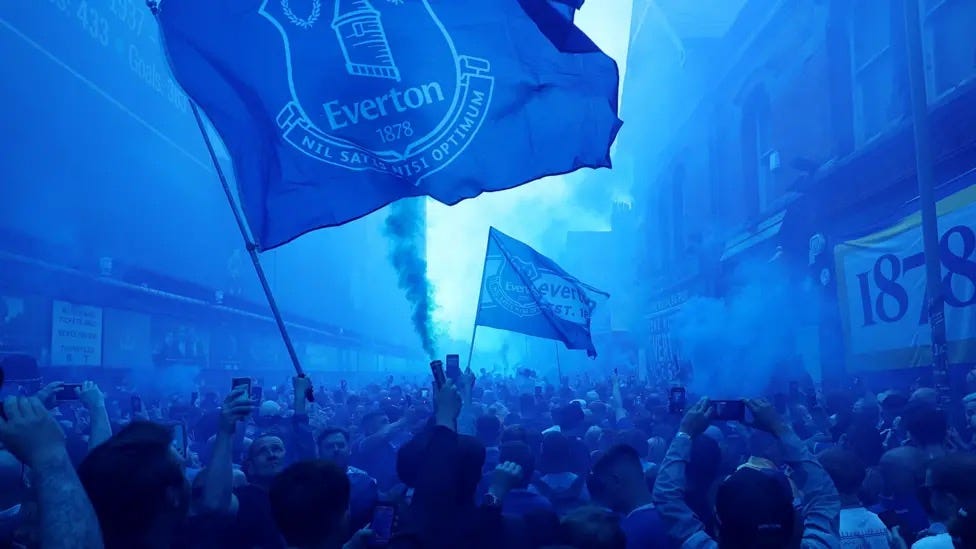
Everton were once known as the people’s club. Not as branding. As demographic reality. Dock workers. Families. Generational loyalty. I remember the Charity Shield in 1995. The stands felt like Liverpool itself. Raw. Local. Unfiltered. You did not need corporate access to belong.
I have spoken to players who lived it. Gavin McCann. Don Hutchinson. Peter Reid. They spoke about Goodison shaking. About being accountable to supporters. About feeling owned by the people in the stands.
They did not speak about yield.
Goodison was not just a stadium.
It was compression.
Tight stands. Close proximity. Affordable access. Generational inheritance. The architecture forced intimacy. It reinforced belonging. It rewarded loyalty over liquidity.
Goodison embodied a philosophy.
Then the philosophy changed.
The new stadium at Bramley Moore Dock is ambitious and impressive. It will be magnificent. But at this level, stadiums are not just homes. They are capital structures. They require financing, servicing and long term revenue certainty.
Everton pushed for public funding support to help deliver it. Regeneration. Civic uplift. Community benefit. That was the case presented.
Public money is not immoral.
But public money creates public obligation.
When taxpayer partnership helps build infrastructure, accessibility should sit at the centre of the model. Otherwise the moral symmetry weakens.
Then came large scale American ownership.
This is not about nationality. It is about incentive structure. Modern sports investment operates on return logic. It seeks valuation growth, revenue expansion and scalability.
Return requires yield.
Yield requires optimisation.
Optimisation does not measure sentiment.
It measures numbers.
Now the obvious counter argument.
Premier League survival is expensive. Wage inflation is relentless. Broadcast revenue drives competitive imbalance. If you do not grow income, you fall behind.
All true.
But here is the deeper question.
Must the cost of participating in that arms race always be transferred to the traditional supporter.
Because when ticket prices rise 151% above inflation, that is not simply survival pressure. That is incentive design.
The system does not sit in boardrooms plotting to remove loyal fans.
It does something more subtle.
It prioritises revenue per seat.
If a higher spending demographic produces greater yield, the model gradually tilts toward them.
Not maliciously.
Mechanically.
Through pricing structures.
Through hospitality expansion.
Through segmentation strategies.
Through market positioning.
The club does not need to declare a shift.
The economics perform the filtering.
Everton once defined themselves by contrast.
Liverpool became the global commercial machine.
Everton embodied local loyalty and working class identity.
They could have preserved that contrast. Renovated Goodison intelligently. Maintained intimacy. Protected affordability. Owned distinction instead of scale.
Instead they entered the same capital architecture.
And once inside that architecture, behaviour becomes predictable.
Premier League wages have risen far faster than average UK incomes over the past decades. Agent commissions have expanded. Transfer amortisation has ballooned. Infrastructure projects now operate at nine figure levels.
When costs rise structurally faster than supporter income, something must stretch.
Often it is the fan.
151% above inflation is not villainy.
It is the receipt for decades of escalation.
The demographic shift then happens quietly.
The supporter base evolves from inheritance to affordability.
The dock worker becomes occasional.
The generational season ticket holder feels strain.
The atmosphere adjusts.
This is not about whether Everton deserve ambition.
They do.
This is not about whether the new stadium will be extraordinary.
It will.
This is about alignment.
You cannot position yourself as the people’s club while operating entirely inside a capital optimisation model without tension.
You cannot lean on public partnership while ignoring pricing philosophy.
Public money builds the infrastructure.
Private capital seeks the upside.
The supporter absorbs the transition.
That is the equation modern elite football has normalised.
Everton are not uniquely guilty.
They are participants in a system that increasingly measures value in revenue curves rather than continuity of community.
Years ago I argued that clubs should retain structured commercial rights within player contracts to slow long term cost inflation and reduce external extraction. Build internal leverage. Protect sustainability before spectacle.
I was told that model was dead.
What replaced it was acceleration.
And acceleration compounds.
The system does not hate fans.
It simply does not prioritise them.
It prioritises growth.
And growth, left unchecked, reshapes culture.
When a club built on working class loyalty begins operating inside private equity logic, the badge does not change.
The incentives do.
And incentives always shape outcomes.
The next decade will determine whether Everton’s new home amplifies belonging or quietly redefines who can afford to belong.
Because once affordability drifts far enough, no architecture can buy it back.
Football belongs to people.
If it becomes primarily a capital vehicle, then belonging becomes conditional.
151% is not just pricing.
It is a signal.
And signals reveal where incentives point.