

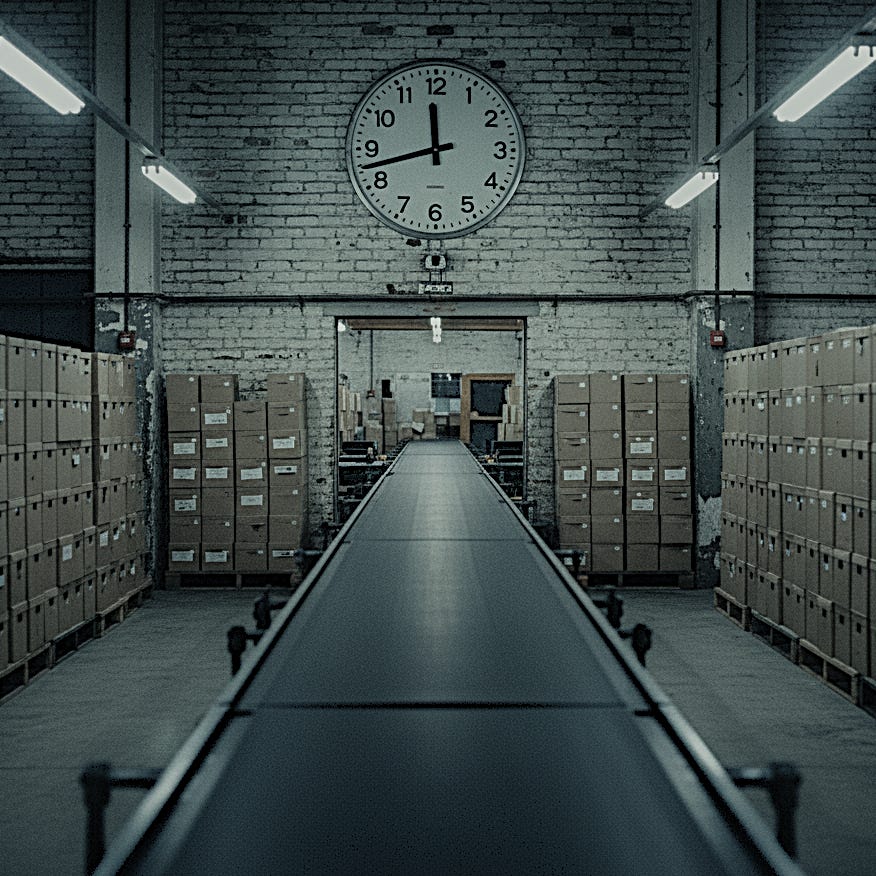
Episode Six Recap — When the Line Kept Moving
By the time Arty understood what had changed, nothing outwardly looked different.
The factory still ran. Orders still left on time. The machines worked faster than the men who had once defined the place. What arrived as improvement revealed itself slowly as something else — a system that no longer needed permission to continue.
Mick’s absence stopped feeling temporary. His space became efficient. Logical. Necessary.
Decisions began arriving already made. Suppliers changed without discussion. The rhythm of the factory moved ahead of conversation. Problems solved themselves before reaching Arty’s door.
For the first time since Footshape Boot Works began, the line ran without waiting for him.
He told himself that was success.
He told himself survival meant adapting.
But adaptation came with small compromises. A flaw allowed to pass because stopping the line cost more than fixing it. One pair among hundreds. Reasonable decisions made for reasonable reasons.
Each one easier than the last.
Ginger understood it instinctively. The world was changing whether anyone liked it or not. Systems replaced personalities because systems scaled. Sentiment slowed things down.
Arty didn’t argue.
Because the new world hadn’t forced its way in.
He had opened the door himself.
What Survives
Success arrived quietly.
At Footshape Boot Works it came as the absence of problems.
Deliveries stopped running late. Orders no longer gathered in corners waiting for decisions. The machine settled into rhythm, its sound becoming part of the factory’s natural noise. Urgency faded into predictability.
The numbers improved first.
Waste reduced. Margins tightened. Clubs returned with larger orders. New enquiries arrived from places that had never called before.
Efficiency, Ginger called it.
The word spread easily because it sounded sensible. Necessary.
Men went home on time. Pay arrived regularly. Suppliers stopped chasing invoices.
From the outside, Footshape looked stronger than it ever had.
That was what made it difficult to question.
Arty watched the change the way a man watches weather shift. Slowly enough that resistance felt unnecessary. Each improvement solved a problem he remembered fighting only months earlier.
He should have felt relief.
Instead he found himself upstairs more often, looking down at the floor rather than standing on it. Reports replaced conversations. Decisions arrived already processed.
The factory no longer needed guiding.
It only needed continuing.
The visit came on a grey afternoon.
Ginger mentioned it casually.
“Got someone coming through.”
Arty heard the noise before he saw the cars. Voices outside the gates. Camera shutters snapping. Laughter that didn’t belong to the place.
There were people gathered on the pavement. Mostly young women, waiting. Calling out when the car door opened.
George Best stepped out smiling, the attention moving with him. Photographers walked backwards to keep him in frame. Someone shouted his name.
Inside, the machines kept running.
The doors closed and the noise disappeared.
Best picked up a finished boot, turning it in his hands.
“Light,” he said.
He asked how many pairs could be made in a week.
Not how they were made.
How many.
Mark McCormack watched the line instead of the boots. Watching pace. Watching volume. Watching how easily the work moved forward without interruption.
Football was changing, he said later. Players travelled now. Names travelled with them. Attention followed.
Consistency mattered.
Supply mattered.
Reliability.
The language sounded familiar.
After they left, the factory felt smaller somehow. Not physically. Just part of something larger now.
The line never slowed.
The call came weeks later.
Late afternoon. The floor beginning to quieten.
“Bill Shankly here.”
The voice was direct, warm without softness. Don Revie had mentioned the boots. Said the work was honest. Players trusted them.
“At Liverpool,” Shankly said, “we’ve a boot room full of men who care about details. They like what you’re doing.”
He spoke about standards. About small advantages. About doing things properly without fuss.
He mentioned Jock Stein. Matt Busby. Conversations between managers about things that mattered over seasons rather than matches.
Bob Paisley, he said, was particularly fond of the boots.
“We’ll get something sorted,” Shankly said. “Nothing complicated.”
The call ended simply.
Years earlier it would have meant everything.
Now it felt like confirmation.
Behind him, the line continued moving.
Orders increased again after that.
Larger quantities. Shorter timelines. Expectations built around reliability rather than individuality.
The factory absorbed it without effort.
Nothing strained. Nothing broke.
As if it had been waiting for this version of itself all along.
During an inspection near the loading bay, Arty opened a box at random.
The boot inside was good. Strong leather. Clean stitching. Identical to the rest.
Too identical.
He turned it in his hands, searching for something familiar.
There was nothing.
Just consistency.
Across the floor, Ginger spoke quietly with one of the younger lads. The conversation brief. Efficient. Already finished.
The lad nodded and returned to work.
The line moved on.
Arty closed the box.
Michelle noticed before he admitted it.
He stayed later now, but his hands stayed clean. Paper replaced leather. Conversations shortened when he walked the floor.
One evening she found him watching the machines.
“You don’t look happy,” she said.
“I’m not unhappy.”
“That’s not the same thing.”
Below them, the line moved steadily.
After a moment she said quietly, “You used to know everyone’s name.”
He watched the work instead of answering.
The changes continued because nothing stopped them.
Another older worker left. Retirement, officially. His bench filled before the week ended.
The factory didn’t slow.
Once, every departure had left a gap. Now the gaps closed immediately.
Efficiency again.
One afternoon a young worker stopped Arty on the floor.
“How did Mick used to do this cut?”
Arty looked at the leather.
He remembered exactly. Slower. Done by feel.
The old way.
Behind him the press cycled again.
“Like this now,” Arty said, showing the quicker method.
The lad nodded and carried on.
The cut was clean. Faster.
Only afterwards did Arty realise he hadn’t even considered explaining the old way.
The thought passed.
The line didn’t stop.
Football changed too.
Players talked less about feel and more about consistency. Clubs wanted reliability. Identical pairs delivered on schedule.
Footshape fit the moment perfectly.
That should have felt like success.
Instead it felt inevitable.
The factory grew quieter over time.
Not physically. The machines were louder than ever. But conversation faded. Breaks shortened. Work flowed continuously.
The rhythm belonged to production now.
Not people.
One evening, long after everyone had gone home, Arty walked the floor alone.
Rows of finished boots lined the shelves, identical in shape and colour. Ready to leave.
He picked one up.
The leather was strong. The stitching exact.
Good work.
He set it back down.
The next morning the line started again without hesitation.
Orders moved through the factory with quiet precision. Problems resolved themselves before becoming visible.
Ginger nodded once as deliveries left the yard.
Michelle watched from the doorway, saying nothing.
Arty stood at the edge of the floor, listening to the rhythm he had once set himself.
The work no longer needed guiding.
It simply continued.
The machines ran smoothly.
The boots moved forward, identical, reliable, finished.
Arty waited for the feeling he used to have when the work was right.
It didn’t come.
The line carried on anyway.
The End
Matchmakers Note:
Thank you for reading "The Boot." I truly appreciate your support. Your readership means the world to me.