

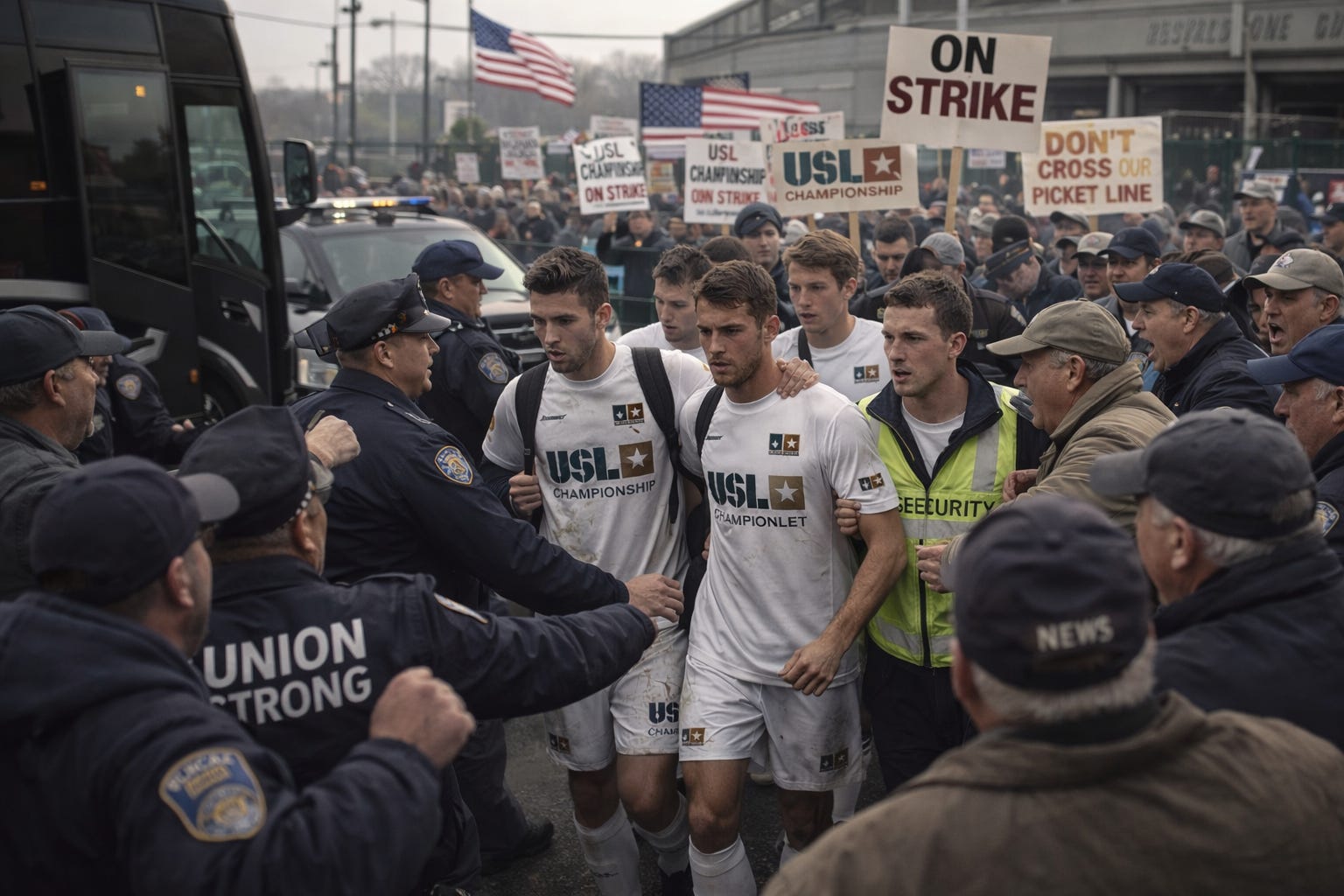
This week professional footballers in America received a document explaining how they could resign from their union, cross a picket line, and even be permanently replaced if they decide to strike.
Not from a factory.
From a professional football league.
The league involved is the United Soccer League, which operates the USL Championship, one of the main professional divisions in American football.
Players are represented by the USL Players Association, and negotiations over a new collective bargaining agreement have been dragging on for months.
The document sent to players reads like a legal FAQ.
Can you cross a picket line?
Yes.
Can you resign from the union?
Yes.
Can you still work if others strike?
Yes.
Can striking players be permanently replaced?
Also yes.
On paper it looks like neutral information.
But anyone who understands labour disputes knows exactly what it is designed to do.
Divide the dressing room before the fight even begins.
The Economics of the Dream
I’ve sat in football boardrooms negotiating contracts.
I’ve represented players.
And one truth becomes obvious when you see the industry from the inside.
Much of professional football — particularly outside the elite — quietly runs on cheap labour chasing a dream.
Young players accept low wages because the alternative is walking away from the game they have spent their entire lives pursuing.
They tolerate instability because the next contract might change everything.
The system understands this.
And it quietly depends on it.
The Reality Most Fans Never See
Many players in the second tier of American football earn salaries that would surprise supporters.
Some earn around $30,000 to $40,000 a year.
That’s not superstar money.
That’s survival money.
Because of that reality, many players take second jobs.
Sales roles.
Personal training.
Coaching.
Some even work in accounting or office jobs during the offseason simply to make ends meet.
These are professional athletes playing in front of crowds, travelling across a continent, and performing at a high level.
Yet financially many live closer to ordinary working life than the glamorous image fans associate with professional sport.
The $25 Million Contradiction
Now consider this.
To launch a club in the USL Championship, ownership groups reportedly pay franchise fees of around $25 million.
Think about that contrast.
Millions to enter the league.
Yet many of the players performing on the pitch still need second jobs.
Modern football loves to talk about growth.
But growth built on cheap labour isn’t progress.
It’s simply a business model.
When Players Push Back
When players try to organise for better conditions, football suddenly looks less like a romantic sport and more like a conventional industry.
Careers become leverage.
Contracts become pressure points.
Replacement workers become an option.
That’s when the language of community and opportunity disappears.
Because when serious money is involved, football behaves exactly like any other business.
Why This Matters to Fans
Supporters often think labour disputes are internal arguments between players and leagues.
They aren’t.
They reveal the values of the sport.
Football rests on three pillars.
Players.
Fans.
Communities.
If one of those pillars is treated as disposable, the entire structure eventually weakens.
Fans don’t fall in love with spreadsheets.
They fall in love with players.
The personalities.
The stories.
The moments that make the game unforgettable.
When the people creating those moments are treated as replaceable labour, something essential about football begins to fade.
Football’s Biggest Myth
Football’s biggest myth is that it is simply a business like any other.
It isn’t.
If it were, fans wouldn’t care so deeply.
Football survives because people believe it stands for something more than money.
Community.
Identity.
Dreams.
The question now is simple.
In the rush to grow the game, have the people running football forgotten the people who actually play it?
Because if they have, the sport risks losing the very thing that made it powerful in the first place.
Its soul.