

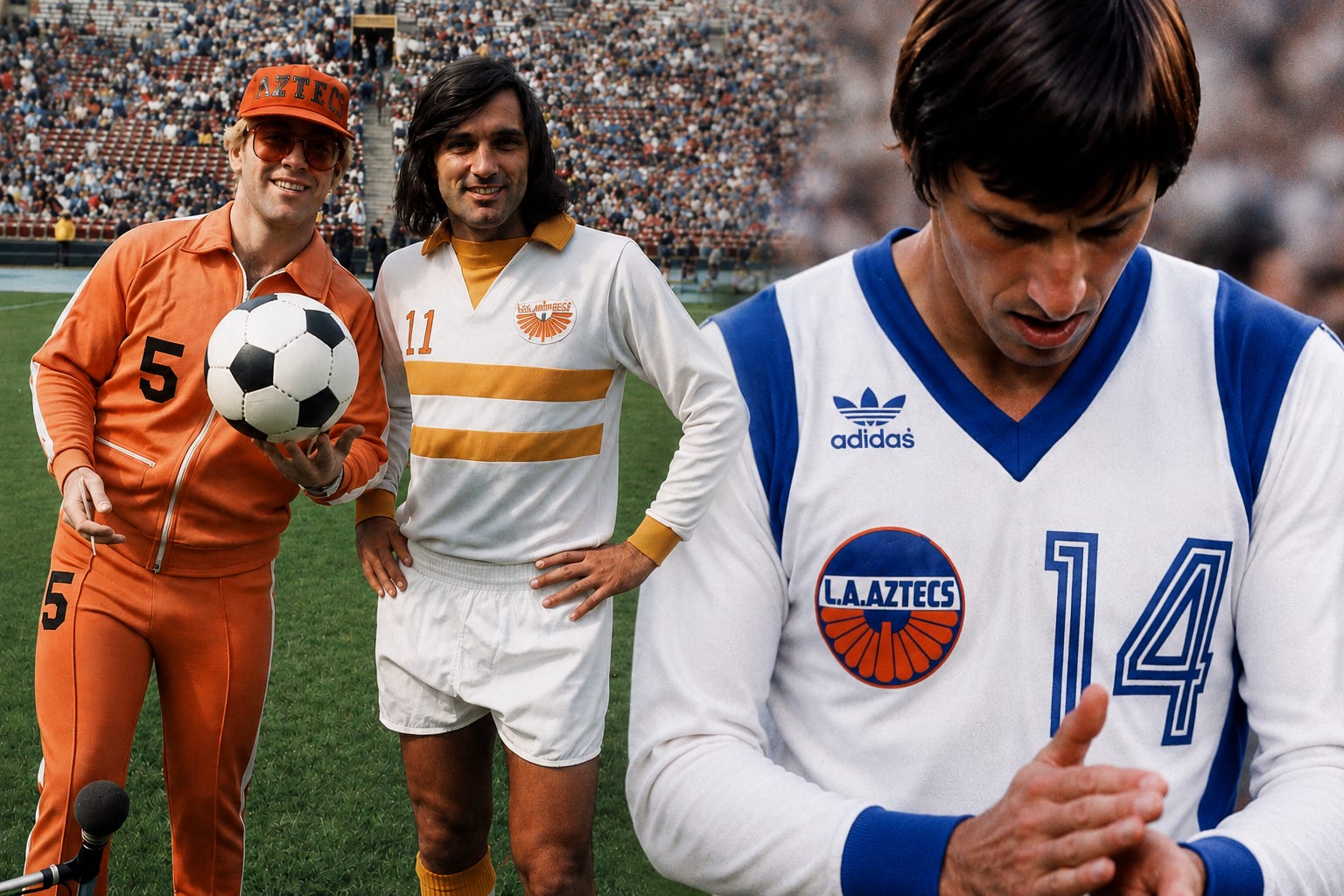
The LA Aztecs revival is live on Wefunder.
Like most football projects, the obvious path seems simple.
Raise money.
Run adverts.
Find investors.
Build the club.
That is how football is supposed to work.
At least that is what I thought.
But over the past few weeks I have found myself wrestling with a question that will not leave me alone.
Do I need more shareholders?
Or do I need more fans?
Because those are not always the same thing.
Anyone can buy a share certificate.
Anyone can invest a few dollars online.
But very few people will wear the shirt.
Bring a friend.
Travel to a game.
Volunteer their time.
Promote the club for free.
Defend it when things go wrong.
Help build something before anyone else believes in it.
That is what supporters do.
And football clubs are built by supporters.
Not just investors.
Before anyone gets angry, I am not saying investors do not matter.
Of course they do.
Every football club needs capital.
The question is whether capital should come first.
Or community.
Because the more I think about it, the more I wonder whether modern football has got the order backwards.
The LA Aztecs are not a blank badge.
This is a club that once had George Best.
A club that once had Johan Cruyff.
A club that represented imagination, ambition and possibility.
But history does not bring a football club back to life.
People do.
A badge is just a badge until a community decides it means something.
And that brings me to the problem.
I could spend more money on advertising.
I could hire agencies.
I could focus entirely on raising investment.
I could probably speed up the fundraising process.
But if I cannot convince 1,000 people to genuinely care about the idea, what exactly am I building?
A football club?
Or a financial vehicle?
That question has been bothering me.
Because I do not think football’s biggest problem is money.
I think football’s biggest problem is belonging.
Modern football has become incredibly good at creating customers.
We sell memberships.
We sell subscriptions.
We sell hospitality.
We sell merchandise.
We sell streaming packages.
We sell sponsorships.
But somewhere along the way many clubs stopped asking a simple question.
How do we make supporters feel like this is theirs?
Not legally.
Emotionally.
That is where my thinking has started to change.
Maybe the real question is not shareholders or supporters.
Maybe the real question is whether supporters can become owners without turning the club into just another financial product.
Not Wall Street owners.
Not passive investors.
Fan-owners.
People with skin in the game who stay when things get difficult, care when nobody is watching, and help build something that lasts.
Not because they have to.
Because they want to.
What if those people became the Founding 1,000?
What if those supporters helped create a Supporters Trust that held a meaningful stake in the club on behalf of the fan community?
Not because ownership is some magic solution.
And not because I want to create a clever legal structure.
In truth, I think the ownership part may be the least important part.
The community is the important part.
The ownership simply proves the community matters.
Those supporters could still invest through Wefunder if they wanted to.
The two ideas are not in conflict.
In fact, they strengthen each other.
Because the strongest football clubs in the world do not just have investors.
They have tribes.
People who feel connected to something bigger than themselves.
People who do not just consume.
People who contribute.
Maybe I am overthinking this.
Maybe supporters do not care about ownership.
Maybe they only care about winning.
Or maybe football has spent so long treating supporters like customers that we have forgotten what genuine belonging looks like.
I do not know.
That is why I am asking.
If you were building the LA Aztecs from scratch, would you rather inherit a club with a millionaire owner?
Or help build one alongside 1,000 other supporters?
Let me know in the comments.
Because before we build a football club, we need to find out whether a community wants to build one with us.