

Before the police investigate, the internet investigates.
Before a jury hears evidence, social media hears rumours.
Before a verdict arrives, a sentence has often already been handed down.
That is where we are now.
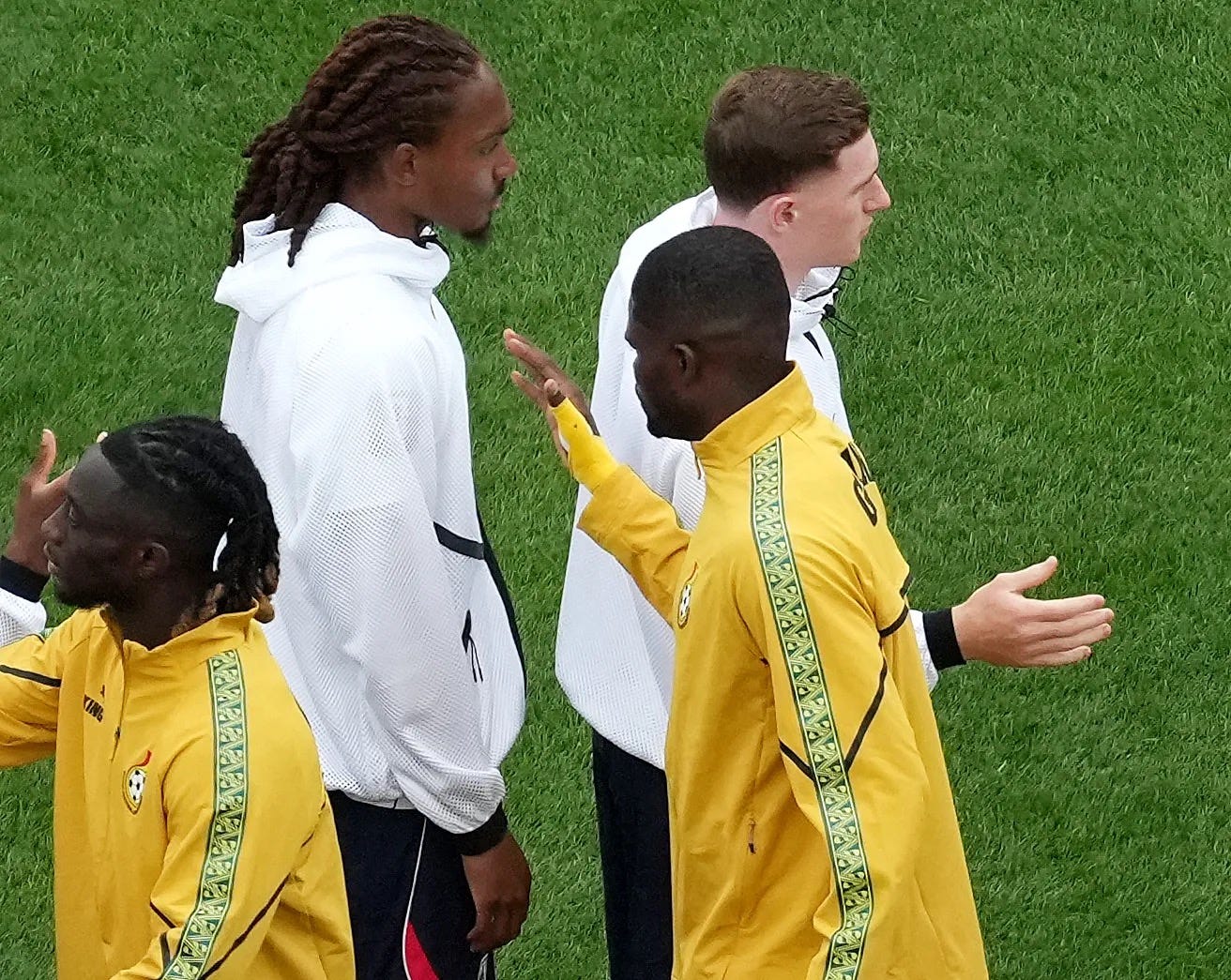
One clip. One handshake. One footballer appears to avoid another before kick-off.
Within minutes, the public courtroom opens.
Some call it courage. Some call it disrespect. Some call it justice. Some call it prejudice.
Nobody knows exactly what was in his head.
But everyone knows what they want it to mean.
That is the modern sickness.
We do not wait for facts anymore. We choose a side, then build the argument backwards.
Football loves certainty.
Hero.
Villain.
Winner.
Loser.
Social media loves certainty even more.
Guilty.
Innocent.
Good man.
Bad man.
But real life is rarely that clean.
The law in England says a person is innocent until proven guilty.
That principle matters. Not because every accused person is innocent. Not because every allegation is false. But because the alternative is barbaric.
The alternative is guilt by accusation.
The alternative is punishment by headline.
The alternative is mob rule with better Wi-Fi.
And yet culturally, we often behave as if the opposite is true.
The moment an allegation becomes public, the punishment begins. Employers panic. Sponsors panic. Fans panic. Clubs panic. The headline becomes the sentence. The charge becomes the conviction. The accused is expected to prove innocence long before a court has tested the evidence.
That should worry anyone who cares about fairness.
But here is where the argument often gets lazy.
Institutions cannot always do nothing.
If a school, a football club, a hospital, a business or a safeguarding body receives a serious and credible allegation, it may have a duty to act before a trial. That is not mob justice. That is risk management. It is also basic protection for potential victims, colleagues, children, staff and the wider public.
The real question is not whether institutions should act.
The question is how.
There is a difference between administrative safeguarding and cultural execution.
Suspension on full pay while facts are checked is one thing. Quietly moving someone away from a sensitive environment while an investigation takes place is one thing. Preserving evidence, protecting complainants and preventing further risk is one thing.
Public condemnation is another.
Tearing down posters is another.
Briefing against someone is another.
Ripping up contracts before evidence is tested is another.
Allowing sponsors, headlines and hashtags to become judge, jury and executioner is another.
Safeguarding is a necessity.
Public erasure is a choice.
A society can protect its people without sacrificing its soul to the crowd.
That is the agonising middle ground.
And adults should be capable of standing in it.
There is another truth too.
Presumption of innocence is a legal principle.
It is not a friendship contract.
It does not force trust. It does not force warmth. It does not force respect.
And it does not force a handshake.
A court can decide guilt.
A court cannot manufacture conscience.
That is why this debate is difficult.
And it should be difficult.
Because two serious principles are colliding.
Due process matters.
Personal conscience matters.
Victims deserve to be heard.
The accused deserve a fair hearing.
These things are not contradictions. They are the foundations of a society that has not completely lost its mind.
Football has been here before.
Wayne Bridge refusing to shake John Terry’s hand was about private betrayal dragged into public theatre.
Anton Ferdinand refusing to shake John Terry’s hand belonged to a different moral universe. That was not just dressing-room drama. It sat inside a wider argument about racism, power, credibility and whether football’s rituals of respect mean anything when the underlying issue is unresolved.
Those two examples are not the same.
That is the point.
The handshake line is asked to carry everything: personal betrayal, racism allegations, disciplinary disputes, political arguments, criminal allegations and the private conscience of men standing under cameras.
It is an absurd amount of moral weight to place on a five-second ritual before kick-off.
The handshake line is treated as a symbol of unity.
In reality, it is a performance.
A ritual.
A public display that everything is normal.
But sometimes everything is not normal.
Sometimes there is anger, hurt, doubt and uncertainty sitting inside that line of players.
Football does not know what to do with uncertainty.
So it pretends.
Two lines of players. Hands out. Cameras rolling. Respect performed. Game begins.
But then someone keeps his hand down.
And suddenly the whole machine looks uncomfortable.
Good.
Maybe it should.
Because the handshake line was built for sport. It was not built for unresolved moral conflict. It was not built for allegations. It was not built for trauma. It was not built for legal uncertainty.
It was built for television.
And sometimes real life walks straight through the television script.
The most dangerous people in this debate are the ones who pretend it is simple.
It is not.
If you say allegations should always be ignored until conviction, you are ignoring the reality that many victims never get justice. Many never report. Many are not believed. Many are destroyed by the process.
That matters.
But if you say accusation alone is enough to condemn a person, you are destroying the very idea of justice.
That matters too.
A serious society must be able to hold both truths.
Sexual violence is real.
False accusation is real.
Institutional failure is real.
Trial by social media is real.
None of these facts cancels out the others.
That is the bit our culture has lost.
We no longer want complexity. We want slogans. We want easy villains. We want moral certainty served hot in thirty seconds.
But justice is slow for a reason.
We built courts because human beings are terrible at being impartial.
We built rules because crowds get drunk on certainty.
We built due process because outrage is not evidence.
And this matters beyond football.
A Premier League footballer may lose a sponsor, but he still has money, lawyers, agents and a wall of professionals around him.
An ordinary person does not.
A schoolteacher accused online does not retreat behind a PR machine. They lose their classroom, their reputation, their mortgage application, their friends at the school gate and the name they spent twenty years building.
A builder does not have a media team. He has a van, a phone number and local trust. Once that trust is poisoned, work disappears.
A nurse does not have sponsors to lose. She has a vocation, a registration, a rota and a community that now whispers.
The algorithm does not care about the scale of the collateral damage.
Only the speed of the clicks.
The footballer loses a sponsor.
The schoolteacher loses their life’s work.
That is why this cannot be treated as just another football talking point.
The law may say innocent until proven guilty.
But the internet often says prove you are innocent.
Those are not the same thing.
One protects justice.
The other feeds the crowd.
A handshake does not prove guilt.
A handshake does not prove innocence.
Refusing one does not make someone a hero.
Offering one does not make someone a coward.
It is a gesture. A line. A choice.
People are free to criticise that choice.
But they should be honest about what they are criticising.
They are not defending due process by demanding compulsory warmth.
They are demanding performance.
They are demanding the picture looks normal even when the situation is anything but normal.
Maybe the fairest position is this.
Nobody should be convicted by gesture.
Nobody should be forced to perform respect.
Allegations should be treated seriously.
Evidence should be tested properly.
Victims should not be mocked.
The accused should not be tried by hashtags.
Institutions should safeguard without grandstanding.
Clubs should protect without performing moral theatre.
Sponsors should not be allowed to become courts.
And sometimes, when the facts are not clear, the most honest sentence in the English language is:
I do not know.
We should use it more.
Football wants certainty.
Social media wants certainty.
Life rarely gives it.
And if we cannot live with uncertainty, we will keep mistaking noise for truth.
We will keep turning handshakes into verdicts.
We will keep turning allegations into entertainment.
We will keep pretending justice is easy.
It is not.
That is why it matters.
Not because of one handshake.
But because of what the reaction reveals about us.
The law says innocent until proven guilty.
The internet says prove you are innocent.
One is justice.
The other is a mob in a smart jacket.
And if we forget the difference, none of us are safe.