

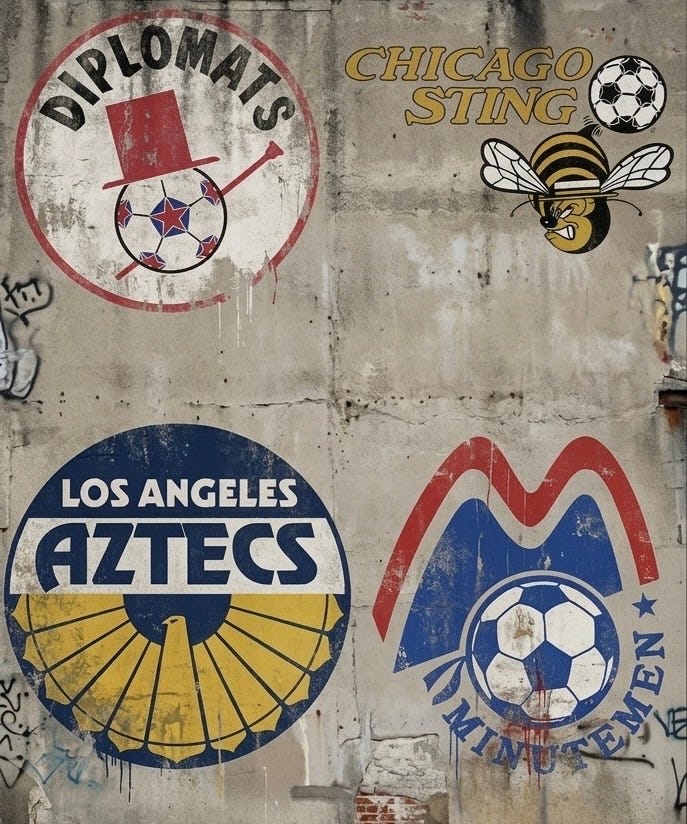
For nearly four years these clubs were trapped inside bureaucracy.
Their trademarks sat inside the United States Patent and Trademark Office with no progress and no explanation.
Eventually the situation had to be forced forward through federal court service simply to make the process move.
And now, after years of delay…
Four historic clubs from American soccer history are coming back.
Los Angeles Aztecs
Washington Diplomats
Chicago Sting
Boston Minutemen
These are not brands invented in a marketing meeting.
These are real football clubs that helped build professional soccer in the United States decades ago.
Clubs that once brought global legends to American stadiums.
Clubs that carried identity, personality and football culture.
And like many things in modern football, they disappeared when the game lost its way.
But football history has a strange habit.
The stories people try to bury are often the ones that refuse to die.
The Fight to Bring Them Back
For nearly four years the revival of these clubs stalled.
Trademark filings sat dormant.
No movement.
No explanation.
Just silence.
Anyone who has worked with intellectual property systems knows how easily ideas can disappear inside bureaucracy.
Eventually the only option left was escalation.
Federal court service had to be initiated simply to force the process forward.
But what kept the project alive during that time was the reaction from football supporters.
Hundreds of people backed a petition calling for these historic clubs to return.
Supporters shared the campaign.
Fans sent messages.
People from across the football world said the same thing.
Football history matters.
Those names still mean something.
And they deserve another chapter.
The Era That Built American Soccer
Before franchise soccer dominated the landscape, the United States experienced a remarkable period of football ambition.
During the 1970s and early 1980s professional clubs appeared across the country and began attracting international stars.
Cities like Los Angeles, Chicago, Washington and Boston suddenly found themselves hosting some of the most recognisable footballers in the world.
It was bold.
It was experimental.
But above all it was alive.
Football had personality.
And the clubs that carried that spirit are the ones whose names people still echo decades later.
Los Angeles Aztecs
Hollywood’s Championship Club
The Los Angeles Aztecs arrived in 1974 and immediately made history.
In their first season the club won the American soccer championship.
Expansion teams rarely win titles in their debut year.
The Aztecs did.
The title-winning side featured players including Doug McMillan, Uri Banhoffer, Tony Douglas, and Luis Marotte, who helped drive the team to the championship.
Later the club became one of the glamour names of American soccer.
George Best, the Manchester United legend and one of football’s most charismatic players, joined the club in 1976 and electrified crowds across the country.
A few years later Johan Cruyff, one of the most influential footballers in history, also played for the Aztecs and was named league MVP in 1979.
Long before Los Angeles became a modern soccer capital, the Aztecs helped put the city on the football map.
Washington Diplomats
Football in the American Capital
The Washington Diplomats represented the nation’s capital during one of the most fascinating chapters in American soccer history.
The club played at RFK Stadium, where crowds gathered to watch professional football in the heart of Washington D.C.
Their most famous signing was Johan Cruyff, who joined the team in 1980.
Cruyff was not simply a superstar.
He was one of the architects of modern football thinking.
Watching him play in Washington introduced American audiences to a completely different level of football intelligence.
The Diplomats also featured respected European figures such as Wim Jansen and Guus Hiddink, both of whom later became major figures in world football.
For a time one of the greatest football minds the game has ever produced was orchestrating matches in the American capital.
Chicago Sting
Champions of the Midwest
If Los Angeles represented glamour, Chicago represented winning.
The Chicago Sting became one of the most successful clubs in American soccer history.
They won the national championship twice.
First in 1981, defeating the powerful New York Cosmos.
Then again in 1984, during the final years of that remarkable era.
Few clubs managed to win two championships during that time.
The Sting built their success around players including:
Karl-Heinz Granitza
Arno Steffenhagen
Pato Margetic
Ingo Peter
Frantz Mathieu
Rudy Glenn
Granitza became one of the most prolific goal scorers in American soccer history.
The 1984 title side also featured Seninho, Victor Nogueira, Mark Simanton, and Victor Kodelja.
Chicago built a passionate football culture around the Sting with matches played at venues including Soldier Field and Wrigley Field.
Boston Minutemen
New England’s Football Pioneers
The Boston Minutemen carried a name rooted in American history.
The “Minutemen” were the colonial militia who fought in the opening battles of the American Revolution.
The symbolism was deliberate.
The club connected football with the identity and heritage of New England.
During their time in American soccer the Minutemen attracted international stars.
Most famously Eusébio, one of the greatest forwards the game has ever produced.
Eusébio won the Ballon d’Or in 1965 and finished as top scorer of the 1966 World Cup, becoming one of the most iconic figures in football history.
The club also featured players such as Shep Messing and António Simões, adding further international pedigree.
For fans in New England, seeing players of that calibre competing in their region was extraordinary.
The Noise Online
Since announcing these revivals there has been the predictable noise online.
A few people trolling the idea.
Most of them have absolutely no idea about the history they are talking about.
They assume this is about competing with US Soccer.
It isn’t.
This is about something bigger.
This is about American soccer.
A football culture that existed long before the modern franchise model took control of the game.
The goal isn’t to compete with that system.
The goal is to build something that eclipses it.
Something more authentic.
Something supporters actually believe in.
The Problem With Franchise Soccer
Modern soccer in America made a fundamental mistake.
It replaced clubs with franchises.
Clubs grow from communities.
Franchises grow from investors.
Clubs belong to supporters.
Franchises belong to owners.
When football becomes a franchise system, identity slowly disappears.
Teams move cities.
Names change.
Supporters become customers.
That system may work for television deals.
But it does not build football culture.
A Different Model
The clubs returning today will be built on a different principle.
They will be fan-owned.
Not franchises.
Real football clubs where supporters have a genuine stake in the future of the team.
Because football was never meant to belong to investors.
It was meant to belong to the fans.
Building the National Soccer League
These clubs will form part of a new project.
A National Soccer League built as a football entertainment property owned by supporters.
The aim is simple.
Bring personality back to football.
Bring identity back to clubs.
Bring ownership back to supporters.
And make the game exciting again.
This league will not be built for franchise investors.
It will be built for the people who love football.
The Next Chapter
Football history is full of forgotten clubs.
But sometimes history refuses to stay forgotten.
The Los Angeles Aztecs
The Washington Diplomats
The Chicago Sting
The Boston Minutemen
Four clubs that helped build American soccer.
Four identities that still mean something.
And now they return.
Because football does not belong to corporations.
Football belongs to the people who care about it.
And this time…
the fans are taking it back.