

The Quiet Centralisation of Power, Profit, and Narrative
(By Matchmaker)
Football didn’t suddenly become commercial.
It was systematically re-engineered to be commercial.
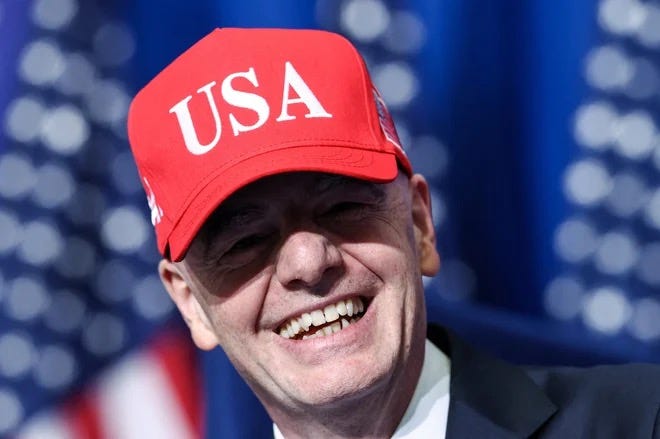
And at the centre of that transformation sits Gianni Infantino — a leader who doesn’t rule through chaos or scandal headlines, but through structure, diplomacy, and institutional consolidation inside FIFA.
Not loud power.
Quiet power.
The kind that reshapes the game while telling the world it’s “growing it.”
THE INFANTINO MODEL: CONTROL THE SYSTEM, NOT THE NOISE
Infantino rose during FIFA’s credibility crisis, promising reform and transparency.
What followed was not a collapse of power — but a refinement of it.
Instead of dramatic controversy, the modern era has been defined by:
-
Tournament expansion
-
Commercial scaling
-
political diplomacy
-
narrative management
-
centralised governance
This is not accidental leadership.
This is institutional engineering.
OVER-COMMERCIALISATION: WHEN THE WORLD CUP BECAME A PREMIUM PRODUCT
Let’s say the quiet part out loud.
The World Cup is no longer just a tournament.
It is a global commercial asset packaged in emotional branding.
Fans see:
-
Rising ticket costs
-
Corporate hospitality dominance
-
Sponsor saturation
-
tiered access experiences
While FIFA communicates:
Growth. Inclusion. Global unity.
But the lived fan reality increasingly feels like:
Pay more, travel further, consume more — or watch from home.
Hospitality packages, VIP ecosystems, and corporate-first allocation models signal a structural shift:
Football’s biggest event is being optimised for revenue extraction, not fan accessibility.
That is over-commercialisation by design, not by accident.
THE SMALL NATIONS PARADOX: “FOOTBALL FOR THE WORLD” VS FINANCIAL REALITY
FIFA’s messaging heavily leans on global development funding and support for emerging football nations.
On paper, that sounds noble.
In practice, the structural imbalance remains glaring:
-
Smaller federations still lack infrastructure
-
Grassroots systems remain underfunded
-
elite football wealth continues concentrating in top markets
Yes, development grants exist.
But grants are not the same as sustainable football ecosystems.
Here is the contradiction:
FIFA expands tournaments in the name of inclusivity, yet the commercial benefits disproportionately flow toward established markets, broadcasters, and sponsors.
Smaller nations gain participation.
The system gains monetisation scale.
That is a strategic trade-off rarely discussed openly.
HUMAN RIGHTS OPTICS: THE UNCOMFORTABLE SHADOW OF MEGA EVENTS
Modern FIFA governance cannot be analysed without addressing the human rights scrutiny tied to tournament hosting decisions.
Recent World Cups and future host strategies have faced:
-
Labour rights criticism
-
infrastructure ethics debates
-
governance transparency concerns
-
questions about the true social cost of mega events
FIFA’s response framework has typically focused on:
-
legacy narratives
-
development messaging
-
unity branding
But critics argue that ethical concerns are often treated as reputational risks to manage, rather than structural issues to fundamentally reform.
That perception gap erodes institutional trust, especially among younger fans who increasingly value ethics alongside sport.
THE POLITICAL DIPLOMACY STRATEGY (INCLUDING U.S. POWER ALIGNMENT)
Infantino’s visible engagement with global political leaders — including interactions with figures like Donald Trump during the 2026 World Cup cycle — reflects a calculated governance approach.
This is not random optics.
It is operational positioning.
Mega tournaments require:
-
Government security
-
infrastructure approval
-
regulatory alignment
-
political cooperation
However, the side effect is clear:
The head of world football increasingly appears as a geopolitical operator rather than a neutral sporting administrator.
And that shift changes how the institution is perceived globally.
FIFA CRYPTO, DIGITAL MONETISATION, AND THE FINANCIALISATION OF FANS
Now we enter the modern frontier.
Discussions around FIFA-linked crypto initiatives, fan tokens, and digital engagement economies reveal a deeper strategic direction:
Monetise the global fanbase beyond traditional sport consumption.
Not just:
-
tickets
-
merchandise
-
broadcasting
But digital financial ecosystems tied directly to fan identity.
To corporate strategists, this is innovation.
To traditional supporters, it raises a more existential question:
When fans become digital revenue streams, does the soul of the game get diluted?
Football was built on belonging.
Crypto-driven engagement risks reframing it as transactional participation.
STRUCTURAL RUTHLESSNESS (NOT PERSONAL DRAMA)
Let’s be intellectually precise.
There is no evidence of theatrical tyranny.
No cartoon villain leadership.
What exists instead is structural ruthlessness:
-
Expanding competitions to consolidate control
-
strengthening central governance influence
-
commercial scaling under unity messaging
-
diplomatic alignment with power centres
-
narrative framing that softens hard economic realities
That is far more effective — and far more durable — than loud controversy.
THE ORWELLIAN SHIFT: LANGUAGE VS REALITY
Modern football governance has mastered language.
“Development” can mean commercial expansion.
“Inclusion” can mean tournament scaling.
“Growth” can mean revenue optimisation.
The words sound virtuous.
The structures remain highly centralised.
This is where the Orwellian undertone emerges:
Not censorship.
Not propaganda.
But narrative framing that presents commercial evolution as moral progress.
FINAL VERDICT: THE ERA OF CORPORATE FOOTBALL GOVERNANCE
History will not judge the Infantino era by headlines alone.
It will judge it by structural outcomes.
Did football become more global?
Yes.
Did revenues grow exponentially?
Yes.
But the harder questions remain:
-
Did smaller nations truly gain sustainable power?
-
Did fans become more central, or more monetised?
-
Did governance become more transparent, or more sophisticated?
-
Did commercialisation outpace cultural preservation?
Under Infantino, FIFA has not lost control of football.
It has perfected institutional control over it.
The game still belongs to the fans emotionally.
But economically, structurally, and politically —
it is increasingly managed as a global corporate ecosystem.
And that is the real under-the-hood story most people are only just beginning to notice.