

Everyone talks about class.
Almost nobody tells the truth about it.
They say class is about accent. School. Clothes. Manners. Taste. The street you grew up on. The college you attended. The job title on your email signature. Whether you drink beer in a pub or wine in a kitchen with an island nobody really needed.
That is theatre.
Class is not theatre.
Class is power.
Class is ownership.
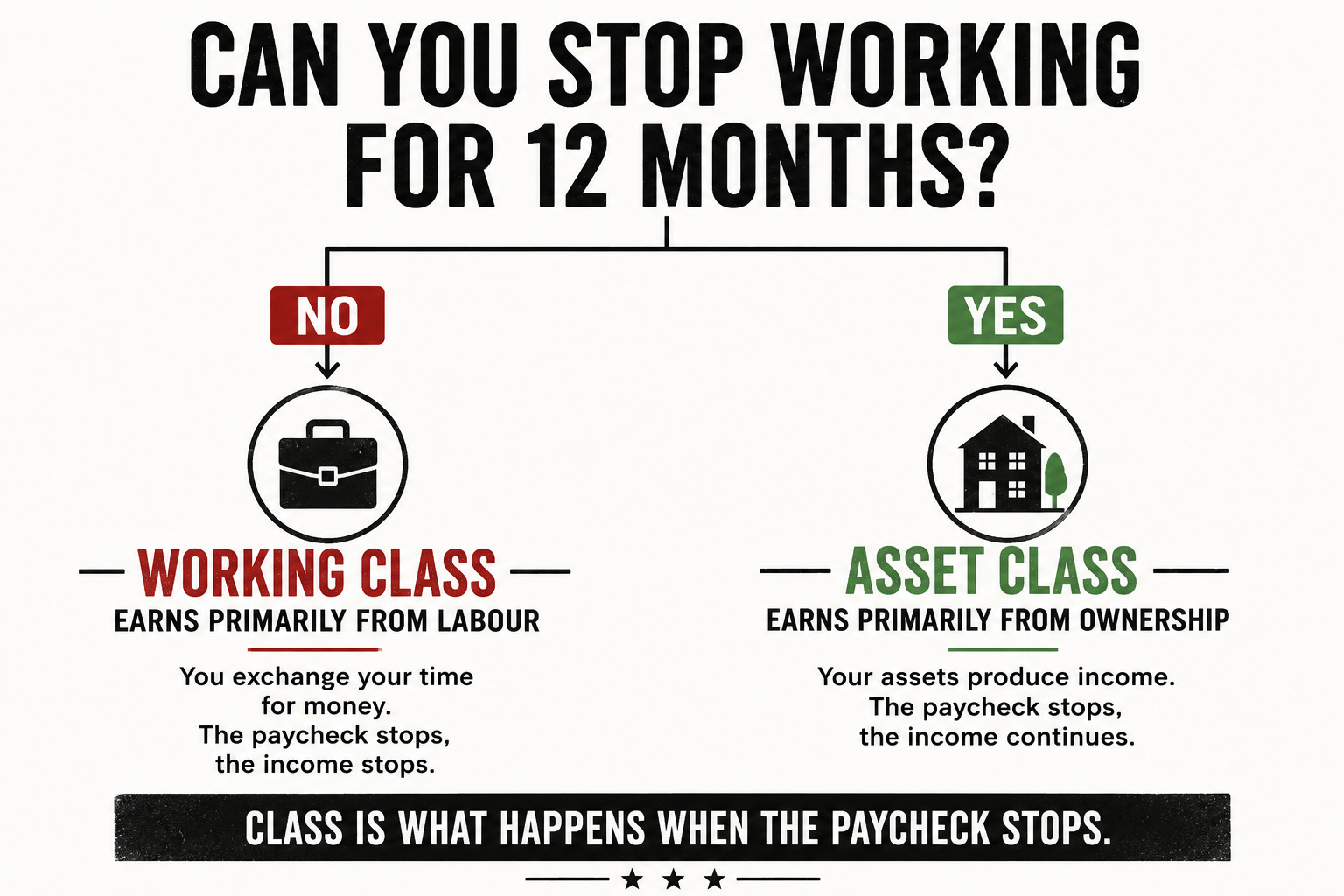
Class is what happens when the paycheck stops.
That is the test.
If you stop working tomorrow and fear walks through the front door, you are not free.
You may be educated. Comfortable. Well dressed. Respected in meetings. The sort of person who says “circle back” without being arrested.
But if the wage stops and the whole thing starts shaking, you are still dependent on work.
You are still selling your time to survive.
That is working class.
Not the cartoon version.
The real version.
The economic version.
The version nobody wants to admit.
Because if we said it out loud, millions of people in Britain and America would have to face something uncomfortable.
They are not owners.
They are earners.
That is the modern divide.
People who work for money.
And people whose money works for them.
The worker gets taxed before the money reaches the bank.
The owner borrows against assets.
The worker pays rent.
The owner collects rent.
The worker hopes wages rise.
The owner watches asset prices rise.
The worker is told to budget better.
The owner is called a wealth creator while everyone else pays the invoice.
That is the trick.
We convinced millions of people they had moved up because they had nicer jobs, nicer cars, nicer kitchens, nicer phones, nicer holidays, and nicer debt.
But debt is not wealth.
A financed car is not freedom.
A job title is not security.
A mortgage is not power if one bad year can take it away.
The old working class knew where they stood.
They worked in mines, factories, docks, farms, warehouses, building sites, garages, salons, shops, bars, restaurants, hospitals, schools, and workshops.
Their wealth was in their hands.
Their backs.
Their skills.
Their routines.
Their families.
Their communities.
They did not own much.
But they knew the score.
Now the score has been hidden under branding.
The new working class wears office clothes.
It uses laptops.
It sends emails.
It sits on Zoom calls.
It works in healthcare, education, media, logistics, finance, tech, hospitality, football, retail, care, trades, delivery, admin, and self-employment.
Some earn £25,000.
Some earn $250,000.
That difference matters.
But it does not change the deeper structure.
If your income depends mainly on your labour, you are an earner.
If your life depends mainly on assets, you are an owner.
That is the line.
Of course, income matters.
Opportunity matters.
Education matters.
Nobody serious is claiming a surgeon and a warehouse worker live the same life.
They do not.
One has more choices, more security, more status, and more protection.
But both still depend on selling labour.
One sells specialised labour at a higher price.
The other sells physical or operational labour at a lower price.
The underlying relationship remains the same.
The landlord with ten properties may earn less than the surgeon in a given year.
But the landlord owns the pipe.
The surgeon still carries the bucket.
That is class.
Not manners.
Not vowels.
Not whether you say football or soccer.
Ownership.
Control.
Leverage.
I have seen this up close.
I have sat with football people, investors, agents, barbers, founders, tradesmen, club owners, and fans. The accents changed. The shoes changed. The rooms changed. But the fear often did not.
A man in a suit can be just as trapped as a man in work boots.
He may hide it better.
That is all.
This is why so many people feel poorer than they look.
They have the kitchen.
They have the car.
They have the subscriptions.
They have the family photos.
They have the professional profile.
They have the holiday pictures.
But underneath it all is fear.
The bills are real.
The childcare is real.
The mortgage is real.
The rent is real.
The healthcare bill in America is very real.
The student debt is real.
The credit card balance is real.
The anxiety is real.
When prices rise faster than wages, the mask slips.
People discover they were not wealthy.
They were just well-presented workers.
This has hit Britain hard.
It has hit America hard too.
Different flags.
Same machine.
Factories closed.
Towns hollowed out.
Housing became an investment product.
Education became expensive.
Healthcare became a trap in America.
Childcare became a second mortgage.
Secure jobs became contracts, gigs, side hustles, and “flexibility.”
Flexibility is a lovely word when you own the platform.
It is less lovely when you are waiting for the next shift.
But let’s not romanticise the solution.
The move from earner to owner is brutal.
It is easy to tell ordinary people to build assets.
It is much harder to explain how they are supposed to do that when the system eats the surplus before they ever see it.
Rent eats it.
Childcare eats it.
Healthcare eats it in America.
Energy bills eat it.
Food prices eat it.
Debt eats it.
The car payment eats it.
The emergency repair eats it.
The month eats it.
That is the catch.
You need spare capital to buy assets.
But modern life is designed to remove spare capital from working people.
So this cannot just be a lecture about mindset.
Mindset matters.
Discipline matters.
Financial education matters.
But no amount of motivational nonsense changes the fact that millions of people are trying to build ownership while standing on a treadmill that speeds up every year.
That is why the answer cannot only be individual.
It has to be structural.
More people need access to ownership at the point where value is created.
Employees should own shares in the companies they help build.
Fans should own pieces of the clubs they keep alive.
Communities should own local assets before outside investors turn them into extraction machines.
Workers should have routes into equity, profit share, cooperative ownership, and small business formation.
The first piece of leverage is the hardest.
That is the part polite society leaves out.
Once you own assets, the system helps you.
Before you own assets, the system invoices you.
That is why class is not just a personal finance problem.
It is a power problem.
Being proud of working-class roots is not enough.
Pride does not pay the gas bill.
Nostalgia does not build equity.
Anger does not compound.
The next working-class movement cannot only be about wages.
It has to be about ownership.
Home ownership.
Small business ownership.
Employee ownership.
Community ownership.
Fan ownership.
Local media ownership.
Intellectual property.
Tools.
Skills.
Shares.
Brands.
Platforms.
Land.
Things that cannot be taken away by a bad boss, a bad quarter, or a spreadsheet in a glass building.
The old dream was a fair wage for a fair day’s work.
That still matters.
But it is not enough anymore.
Because wages alone are losing against assets.
The people who own things are moving faster than the people who only work.
Working class is not failure.
It is not stupidity.
It is not shame.
Working class is the condition of having to work because you do not own enough to stop.
That includes millions who would never use the phrase.
Teachers.
Nurses.
Barbers.
Drivers.
Designers.
Junior lawyers.
Coaches.
Builders.
Police officers.
Care workers.
Office managers.
Freelancers.
Creators.
Small founders one bad quarter away from panic.
They are all closer to each other than they are to the asset class.
That is the uncomfortable truth.
The real divide is not lager versus wine.
It is not football versus theatre.
It is not accent versus pronunciation.
It is not the pub versus the private members’ club.
It is work versus ownership.
Once you see that, the world starts making sense.
Why housing feels broken.
Why young people feel locked out.
Why football clubs no longer feel like community institutions.
Why towns feel extracted.
Why politics feels fake.
Why corporations talk about purpose while squeezing wages.
Why people are angry but cannot always explain where to aim it.
The anger is not irrational.
It is often badly translated.
People know something has gone wrong.
They know hard work no longer guarantees security.
They know the ladder has been pulled up.
They know status is being sold as a substitute for ownership.
That is why the working-class conversation matters.
Not because we need more class war.
Because we need more class honesty.
The biggest lie of modern life is that status equals security.
It does not.
Ownership does.
Until ordinary people understand that, they will keep climbing ladders leaning against someone else’s wall.
And once they do understand it, the snobs should be worried.
Not because anyone is coming for revenge.
Because the mask is coming off.