

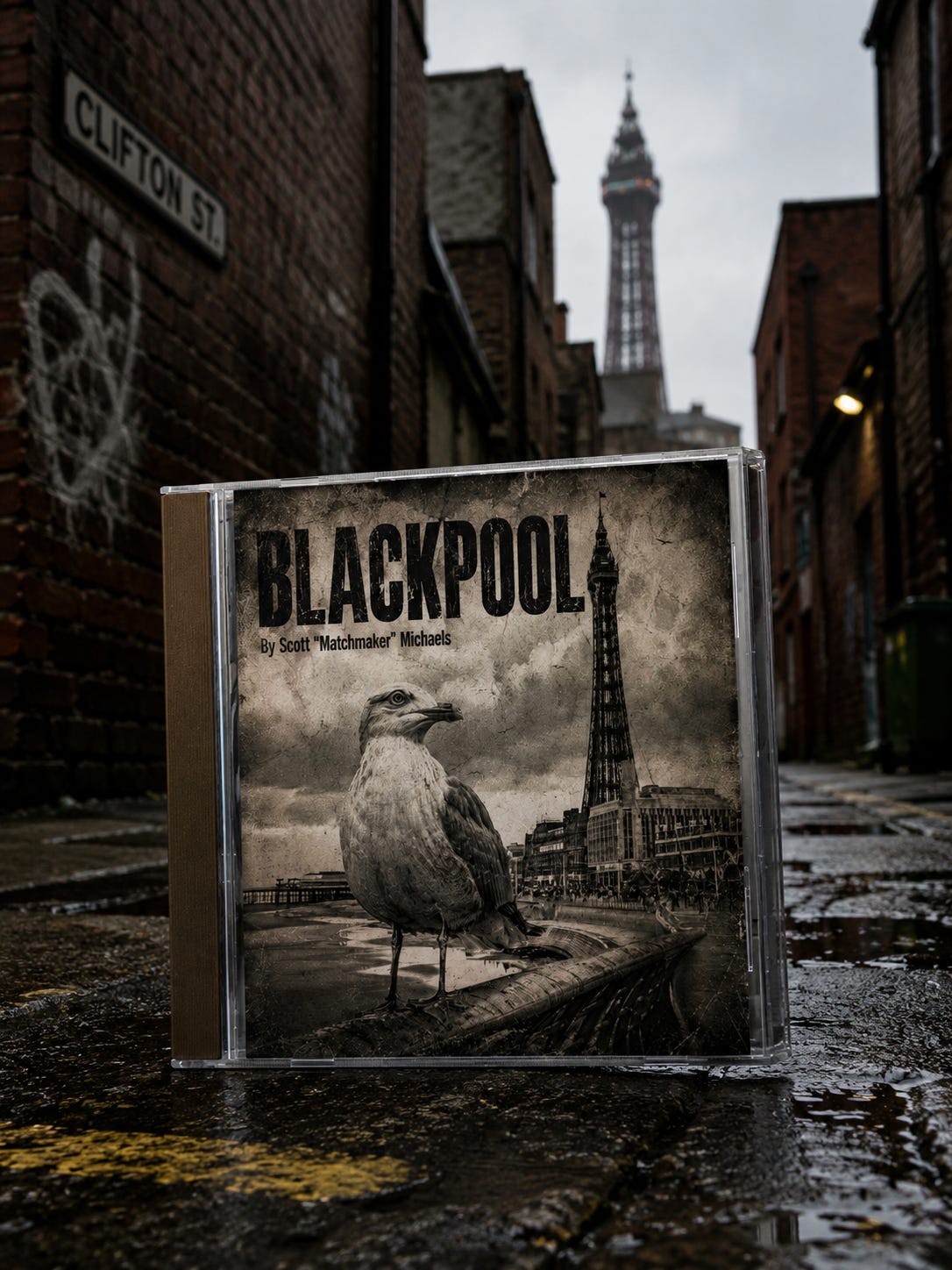
Blackpool does not need pity.
It needs respect.
I moved into the area in 2017 from Morecambe. Another seaside town. Another place with beauty, hardship, humour, pride, and people who have learned to survive when the rest of the country looks away.
When I came to Blackpool, I did not just see the Tower.
I saw the people.
I saw the pubs.
I saw the football clubs.
I saw the volunteers.
I saw skint people still putting tins into food banks.
I saw people with almost nothing still finding something to give.
That is why I wrote Blackpool.
Not because the town is perfect.
Because it is human.
The Town That Gave Britain Memories
Before cheap flights, package holidays and performative holidays for Instagram, Blackpool was Britain’s great escape.
Families came for Blackpool Tower.
They came for the Pleasure Beach.
They came for the Winter Gardens.
They came for the Grand Theatre.
They came for the three piers.
They came for the Illuminations.
They came for donkey rides, arcades, ballroom dancing, comedians, chips on the prom, sticks of rock, football weekends and one week away from the factory, the mill, the dock, the warehouse or the office.
Blackpool was not just a seaside town.
It was a working-class cathedral.
No stained glass.
Neon lights.
Sea air.
Pub carpets.
Fruit machines.
Wet pavements.
Laughter.
And the Tower standing above it all like a reminder that ordinary people deserve wonder too.
For generations, Blackpool gave working people something priceless.
Escape.
Then Britain Changed
The factories closed.
The mills went quiet.
The planes got cheaper.
Spain became affordable.
Investment moved elsewhere.
The crowds got smaller.
The headlines got uglier.
And slowly, the same country that once used Blackpool for its happiness started using Blackpool as a symbol of decline.
That never sat right with me.
Places do not decline because ordinary people stop caring.
They decline when opportunity leaves.
When industry leaves.
When money leaves.
When decision-makers take from a place for decades and then act shocked when the place starts to struggle.
Blackpool has problems.
Of course it does.
But Blackpool is not the problem.
It is a town carrying the consequences of decisions made far away from the promenade.
The Blackpool I Know
The Blackpool I know is not the lazy stereotype.
It is not just stag dos, cheap jokes and bad headlines.
The Blackpool I know has heart.
I have friends in the area.
I know people around Blackpool Football Club.
I know people around AFC Fylde.
I have drunk in the pubs.
I have socialised locally.
I have heard the conversations after matches, at bars, in cafés, around people who actually live the life instead of commenting on it from a distance.
Football tells you a lot about a place.
It shows loyalty.
It shows frustration.
It shows pride.
It shows who still turns up when things are going badly.
That is Blackpool.
It turns up.
Again and again.
The Empathy Nobody Talks About
Here is the thing outsiders often miss.
Blackpool has more empathy than almost anywhere I know.
Not soft empathy.
Hard-earned empathy.
The kind built from real life.
I have seen people who are struggling themselves still donate to food banks.
I have seen people with barely enough money for the week still help someone having an even worse one.
I have seen volunteers give their time when they could have easily said, “I have enough problems of my own.”
I have seen pensioners, parents, football people, pub landlords, small business owners and ordinary residents quietly step up.
No cameras.
No speeches.
No LinkedIn virtue-signalling circus.
Just people helping people.
That is the thing about hardship.
It can make some people bitter.
But in Blackpool, I have seen it make many people kinder.
When you know what struggle feels like, you recognise it in someone else.
You do not walk past it.
You stop.
You help.
That is the soul of the town.
The Landmarks Still Matter
Blackpool’s landmarks are not just tourist attractions.
They are memory machines.
The Tower is not just steel and history. It is childhood. It is first dates. It is family photos. It is proof that ordinary people once built something grand for ordinary people.
The Pleasure Beach is not just rollercoasters. It is screams, laughter, fear, candyfloss, queues, chaos and kids feeling like the world is massive.
The Winter Gardens is not just a venue. It is showbusiness, dance, politics, music, boxing, conferences, beauty, noise and working-class ambition under one roof.
The Illuminations are not just lights. They are proof that even when a town has been battered, it can still glow.
The piers are not just old structures stretching into the sea.
They are survivors.
Like the town itself.
Weathered.
Damaged in places.
Still standing.
Why The Seagull Is On The Cover
People laugh at seagulls.
They call them pests.
But a seagull survives everything.
Bad weather.
Rough seas.
Changing tides.
Cold mornings.
Empty beaches.
It adapts.
It fights.
It finds a way.
That is why the seagull belongs on this song.
Because Blackpool is a seagull town.
Loud.
Weather-beaten.
Misunderstood.
Impossible to ignore.
Still here.
Still hungry.
Still flying into the wind.
This Song Is Not About Pity
I did not write Blackpool as a charity appeal.
I wrote it as a salute.
A salute to the people who keep going.
The volunteers.
The families.
The football fans.
The bar staff.
The café owners.
The taxi drivers.
The carers.
The cleaners.
The musicians.
The teachers.
The parents.
The grafters.
The people who have been written off by society but still give more back to their community than many people with far more money.
That is the real story.
Blackpool’s greatest asset is not the Tower.
It is not the Pleasure Beach.
It is not the Illuminations.
It is the people.
The people who still care.
The people who still give.
The people who still laugh.
The people who still open the doors, pull the pints, run the clubs, coach the kids, volunteer at food banks, help their neighbours and keep the place alive.
Why I Wrote It Now
Because too many people talk about towns like Blackpool like they are finished.
They are not finished.
They are underfunded.
They are underestimated.
They are tired.
They are bruised.
But they are not finished.
There is a difference.
Blackpool still has what many richer places have lost.
Identity.
Humour.
Edge.
Empathy.
Soul.
You cannot fake that.
You cannot buy it with a regeneration grant or a glossy brochure.
It comes from people.
It comes from history.
It comes from pain.
It comes from pride.
The Point Of The Song
The song is my way of saying: look again.
Look past the headlines.
Look past the decline.
Look past the easy jokes.
Look at the Tower in the rain.
Look at the lights on the promenade.
Look at the old boys in the pubs.
Look at the volunteers at the food banks.
Look at the football supporters still turning up.
Look at the people who have every reason to give up but keep giving anyway.
That is Blackpool.
A town battered by the tide but still facing the sea.
A town mocked by outsiders but still full of people with more heart than places twice as wealthy.
A town that gave Britain memories for generations and deserves more than sneers in return.
That is why I wrote Blackpool.
Not to mourn it.
Not to polish it.
Not to pretend it is perfect.
To tell the truth.
Blackpool is flawed.
Blackpool is proud.
Blackpool is funny.
Blackpool is hurting.
Blackpool is generous.
Blackpool is still here.
And sometimes, that is the most powerful thing a place can be.
Blackpool is more than a song.
It is a tribute to a town, its people, and the spirit that has kept it going through good times and bad.
If you have ever walked the promenade on a cold evening, watched the lights come on, stood on the terraces, shared a laugh in a local pub, or simply felt proud of where you come from, then this song is for you.
Blackpool is available now on all major streaming platforms, including Spotify, Apple Music, Amazon Music, YouTube Music and other leading digital music services worldwide.
Turn it up. Share it with someone who loves the town. And if you are from Blackpool, Morecambe, Fleetwood, Preston, Blackburn, Barrow or any other proud working-class community that refuses to quit, I hope you hear a little bit of home in every line.