

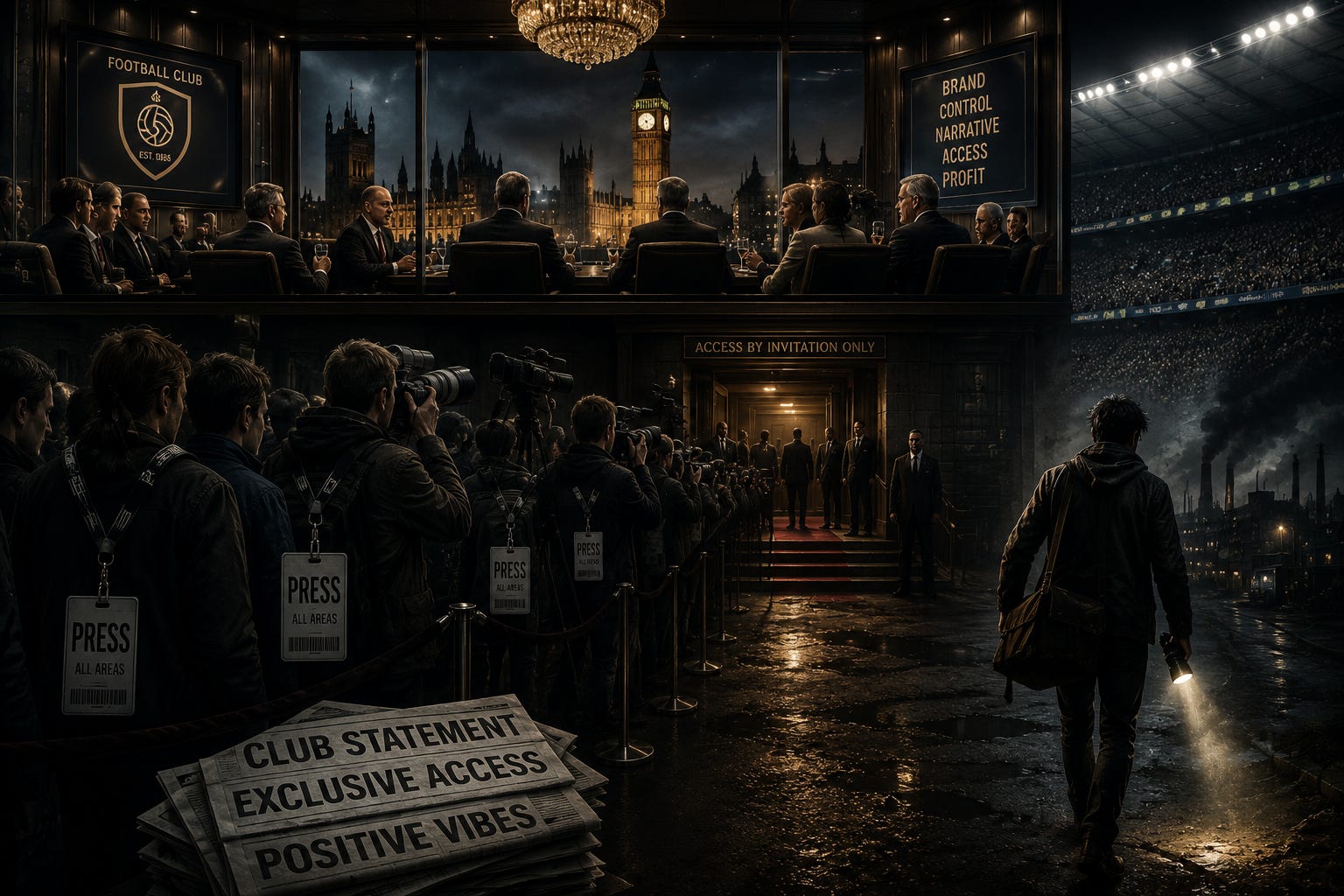
Football clubs used to fear bad headlines.
Now they fear independent headlines.
There is a difference.
The most dangerous person in modern football is no longer the angry supporter.
It is the journalist who does not need access.
Because access is how modern power controls the story.
No credential.
No interview.
No training-ground access.
No seat in the press box.
No quote.
No relationship.
That is not openness.
That is control dressed up in club colours.
Football now wants the coverage of a free press and the control of a state broadcaster.
It wants documentaries.
Influencers.
Podcasts.
Behind-the-scenes clips.
Soft interviews.
Global engagement.
Club-approved emotion.
What it does not want is scrutiny.
Newcastle United banned local journalists from The Chronicle, The Journal and the Sunday Sun after coverage of supporter protests against Mike Ashley’s ownership.
Not gossip.
Not nonsense.
Supporter protest.
A community pushing back against an owner.
And the journalists covering it were frozen out.
That is the point.
The punishment was not just aimed at the papers.
It was aimed at the next reporter.
The next question.
The next uncomfortable truth.
Brighton excluded Guardian journalists and photographers after reporting allegations involving owner Tony Bloom and his gambling interests.
Bloom denied the allegations.
The club disputed the reporting.
Fine.
That is their right.
But banning the journalists is not transparency.
It is not accountability.
It is power saying: you can report on us, but not from inside the room.
Blackburn Rovers withdrew access from the Lancashire Telegraph after critical local coverage and a breakdown in relations.
Again, this matters.
Because local journalism is often the last serious witness left.
National media arrive for crisis.
Local reporters stay for the pattern.
They know the club.
They know the town.
They know the fans.
They know the silence between the statements.
So when a club goes after the local paper, it is not just punishing a journalist.
It is weakening the public record.
MLS has the same disease.
Real Salt Lake banned Salt Lake Tribune columnist Gordon Monson after criticism of ownership.
The newspaper responded by refusing to cover the match.
That is backbone.
That is what media solidarity looks like.
Because if one columnist can be frozen out for criticising an owner, the issue is no longer one columnist.
It is whether the league tolerates independent scrutiny at all.
Then look at Inter Miami.
Franco Panizo covered every Inter Miami home match for six seasons.
Then he was denied match credentials without a public explanation.
This is not a small club hiding in a corner.
This is Messi.
This is Beckham.
This is one of the most visible clubs in world football.
A club with that much global attention should be more accountable, not less.
When a long-serving independent journalist is suddenly outside the room, people are entitled to ask what kind of media culture is being built.
The ban is not the biggest danger.
The lesson is.
Every journalist sees it.
Every freelancer sees it.
Every local reporter sees it.
Ask the wrong question and you may lose access.
Lose access and you may lose stories.
Lose stories and you may lose income.
So the questions soften.
The criticism gets safer.
The writing gets flatter.
The press conference becomes theatre.
The club statement becomes news.
The journalist becomes a guest.
The supporter becomes the last person in the room to know the truth.
That is how journalism gets weakened.
Not through one grand act of censorship.
Through a thousand small incentives.
A denied credential.
A frozen relationship.
A warning call.
A cancelled interview.
A reminder that “access is a privilege.”
That phrase gives the game away.
Access may be a privilege.
Truth is not.
Power will tell you fans have never had more insight.
They will point to the 4K cameras in the dressing room.
The microphones on the training pitch.
The emotional mini-documentary.
The player walking through the tunnel in slow motion.
The owner doing a soft-focus interview about vision, values and legacy.
They want you to mistake proximity for transparency.
But a camera pointed where power wants you to look is not journalism.
It is a mirror.
Journalism is the flashlight pointed into the dark.
Club media can be useful.
It can be entertaining.
It can show supporters things they would never normally see.
But it is not journalism.
It is communication.
It is brand management.
A club channel will not investigate the owner.
A club podcast will not follow the debt.
A club documentary will not expose the business model unless the club wants it exposed.
A club interviewer will not ask the question that gets them banned.
That is why independent journalism matters.
Because supporters need someone outside the machine.
Someone willing to ask why ticket prices keep rising.
Why supporters are priced out.
Why public money supports private profit.
Why ownership is hidden behind statements.
Why debt grows while fans are told to be loyal.
Why a club built by a town now behaves like a private content studio with turnstiles.
And football is not alone.
Politics has the same disease.
Politicians want coverage without scrutiny.
Interviews without interrogation.
Headlines without accountability.
Press conferences without consequences.
Too much political journalism now looks like access management.
The journalist needs the politician.
The politician needs the journalist.
The relationship becomes the product.
The public becomes the afterthought.
Ask a simple question.
Are you going to nationalise anything meaningful?
Water?
Rail?
Energy?
Mail?
Or are you just going to manage the same broken system with warmer language?
That is not a trick question.
It is one of the biggest economic questions in Britain.
Who owns the pipes?
Who owns the trains?
Who owns the bills?
Who owns the land?
Who owns the debt?
Who owns the future?
That is what journalism should force into the room.
Not vibes.
Not slogans.
Not polling theatre.
Not “a difficult week for the leader.”
The question is always the same.
Who benefits?
Who benefits when football clubs control access?
Who benefits when politicians speak in fog?
Who benefits when supporters argue about managers but not ownership?
Who benefits when voters argue about personalities but not assets?
Who benefits when journalism protects relationships instead of the public?
Not supporters.
Not voters.
Not working people.
Power benefits.
Power always prefers soft questions.
Power always prefers controlled rooms.
Power always prefers friendly media.
Power always prefers the microphone it owns.
The public is not stupid.
The public knows something is wrong.
They know football is dearer.
They know politics sounds managed.
They know public services feel drained.
They know housing feels impossible.
They know wages struggle while assets inflate.
They know the deal has gone bad.
What they lack is not intelligence.
They lack a map.
That is what journalism is supposed to provide.
A map of power.
Who owns what.
Who pays.
Who profits.
Who loses.
Who benefits.
The best journalists do not merely report events.
They explain systems.
They translate power.
They follow money.
They make complicated things understandable.
They make ordinary people harder to con.
That was the job.
It still is.
But too much modern journalism has become brilliant at describing conflict and weak at explaining power.
It tells us who is angry.
It rarely tells us who profits.
It tells us what was said.
It rarely tells us what was meant.
It tells us who is winning the argument.
It rarely tells us who owns the asset.
That is not enough.
Football does not need more club-approved content.
Politics does not need more consultant-approved messaging.
The public does not need more noise.
It needs journalism with teeth.
And this is where the reader has a job too.
If you want journalism with teeth, stop rewarding the machine that removed them.
Support local newspapers.
Pay independent reporters.
Share serious investigations.
Subscribe to outlets that challenge power, not just ones that flatter your tribe.
Stop mistaking club content for journalism.
Stop mistaking political theatre for accountability.
Reward the people who stand outside the room.
Because if nobody pays for independent journalism, we should not act shocked when all that remains is sponsored emotion and official statements.
Access is not the prize.
Truth is the prize.
Context is the prize.
Public understanding is the prize.
The best journalists were not invited into rooms because power trusted them.
They were invited because power feared what they might write if they were kept outside.
Somewhere along the way, journalism forgot that.
It started treating access as victory.
It is not.
Sometimes being banned means you were finally close to the truth.
Sometimes losing the pass means you kept the point.
Sometimes being outside the room is the only way to describe what is really happening inside it.
Football clubs will keep behaving like media companies.
Politicians will keep behaving like brands.
Institutions will keep controlling the microphone.
Unless journalism remembers what it is for.
Not comfort.
Not access.
Not relationships.
Accountability.
The role of journalism is not to make power look human.
It is to make power explain itself.
That is the deal.
And if power does not like the question?
Ask it again.