

There’s a phrase economists use.
The K-shaped economy.
Some people go up.
Some people go down.
And the gap between them widens.
You can see it in the United States.
You can feel it in the United Kingdom.
And if you’re honest, you know it’s not slowing down.
If you’re at the top, life still works.
Capital moves.
Opportunities exist.
Access is easy.
If you’re not?
Everything feels tighter.
More expensive.
More restricted.
Less forgiving.
This isn’t a cycle.
It’s a direction.
You’ve got voices from completely different worlds pointing at the same fault line.
Bernie Sanders talks about inequality and concentration of wealth.
Ray Dalio talks about instability when the gap gets too wide.
Different language.
Same signal.
Respect both.
Because when opposite ends agree on the problem…
You stop treating it like opinion.
This isn’t really about money.
Money is just the output.
This is about control.
Who owns the system.
Who sets the rules.
Who decides access.
Once control concentrates, everything else follows:
• Pricing
• Opportunity
• Narrative
• Mobility
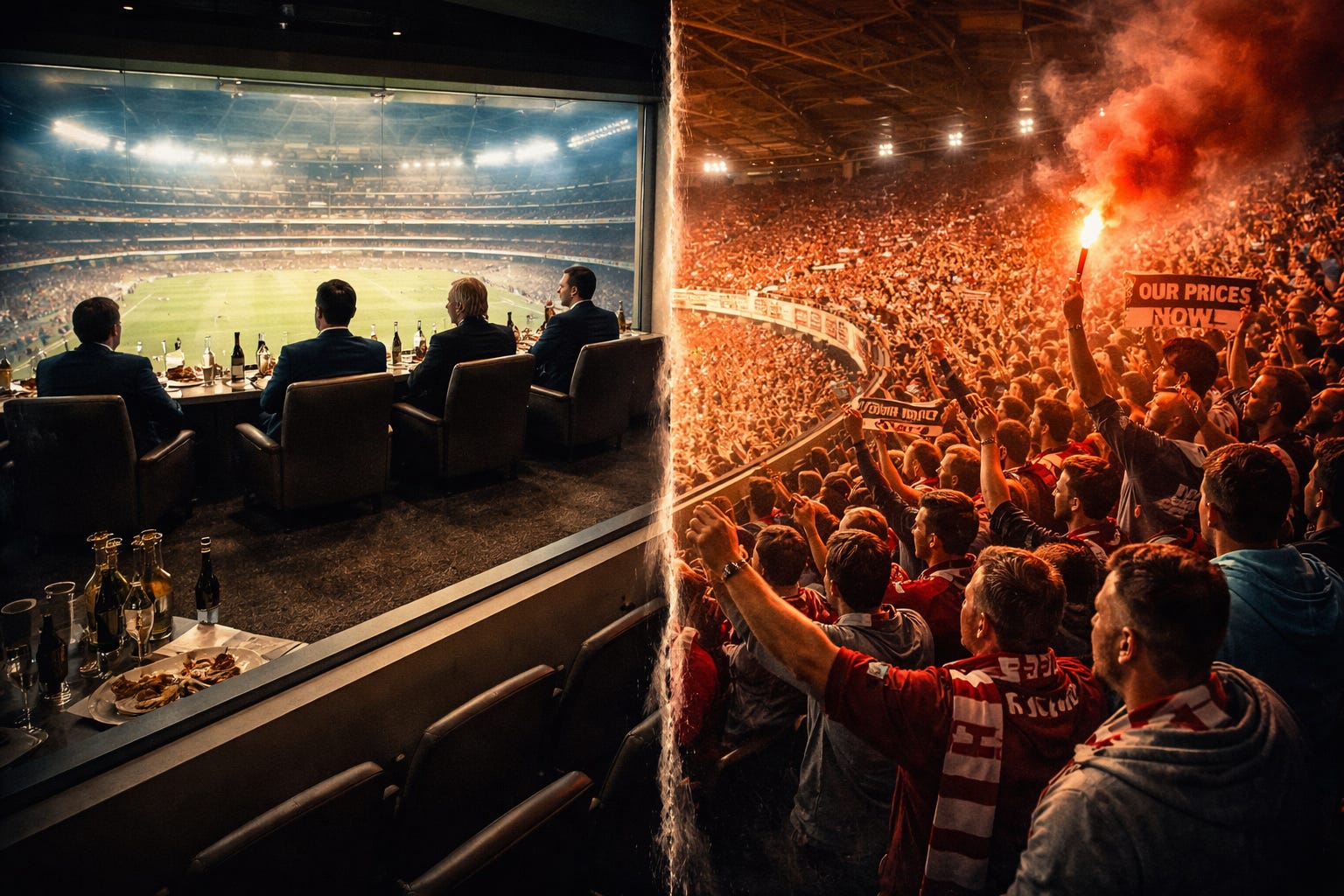
If you want to see it clearly, look at football.
At the top:
• Global ownership groups
• Billion-pound valuations
• Broadcast deals shaping decisions
At the bottom:
• Fans priced out
• Identity diluted
• Matchday turned into a transaction
Same structure.
Different industry.
Even FIFA talks about fans.
They promote inclusion.
They create engagement.
They allow voting.
But only where it doesn’t matter.
Fans can vote on moments.
Not ownership.
Not pricing.
Not direction.
That’s not participation.
That’s controlled participation.
The problem isn’t that fans don’t have a voice.
It’s that their voice has no power.
The solution isn’t complicated.
But it changes everything.
“The solution isn’t complicated.
It’s structural.
It’s already been proven in parts.
And if implemented properly, it would change how every football club is run — permanently.