

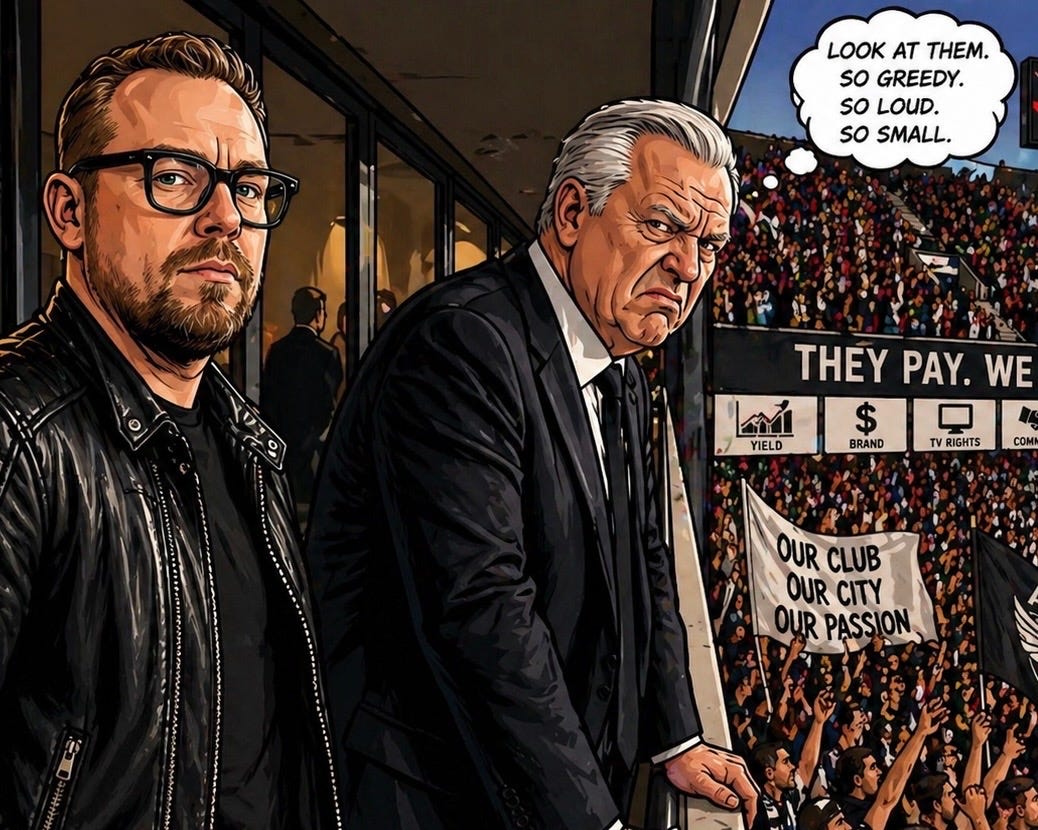
Walk into a stadium.
Full house.
£80 tickets.
£12 beers.
You call it passion.
They call it yield.
Follow the money
In America, a football club isn’t sport.
It’s an asset.
Structure it right and you get:
-
Amortisation on what you buy
-
Deductions on what you spend
-
Public money building your stadium
-
A softer tax bill when you sell
The Brookings Institution has tracked tens of billions in public funding for stadiums.
The National Bureau of Economic Research has shown those deals rarely return meaningful economic value to the public.
So the public funds the asset.
The owner keeps the upside.
That’s not a flaw.
That’s the design.
Now look at the UK
Different system.
Same extraction.
The Premier League generates over £6 billion a year.
And still:
-
Ticket prices rise
-
Debt sits on clubs
-
Fans own nothing
The product improves.
Your position doesn’t.
Let’s be honest about what this is
This isn’t tradition.
This isn’t community.
This is asset management with a crowd.
And you can feel it
The shift didn’t happen on the pitch.
It happened in the room.
-
Clubs became balance sheets
-
Decisions followed valuation
-
Culture became secondary
Football didn’t drift away from fans.
It was priced away from them.
I’ve seen it up close
I’ve sat in those rooms.
Behind closed doors.
And I’ve heard how fans are discussed when they’re not in the building.
Not as people.
As numbers.
-
Yield
-
Price tolerance
-
Segments
You think you’re part of the club.
In that room, you’re a line in a model.
That’s not opinion.
That’s how the system sees you.
The ground is shifting
Not because anyone is leading it.
Because the model is stretching.
-
Prices rising faster than incomes
-
Younger fans disengaging
-
Trust in institutions collapsing
The gap between who pays and who benefits is now visible.
And once people see it, they don’t unsee it.
What happens next
When systems lose alignment, they don’t get fixed.
They get replaced.
People stop asking for better treatment.
They ask a better question:
Why don’t I own part of this?
Why this hasn’t been done
If this was easy, it would already exist.
It doesn’t.
Because ownership is the hardest layer to build in football.
Not content.
Not branding.
Not noise.
Ownership.
You have to align all of it.
At the same time.
Most people don’t even try.
They talk about change.
They don’t build it.
That’s the difference
Everyone can see the problem.
Very few are willing to build the solution.
So stop complaining about the system
It’s working exactly as designed.
Just not for you.
If you want a different outcome, you need a different structure.
That’s what Football Is For The Fans is
Not a campaign.
A correction.
An ownership layer on top of football.
-
Fans inside the cap table
-
Value shared, not extracted
-
Incentives aligned
Same game.
Different power.
Because this doesn’t start with debate.
It starts with action.
The Aztecs aren’t nostalgia.
They’re a test.
Can you build a club where fans aren’t just funding it…
but owning it?
That’s what’s happening.
Right now.
This isn’t an idea.
It’s being built.
The only variable is who gets in early.
Why aren’t people rushing in?
Because this is what early looks like.
Unproven.
Uncomfortable.
Easy to question.
Most people wait.
They look for signals.
Permission.
Someone else to go first.
But that’s the trade-off
By the time something feels safe:
-
The price has moved
-
The positions are taken
-
The upside is smaller
If everyone understood it, it wouldn’t be available.
Here’s the uncomfortable truth
Most people won’t move.
They’ll:
-
Watch
-
Analyse
-
Hesitate
And later tell themselves they missed it.
They didn’t miss it.
They avoided it.
You’ve spent your life paying into football.
That was your role.
This is your chance to change it.
Stay in the stands.
Or step onto the cap table before the price moves.
This isn’t content.
This is a line in the sand.
On one side:
Fans as customers.
On the other:
Fans as owners.
Pick your side.