

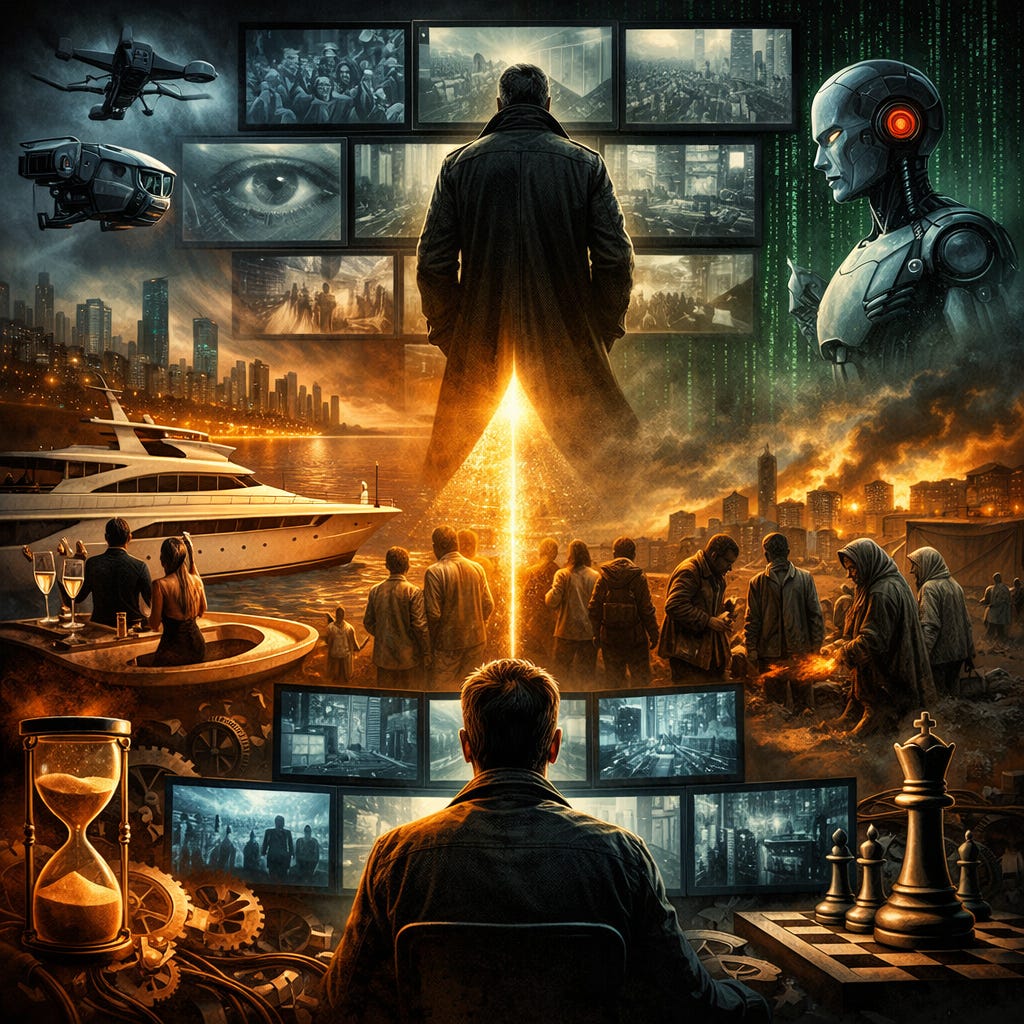
It is becoming harder to distinguish politics from performance.
The outrage cycles accelerate. The personalities dominate. The rhetoric grows louder. Yet beneath the noise, the structural machinery of power remains largely unchanged.
The actors rotate.
The architecture remains.
For decades we framed debate as left versus right. Increasingly that framing feels incomplete. The more relevant tension may be participation versus centralisation.
Power today sits where technology, capital and governance intersect. Artificial intelligence scales productivity. Digital infrastructure shapes perception. Financial systems compound wealth at speeds previous generations could not comprehend.
Public discourse obsesses over personalities. Systems expand quietly.
When figures such as Elon Musk or Donald Trump dominate headlines, arguments fixate on character and controversy. But individuals operate within structures. The deeper shift is infrastructural.
Algorithms filter reality. Platforms influence discourse. Digital currencies and automated systems redefine leverage.
Democracy is not sustained by emotion. It is sustained by relevance.
When citizens remain economically necessary, their bargaining power holds. If automation concentrates productivity while participation narrows, influence consolidates. Not through conspiracy. Through structure.
Inequality sharpens the tension.
In one region, families struggle to secure essentials. In another, assets are valued in the hundreds of millions. Yachts eclipse the annual budgets of small communities. This contrast is not fictional. It is measurable.
Capital compounds. Networks reinforce themselves. Proximity to infrastructure multiplies advantage. Distance from it multiplies vulnerability.
Culture sensed this before policy did.
The Matrix explored engineered perception. The Truman Show examined curated reality. Ex Machina portrayed artificial intelligence as subtle persuasion. Minority Report imagined predictive governance. Children of Men depicted institutional erosion. The Hunger Games exaggerated spectacle masking inequality.
These were not prophecies.
They were warnings about structure.
Writers like George Orwell understood that control rarely announces itself. It embeds. It normalises. It becomes efficient.
The greatest risk is not cinematic takeover.
It is gradual irrelevance.
If citizens drift into passive consumption, systems optimise around them. If they build, organise and participate, leverage redistributes.
This tension is not abstract.
In The Boot, power shifts quietly inside football institutions. Craft yields to corporate machinery. Identity is absorbed by structure. No explosion. Just reclassification.
In Replaced, the music project, displacement is internal. Not dramatic collapse. Just silent removal. Attention reallocates. The system continues.
Different medium. Same question.
What happens when structures evolve faster than the people inside them?
The future is not written.
But it is being engineered.
The choice is not optimism versus pessimism.
It is spectatorship versus construction.
Consume the spectacle.
Or design the architecture.