

Football Doesn’t Have A Space Problem. It Has A System Problem.
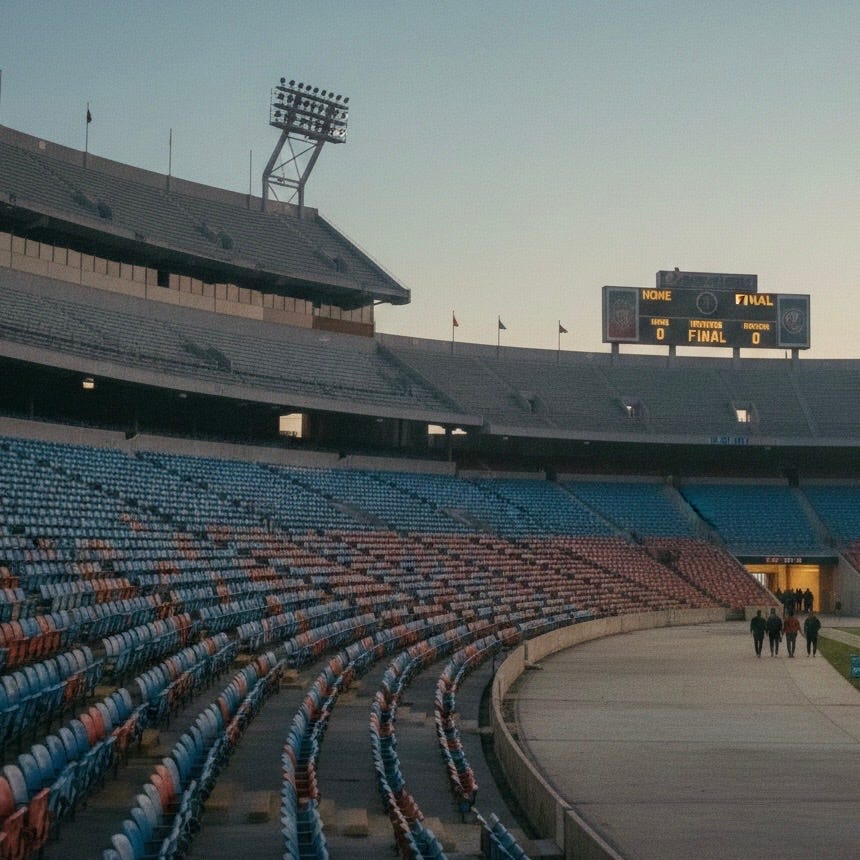
Across England, the United States and Canada, there are football stadiums sitting empty most of the week.
Lights off. Gates closed. Thousands of seats waiting for a purpose that only arrives a few hours at a time.
At the same time, clubs lose money. Fans feel further away from the game. Communities that once revolved around football now orbit around screens instead of places.
Everyone agrees something feels off.
But almost nobody talks honestly about why.
Because the problem isn’t the stadiums.
The problem is the system that surrounds them.
The System Was Built For Control, Not Connection
Modern football didn’t become what it is by accident.
Over the last thirty years, the game reorganised itself around stability and scale. Broadcast revenue grew. Commercial partnerships expanded. Clubs became global brands rather than local institutions.
In many ways, the system succeeded. Football became bigger than ever.
But success changed the incentives.
Control became more important than connection.
Access became restricted.
Risk became something to avoid.
New ideas became something to manage rather than explore.
Stadiums stopped being living spaces and became protected assets. The goal shifted from how do we use this space more? to how do we make sure nothing goes wrong?
And once that mindset takes hold, empty stadiums stop looking like opportunity.
They start looking like safety.
If nothing happens, nothing can fail.
Football doesn’t resist change because it hates new ideas.
It resists change because the system rewards doing nothing.
Why New Ideas Struggle To Enter Football
Over the past few years I’ve approached clubs in England, the USA and Canada about using their stadiums differently. Fan-led events. Community-driven football. Bringing people back into spaces that otherwise sit unused.
On paper, it makes sense.
Incremental revenue.
Community engagement.
Low operational risk compared to full matchdays.
But most conversations never progressed.
Not because the idea was rejected. Because it never truly entered the system at all.
Football institutions are structured to minimise uncertainty. Executives are rarely rewarded for innovation. They are rewarded for avoiding problems. For protecting relationships. For maintaining stability.
So the safest answer becomes silence.
Not yes.
Not no.
Just nothing.
And over time, nothing becomes culture.
Losing Money Is Normalised. Losing Control Isn’t.
This is one of football’s great contradictions.
Clubs losing money is normalised. Owners absorb deficits. Financial inefficiency is accepted as part of competing. The system absorbs loss as long as hierarchy and control remain intact.
But introducing something new introduces unpredictability.
And unpredictability threatens control.
So the system will often tolerate financial loss more comfortably than structural change.
This isn’t corruption.
It’s inertia.
And inertia is harder to move than opposition because it doesn’t argue back. It simply stands still.
The Moment The Penny Dropped
COVID forced a moment of perspective for a lot of people.
For me, it was simple.
I missed people.
The interaction. The conversation. The shared experience of being somewhere together. Football without people felt efficient, but empty.
That realisation became the foundation of Football Is For The Fans. Not as a protest against football, but as a reminder of what made the game valuable in the first place.
Football worked because it brought people together.
The system had become efficient.
But efficiency alone doesn’t create meaning.
Stepping Away From The Noise
Football never lacks opinion.
Industry groups, private chats, WhatsApp conversations — everyone has a view. For a while I stayed inside those spaces, believing that if people understood the thinking behind what I was building, common ground would follow.
Instead, I learned something else.
The system exists socially as well as structurally. People protect what they know. Operators protect their positions. New ideas create discomfort because they question existing assumptions.
Some conversations became negative. Some people criticised publicly what they had supported privately.
So I stepped away.
Not out of conflict, but out of clarity.
Building something new requires focus. Football already has enough debate. What it lacks is people quietly building alternatives.
Ideas aren’t proven in group chats.
They’re proven in the real world.
Why American Soccer Is The Starting Point
The starting point for Football Is For The Fans is American soccer.
Not because of nostalgia, but because of freedom.
Historically, American soccer experimented. It blended sport and entertainment. It understood that atmosphere, personality and accessibility mattered as much as tradition.
The original NASL era understood something modern football often forgets — sport is supposed to be experienced, not just consumed.
That makes it the ideal starting point for something new.
This isn’t the Baller League or the Kings League. Those formats are built around short-form entertainment and digital spectacle.
Football Is For The Fans takes a different path.
The focus isn’t gimmicks. The focus is inclusivity and participation.
The format draws from American soccer traditions — decisive outcomes, no ties, winner-takes-all competition, and a style designed to keep matches alive inside the stadium. A format where the experience belongs to everyone in the ground, not just the broadcast.
The aim isn’t to make football louder.
It’s to make it feel alive again.
The System Isn’t Evil. It’s Just Old
The current football system wasn’t designed to fail fans. It was built for a different era — television growth, commercial expansion and financial security.
It achieved those goals.
But systems that succeed often struggle to evolve. They protect yesterday’s solutions even when the environment changes.
Today’s supporters want participation, not just consumption.
They want access, not distance.
They want authenticity, not presentation.
The gap between what football delivers and what people feel is growing.
And that gap is where new ideas begin.
What Comes Next
Football Is For The Fans is being built deliberately, not quickly.
We are preparing to take the project to market at the right time, not the fastest time. The aim isn’t noise. It’s proof.
The first stage involves working with a small group of aligned investors — five to ten people who understand that football’s future isn’t extraction, but participation. Partners who want to build something sustainable rather than chase short-term hype.
The model challenges a basic assumption in modern sport.
Clubs and their identity should belong to the people who give them meaning. Supporters. Communities. Fans. Ownership and participation from the beginning, not added later as marketing.
This isn’t being built from Silicon Valley, and it isn’t designed around chasing venture capital approval or short-term growth at any cost. Football already has enough models built around extraction.
This one is built around belonging.
Because if football forgets who it belongs to, it eventually loses what made it powerful in the first place.
Football Always Finds Its Way Back To People
Every new idea goes through the same phase.
At first, it’s ignored.
Not because it’s wrong, but because it doesn’t yet fit existing structures. Football waits for proof. Once something works, understanding arrives quickly. Doors that stayed closed suddenly open.
So this stage isn’t rejection.
It’s friction.
And friction is often a sign that you’re pushing against something real.
Empty stadiums won’t stay empty forever.
The clubs that understand early that football is experience, community and belonging — not just broadcast inventory — will benefit first. The others will eventually follow, because football has always evolved through culture before policy.
In the end, the game was never saved by systems.
It was saved by people who refused to forget what football was for.
And it always will be.