

How American Soccer Became a Franchise Business — And Why Fans Are Paying For It
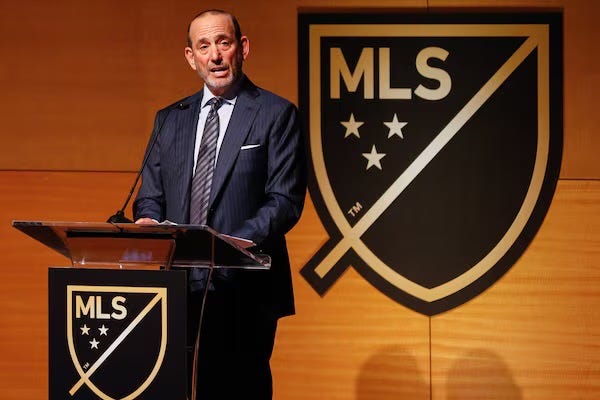
Something strange is happening in football.
Investors are paying $500–600 million to buy a franchise in Major League Soccer.
Half a billion dollars.
For the right to run a football club.
At first glance you assume the revenues must be enormous. Massive TV deals. Global audiences. Billions flowing through the sport.
But when you actually follow the money…
the illusion starts to crack.
The Television Reality
MLS signed a streaming deal with Apple Inc. worth $2.5 billion over ten years.
That sounds huge.
Until you divide it.
That deal equals roughly $250 million per year.
Spread across the league’s 30 clubs, each team receives roughly $8–9 million annually.
Now compare that to England.
Even the bottom club in the top division receives over £100 million per season in broadcast revenue.
The difference is staggering.
Yet MLS expansion slots now approach $600 million.
So where is the value actually coming from?
The Forbes Numbers Tell The Story
According to Forbes’ 2026 valuations, MLS teams are now worth an average of $731 million.
The most valuable club, Inter Miami, is estimated at $1.35 billion.
But buried in the same report is a far more revealing statistic:
19 of the league’s 30 clubs were unprofitable in 2025.
Think about that.
The majority of teams in the league lose money operating their football business.
Yet valuations keep climbing.
Why?
Because this isn’t really about football revenue.
The Franchise Asset Game
MLS is built on a franchise system.
No promotion.
No relegation.
Limited entry.
Scarcity creates value.
Investors are not buying clubs based on television income.
They are buying sports assets they believe will appreciate over time.
Buy a team today for $600 million.
Sell it tomorrow for $1 billion.
That’s the bet.
The football itself becomes almost secondary.
The Second Tier Is Even Stranger
Below MLS sits the USL Championship.
Expansion fees hover around $25 million.
But here’s the key detail.
There is virtually no central TV distribution at all.
Clubs rely on:
• ticket sales
• local sponsors
• stadium events
• community support
So investors are paying millions for clubs with almost no media revenue.
From a global football perspective, the economics are extraordinary.
The Hidden Cost
But someone still has to fund the system.
And increasingly that burden falls on fans and families.
Higher ticket prices.
More advertising.
More corporate sponsorship.
More commercialisation of matchday.
Walk into many stadiums and you’re not just attending a football match.
You’re walking into a live advertising platform.
Logos on everything.
The pitch.
The shirts.
The interview backdrops.
Football becomes the delivery vehicle for marketing.
Then There’s Pay-To-Play
The structure doesn’t stop with professional clubs.
In many parts of the United States, elite youth football operates through pay-to-play academies.
Families can spend thousands of dollars every year just to give their children the chance to compete at higher levels.
Think about that.
In most football nations, the best young players are developed for free.
In parts of the American system, the pathway depends on what parents can afford.
That’s not a meritocracy.
That’s a financial barrier.
The World Cup Will Shine A Light On It
The United States will soon host the biggest event in the sport.
When the World Cup arrives, millions of global supporters will see the American system up close.
And many will ask questions.
Why does the top league have no promotion or relegation?
Why does it cost hundreds of millions to join?
Why do families pay thousands for youth football?
Why are fans bombarded with advertising inside stadiums?
For fans raised on traditional football culture, the answers may feel uncomfortable.
Football Was Never Supposed To Work Like This
Football became the world’s game because it was simple.
A ball.
A patch of grass.
Two goals.
Anyone could play.
That simplicity built the culture of the sport.
But when access becomes restricted — through franchise fees or pay-to-play systems — something fundamental changes.
The game drifts away from the communities that created it.
The Question That Will Open Eyes
American soccer will continue to grow.
Attendances are rising.
Interest is increasing.
The World Cup will accelerate everything.
But with that spotlight will come scrutiny.
And sooner or later, the question will be asked.
Who is football really for?
Investors buying sports assets?
Or the kids kicking a ball in the street dreaming of playing the game?
Because when the world arrives for the World Cup…
a lot of people may start seeing the system differently.
And once you see the economics behind it…
you realise something.
Football was never supposed to be a franchise.
It was supposed to belong to the fans.
Scott “Matchmaker” Michaels