

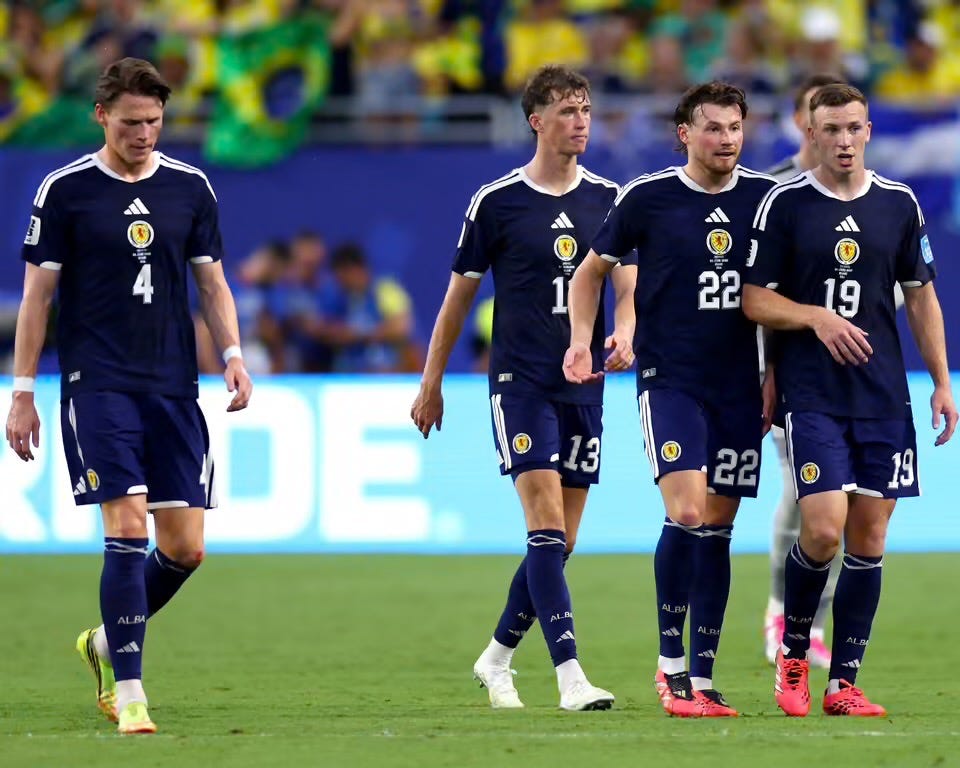
Scotland’s World Cup ended exactly how too many Scottish tournaments have ended.
Not with humiliation.
With frustration.
One win.
Two defeats.
One goal scored.
Four conceded.
Third in Group C behind Brazil and Morocco.
The numbers tell the story.
The football explains it.
The easy argument is money.
Brazil’s players are worth more.
Morocco’s players play for bigger clubs.
Scotland simply could not compete.
I do not buy that.
Transfer values do not decide tournaments.
Systems do.
If money decided international football, Croatia would never reach World Cup finals.
Uruguay would not continually outperform nations ten times their size.
Morocco would never have become one of the world’s fastest-improving football nations.
International football is the ultimate systems test.
You have the players your country produces.
Nothing more.
Nothing less.
And Scotland’s system looked fragile.
The defining game was not Brazil.
It was Morocco.
Conceding early was not fatal.
The response was.
Scotland never truly changed the rhythm of the game.
There was no calculated risk.
No tactical gamble.
No emotional momentum.
Scotland stayed too rigid between the lines. The midfield did not step high enough to disrupt Morocco, and the forwards did not transition quickly enough when possession turned over.
The shape survived.
The threat died.
It felt like everyone was waiting for somebody else to make something happen.
Nobody did.
Respect became caution.
Caution became hesitation.
Hesitation became elimination.
Against Brazil, the pattern continued.
Brazil were better.
Nobody sensible disputes that.
But Scotland looked beaten by Brazil’s reputation before they were beaten by Brazil’s football.
Fear of pace changed the entire psychology of the performance.
The team defended deeper.
Pressed less.
Took fewer risks.
Eventually Brazil punished exactly what Scotland feared most.
That is not simply a quality gap.
It is a confidence gap.
Steve Clarke deserves genuine credit.
He ended Scotland’s 28-year absence from the World Cup.
That achievement should always be recognised.
But qualification earns you an invitation.
Tournament football asks a different question.
Can you solve problems when the plan stops working?
Against Morocco, Scotland could not.
Against Brazil, they did not.
That falls on the manager.
Manager: 4/10.
Players: 5/10.
Nobody doubts their effort.
But effort is not elite performance.
At World Cups, hard work is the entry fee.
The best international teams do not simply work harder.
They think faster.
Adapt quicker.
Demand responsibility.
Too many Scotland players stayed inside the tactical framework instead of taking ownership of the match.
That is what separated them from the nations that progressed.
The uncomfortable truth is that this is not really about Steve Clarke.
Managers come and go.
Systems remain.
The Scottish FA knows this.
Its own youth-development review recognises that player pathways, coaching quality and technical development need to improve if Scotland is to compete consistently with the world’s best.
That is encouraging.
Because admitting the problem is the first step towards solving it.
The Tartan Army, meanwhile, were magnificent.
They reminded me of the Republic of Ireland supporters in America in 1994.
The songs.
The humour.
The warmth.
The belief.
Thousands crossed an ocean to represent their country with pride.
For many neutrals, Scotland’s supporters became one of the stories of the tournament.
They deserved a team that played with the same freedom.
Final ratings:
Manager: 4/10
Players: 5/10
Tournament: 5/10
Fans: 10/10
The supporters looked ready for a World Cup.
Scottish football still looked like it was preparing for one.
The lesson is not that Scotland is too small.
The lesson is that Scotland played too small.
That is the real wound.
Scotland did not go home because Brazil and Morocco had better transfer values.
Scotland went home because Brazil and Morocco had stronger football systems.
Until that changes, the shirts will change.
The managers will change.
The names will change.
The outcome probably will not.
Source support: Brazil beat Scotland 3–0 and won Group C; Morocco beat Haiti 4–2 to finish second on seven points; Scotland were left third with three points and a negative goal difference. Steve Clarke described the Brazil defeat as largely self-inflicted and pointed to wider Scottish player-development issues. The Scottish FA has commissioned a review into men’s youth development and the player pathway.