

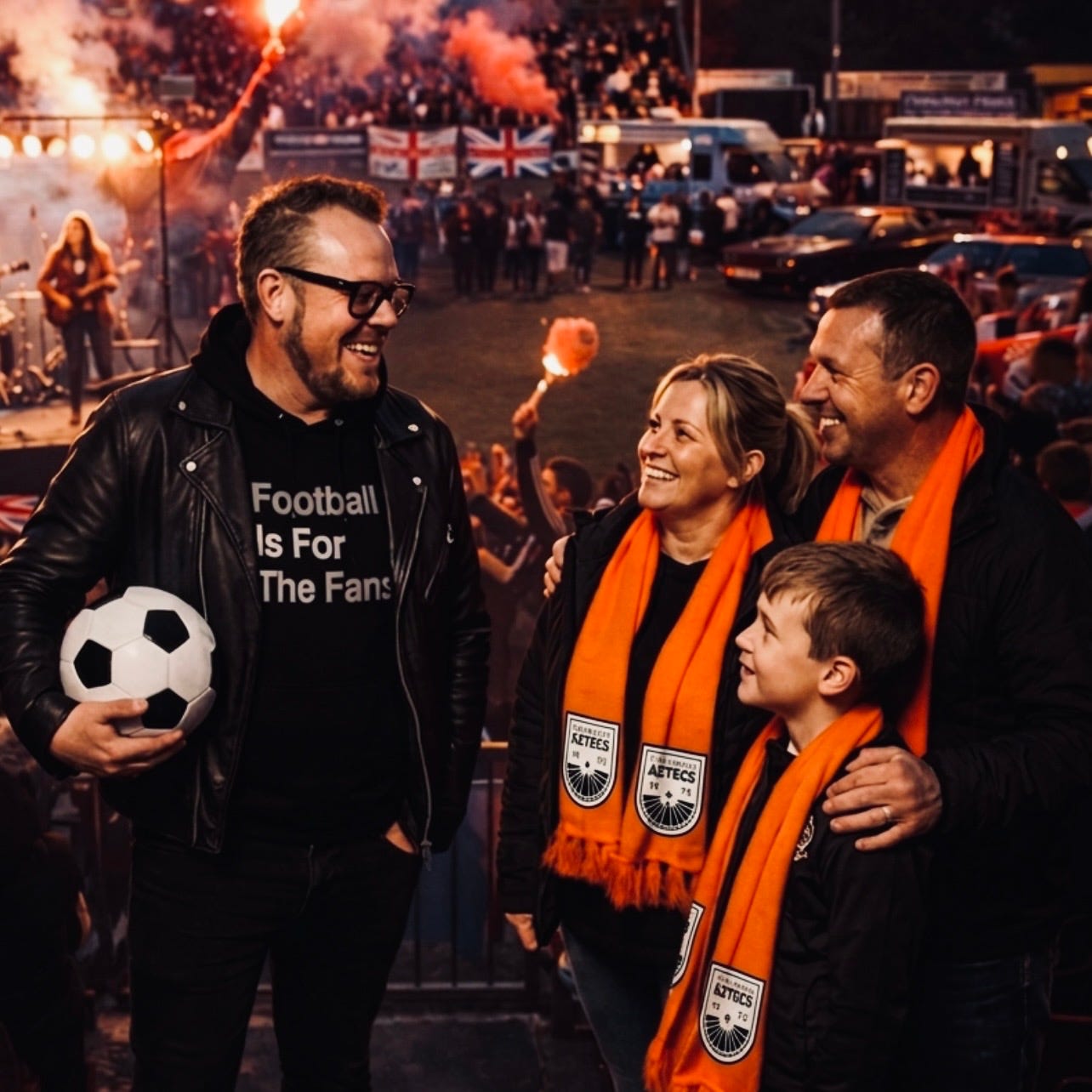
You don’t sell tickets. You build tension.
That’s where football has gone wrong. It became about the fixture instead of the feeling.
Fixture announced. Tickets released. Marketing pushed. Hope people turn up.
That’s not demand. That’s dependency.
The first event isn’t about football. It’s about whether people feel something before it even starts.
If they don’t feel it, they don’t come. If they do, they bring others.
So this is how you fill a stadium before a ball is even kicked.
You start with people, not ads.
Kids. Local clubs. Grassroots teams.
Not random giveaways. Targeted placements into schools, academies, communities.
The goal isn’t generosity. It’s density.
A full lower tier changes everything. Noise. Energy. Camera angles. Perception.
No one wants to be part of something empty. Everyone wants to be part of something alive.
Then you activate the network.
Not promotion. Participation.
Local clubs aren’t attendees. They’re part of the night.
Badges in the stands. Mentions on the pitch. Identity tied into the experience.
Now it’s not a game. It’s theirs.
Then you build a story.
Football used to have characters. Now it has systems. That’s why it feels flat.
Before the first whistle there needs to be friction. Rivalry. Something at stake.
Face offs. Interviews. Moments that create tension.
Tension creates attention. Attention fills seats.
Now you layer something different.
I grew up on American culture. TV, sport, music. It was bigger. Louder. It felt like something.
That stuck.
And the demand for it is already here.
NFL games in London sell out 60000 plus seats.
Country music festivals like C2C sell out multiple nights at the O2.
American artists dominate what people in the UK listen to every day.
I’ve seen it myself.
A Luke Combs tribute show at Lancaster Grand Theatre sells out every year.
Not the real artist. A tribute.
That tells you everything.
People don’t pay for names. They pay for feeling.
And when you bring that into sport properly, it moves.
WWE proves it.
It sells out arenas here.
Not because it’s traditional sport. Because it’s story driven.
Characters. Rivalries. Moments.
People don’t just watch it. They show up for it.
That’s the shift.
When sport becomes experience, demand increases.
Football has the scale. It just hasn’t been structured this way.
So we build that identity into the event.
Muscle cars outside the ground. Food trucks. Country and rock music.
Not as decoration. As atmosphere.
Because this isn’t just football. It’s a cultural experience meeting a football audience.
That contrast is what makes people talk.
Then you use the clubs properly.
Los Angeles Aztecs. Chicago Sting. Washington Diplomats.
These aren’t brands you invented. They already carry weight.
You’re not launching something new. You’re continuing something people recognise.
That feeds directly into merchandise.
Limited. Event specific. Retro inspired. Printed on site.
People don’t just buy shirts. They take part in the moment.
Then you capture everything.
Content is the engine.
Every reaction. Every moment. Every interaction.
Distributed. Clipped. Shared.
SEO captures intent. Content creates it.
Now here’s the part most people ignore.
Execution.
This is where football ideas die.
Talent. Match quality. Scheduling. Venues. Turning attention into attendance.
Real constraints.
So the model is built for that.
Short format games. Condensed schedules. Independently contracted players aligned to exposure and revenue.
Commercial venue deals, not dependency on league systems.
Events built as revenue and content units, not one off fixtures.
The first event is targeted within the next 12 months.
Venue conversations are already happening in the UK in areas where football culture and population density meet.
Not because it takes that long to run a game.
Because this isn’t a one off.
It’s a platform.
There’s a difference between launching quickly and launching properly.
A cheap pilot proves you can run an event.
It doesn’t prove this works.
The objective isn’t to show people attend football. That’s already obvious.
The objective is to show a version that holds attention, converts audience and builds into ownership.
That’s what matters.
The first event sets everything.
Audience. Partners. Perception.
It doesn’t need to be perfect. But it needs to be right.
Because this is about building something that scales.
And none of it matters if the football is poor.
If it’s slow, safe and predictable, everything collapses.
So it has to be fast. Aggressive. Clear. Something people feel.
This isn’t about running an event.
It’s about building a moment people don’t want to miss.
Because the first game defines the ceiling.
Get it wrong and you shrink it. Get it right and it compounds.
You don’t sell the first game.
You engineer the first full stadium.
This is already being tested.
The Los Angeles Aztecs capital raise is live.
Not as an idea. As a signal.
People stepping in early before it’s obvious.
And this is where it becomes real.
You can come in from 100 dollars.
You don’t pay unless the raise completes.
No downside to being early.
But this isn’t about the 100.
It’s about position.
Because the people who step in now will be able to say they were there before it moved.
That matters.
This isn’t just about football.
It’s about whether you watch something take shape or attach yourself to it early enough to matter.
Backing the Los Angeles Aztecs isn’t quiet.
It’s visible.
Every supporter gets their own owner profile page on losangelesaztecs.com.
Your name. Your position. Public. Searchable. Permanent.
Not buried in paperwork.
Placed in the story.
Something you can share. Something you can point to. Something that says you were there before it moved.
Because this isn’t about buying in.
It’s about being recognised as someone who stepped in early, when it still required belief.
That’s the difference.
Most people watch things grow.
A few attach themselves to it before it does.
Most people will read this and move on.
A few will recognise it.
Fewer will act.
That’s always the difference.
Timing.
There is a lead position open.
And there is a window to come in alongside it.
The only question is whether you wait until it’s obvious or move while it still looks early.
scott@footballisforthefans.com
Let’s move.