

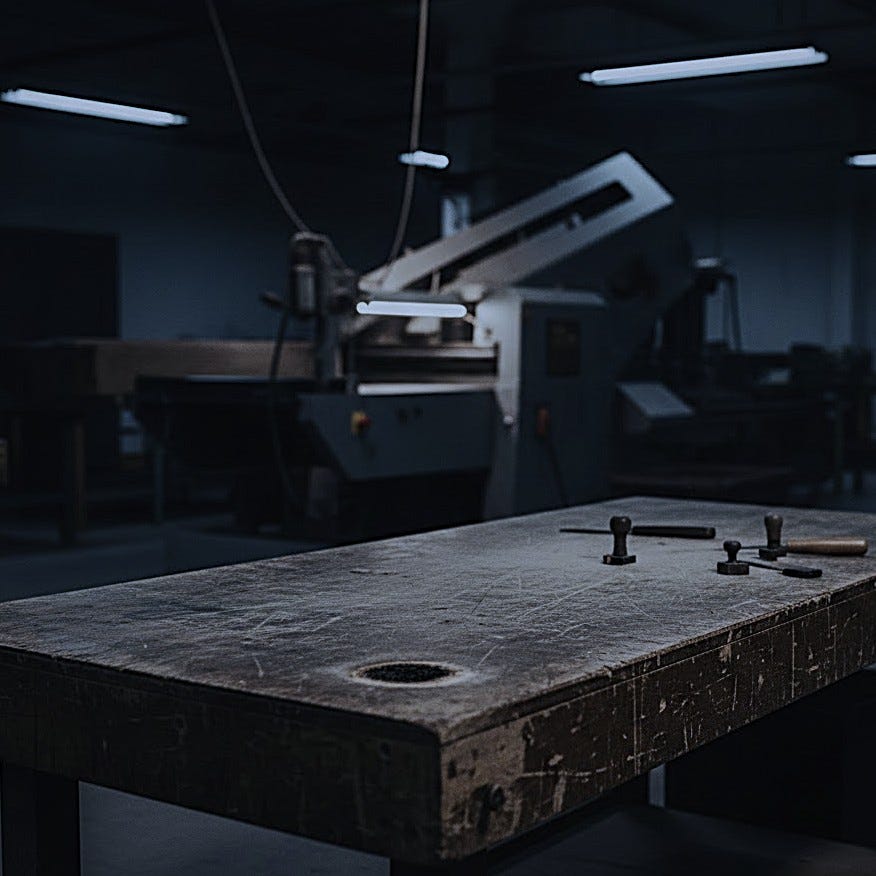
Previously in Episode Four
Footshape Boot Works had stopped being just a factory.
Orders increased. Attention followed. Agencies called. Journalists asked questions nobody in Leeds had asked before. Arty Zee’s name travelled further than his boots.
Insurance changed its language. Inspections arrived without accusation. Paperwork moved faster than people could react. The business was quietly redefined as a brand asset — something more valuable on paper than in reality, and therefore more exposed.
Football was changing. Players were becoming symbols. Attention was becoming currency.
And once attention arrived, structure followed.
Ownership followed.
Protection disappeared.
Episode Five
The first thing Arty noticed was the clock.
White face. Black numbers. Perfect time.
It hung above the clock-in board like it had always been there, ticking loud enough to hear between presses. The old one had always been slow. Five minutes behind on a good day. Nobody minded. Work started when men arrived, not when seconds said so.
This one didn’t drift.
It counted.
Ben walked beneath it carrying order sheets, pretending not to notice.
“Since when did we get that?” Arty asked.
“This morning,” Ben said. “No one asked.”
The factory woke around them. Leather slapped against tables. Steam lifted from moulds. Knives cut in steady rhythm. The smell of glue and heat filled the air like it always had.
Work sounded the same.
The silence between noises didn’t.
Two men in grey coats moved slowly between stations with clipboards and stopwatches. Not inspectors. Inspectors looked for faults. These men looked for time.
They stopped behind Mick O’Hara’s bench.
Mick didn’t look up.
He never did when he was cutting. The blade moved through leather like it remembered the path itself. Thick hands. Short nails. A scar at the base of his thumb from a mistake nobody talked about anymore.
Thirty-two years on the same bench.
Married since seventeen. Same wife. Same house. Same pub every Friday. Pint. Cigarette. Betting slip folded into his wallet. Football on the television Saturday afternoons.
No speeches. No complaints.
Routine was enough.
A grey coat leaned forward.
“How long does one take?”
Mick finished the cut before answering.
“As long as it needs.”
The man smiled politely and wrote something down.
The grey coats moved on.
Ben watched them go.
“They’re timing everyone,” he said.
Arty nodded, eyes still on the floor below.
“If we don’t change,” he said, “we don’t survive.”
Ben looked at him.
“Change who?”
Arty didn’t answer.
The orders kept coming.
That was the strange part.
The factory was busier than it had been in years. More shipments. More calls. More requests for adjustments instead of replacements.
Not clubs.
People.
The first was a young lad from Southport. Peter Withe. Quiet, polite, already built like a centre forward who understood where goals came from even if nobody else did yet. He apologised for bothering Arty, said the studs felt wrong when he planted to shoot.
Small adjustments. Balance forward. Heel tightened.
The boots came back a week later, caked in mud.
Better.
Then came Robin Friday.
Hair too long. Shirt half untucked. Talking fast, laughing at nothing. He dropped the boots on the table.
“They make me think,” he said. “I don’t want to think when I play.”
Ben didn’t like him.
Arty did.
Players like Friday didn’t follow systems. They broke them.
Friday wanted the boots lighter. Softer. Something that felt like nothing at all.
After that, the pattern shifted.
Players stopped asking what clubs wore. They asked what suited them. How they moved. How they struck a ball when nobody was watching.
The factory floor didn’t notice the change.
Arty did.
Mick was called upstairs just before lunch.
No announcement.
One of the grey coats approached him quietly.
“Mister O’Hara?”
Mick wiped his hands on a rag and followed without asking why.
Ben swore under his breath.
Arty stood.
“Don’t,” Ben said. “If you go up there, it becomes a scene.”
The office door closed.
Machines kept running.
The new clock ticked.
Ten minutes later Mick came back down.
He didn’t return to his bench.
He walked past it slowly, as if it already belonged to someone else.
Locker open. Coat on. Door shut carefully.
That carefulness hurt more than anger would have.
At the exit Arty caught up with him.
“They’ve reclassified the cutting,” Mick said.
“What does that mean?”
Mick shrugged.
“Means it’s not mine anymore.”
“They can’t just—”
“They already have.”
No bitterness. Just exhaustion.
“They said there’s another role,” Mick added. “Temporary.”
The word sat there.
“I’ll speak to them,” Arty said.
Mick looked at him properly then.
“I’m not begging, lad,” he said quietly.
He lit a cigarette, hands steady.
“Take care of the place.”
Then he left.
Arty watched him go.
He almost called him back.
Instead, he looked at the line moving behind him.
Orders had to go out.
There would be time later.
That night Arty went to the pub.
Smoke hung low. Football on the television. Normal noise. Normal life.
Ginger Thompson sat at the end of the bar.
“Heard about Mick,” Ginger said.
“They called it restructuring.”
Ginger drank slowly.
“Men like Mick don’t restructure,” he said. “They stop.”
Arty stared at his pint.
“You think it’s Jimmy?”
Ginger shrugged.
“Jimmy doesn’t push. He lets things move.”
Silence settled.
“You’re visible now,” Ginger added. “That changes who takes an interest.”
“And you?”
Ginger’s mouth twitched.
“I’ve always been interested.”
He finished his drink and stood.
“Tell Ben to keep his lads close,” he said. “This is when people start choosing sides without saying it.”
Then he left.
The call came the next morning.
Roth’s voice was quiet.
Mick’s wife had found him early.
A short note.
He couldn’t be temporary.
Arty sat with the phone in his hand long after the line went dead.
Outside, the machines were already running.
By midday Mick’s bench was gone.
A machine stood in its place. Clean. Efficient. Already working.
A young lad operated it.
“What’s your name?” Arty asked.
“Jamie.”
“Do you know who worked here yesterday?”
Jamie shook his head.
“No.”
The machine hummed.
The line moved.
Arty stopped production.
The silence felt wrong.
“Mick worked here thirty-two years,” Arty said.
No speech. No anger.
“He’s gone.”
Heads lowered.
“Start again in ten minutes.”
Later, alone in the factory, Arty stood where Mick’s bench used to be.
The new machine vibrated softly under his hand.
Cold. Precise. Indifferent.
He thought of the morning. Of the clock. Of Ben asking who had to change.
He switched the machine off.
The hum faded into silence.
Arty turned out the lights and locked the door behind him.
Outside, Leeds smelled the same as always. Oil. Rain. Smoke.
A car rolled slowly past the gates.
This time Arty didn’t watch it leave.
He walked away.
And the machine stayed off.
End of Episode Five