

Shortly before the Premier League season started, I published my predictions for all twenty clubs.
Liverpool champions.
Brentford sixth.
Aston Villa fifth.
Everton seventh.
Manchester United tenth.
Tottenham eleventh.
Newcastle thirteenth.
Some of those predictions looked ridiculous to people.
Good.
They were supposed to challenge the market.
Because my original article was never really about predicting a league table.
It was about value.
Football has become obsessed with transfer fees, reputation and what somebody cost.
I am more interested in environment, opportunity, squad construction and whether a footballer actually fits the team buying him.
A transfer fee is not a rating.
It is a negotiated price.
My first article was my pre-season valuation.
This is the second one.
The transfer window has closed.
Clubs have shown their hands.
Players have arrived.
Players have left.
Squads have become stronger.
Others have become weaker.
And we have seen the first pieces of actual football.
So before too much of the season has been played, I want to put my second valuation on record.
Not quietly change my predictions in six months.
Not pretend I knew everything in August.
Reprice them now.
A prediction is a valuation
If you value a company at £100 million and it loses its biggest customer the following week, you do not keep valuing it at £100 million because you already wrote the number down.
You change the valuation.
Football should be no different.
New information changes probability.
That is not getting something wrong.
Refusing to respond to new information would be getting it wrong.
So what has changed?
And what hasn’t?
Brentford: still sixth
This is probably the prediction I like most.
I had Brentford sixth.
There are richer clubs.
Bigger stadiums.
More expensive players.
More glamorous names.
That was exactly why I picked them.
Brentford have built one of the best environments in English football for making footballers better.
They define roles.
They coach.
They recruit for the environment.
They give players opportunity.
They allow mistakes.
That matters.
Football tends to ask whether Brentford have enough top-six players.
I think that is the wrong question.
They don’t need eleven players who already look like top-six players.
They need enough players to become better footballers inside their environment.
Then they need six or seven results to move their way.
That can transform a season.
The transfer window hasn’t changed my view.
Brentford: 6th → 6th.
Liverpool: still champions
I am keeping Liverpool first.
Their opening games have not been perfect.
I don’t care much.
I wasn’t predicting the first three matches.
I was predicting 38.
The question is whether Liverpool have enough goals, quality and depth to survive the periods when they aren’t playing particularly well.
I still think they do.
They also strengthened late in the window.
My original valuation survives.
Liverpool: 1st → 1st.
Everton: 7th to 12th
This is one of my biggest changes.
I had Everton seventh.
I liked the direction of travel.
I liked David Moyes.
I thought stability, organisation and a better environment could allow them to outperform clubs with more expensive squads.
I still believe that.
But I don’t believe it strongly enough anymore to have them seventh.
Why?
Because the squad changed.
Everton lost important quality and finished the window without the depth I expected them to have.
That completely changes the risk.
People analyse starting elevens.
I analyse seasons.
Your best eleven does not play 38 games.
Players get injured.
Suspended.
Tired.
They lose form.
Cup games arrive.
Three injuries at the wrong time can be the difference between seventh and twelfth.
And when your own manager is talking publicly about having a small squad, you should listen.
I still think Moyes can make Everton competitive.
I just think his margin for error has become much smaller.
Everton: 7th → 12th.
That isn’t a change in my opinion of the manager.
It is a change in the risk.
Aston Villa: 5th to 10th
Villa are my other major downgrade.
I originally had them fifth.
But their summer became a rebuild.
Important players left.
Other talented players arrived.
On paper, you can go through them individually and find replacements.
But football isn’t played on paper.
This is one of the great mistakes in transfer analysis.
Player A leaves.
Player B arrives.
Same position.
Problem solved.
Except teams don’t work like that.
Players develop relationships.
A midfielder knows when his full-back will move.
A striker knows where the pass is coming from.
A centre-back knows when his partner will step out.
A goalkeeper understands the defenders in front of him.
Those tiny relationships accumulate.
Change enough pieces simultaneously and you are no longer replacing players.
You are rebuilding chemistry.
Villa may ultimately emerge stronger.
But my prediction isn’t about their squad in 2028.
It is about this season.
The transition risk has increased considerably since I made my original prediction.
So the valuation changes.
Aston Villa: 5th → 10th.
Newcastle: I was too low
Now one in the other direction.
I had Newcastle thirteenth.
I think that was too low.
Their squad at the end of the window is not the squad I was valuing shortly before the season began.
There has been significant movement, but there is enough quality there for me to reconsider the downside I originally saw.
They also completed an eighth summer signing on deadline day.
I don’t suddenly think Newcastle are title challengers.
But thirteenth now looks too pessimistic.
So I move them five places.
Newcastle: 13th → 8th.
If they finish thirteenth, my first prediction wins.
If they finish eighth, the repricing wins.
I’m putting both on record.
Manchester City: 3rd to 2nd
City move upwards too.
But not simply because they spent money.
Premier League clubs collectively spent around £3.46 billion this summer.
Spending is easy.
Spending intelligently is considerably harder.
City’s window changed my assessment because I think they reduced uncertainty in areas of their squad.
That is different.
I originally had them third.
I now think they are Liverpool’s biggest threat.
Manchester City: 3rd → 2nd.
Manchester United: prove it
Manchester United have strengthened.
I have to recognise that.
So I am moving them slightly.
But only slightly.
Because Manchester United have spent enough money over the last decade to teach everybody one valuable lesson:
never award league positions for transfer windows.
New players do not automatically create a new team.
The football still has to improve.
The environment still has to work.
The relationships still have to develop.
My tenth-place prediction was aggressive.
The window makes me slightly less bearish.
Not converted.
Manchester United: 10th → 9th.
Prove me wrong.
Tottenham: I am not buying the receipts
I originally had Tottenham eleventh.
Then they spent heavily.
The conventional response is obvious.
Spend hundreds of millions.
Move them upwards.
I don’t see football that way.
Transfer expenditure and team improvement are not synonymous.
Spending creates new combinations.
New expectations.
New personalities.
Players who need integrating.
Players wondering whether they are still starting.
A manager trying to build a team while everybody else expects the price tag to have built it for him.
Tottenham may prove me completely wrong.
But I am certainly not moving them upwards because the receipts got bigger.
In fact, I am nudging them down.
Tottenham: 11th → 12th.
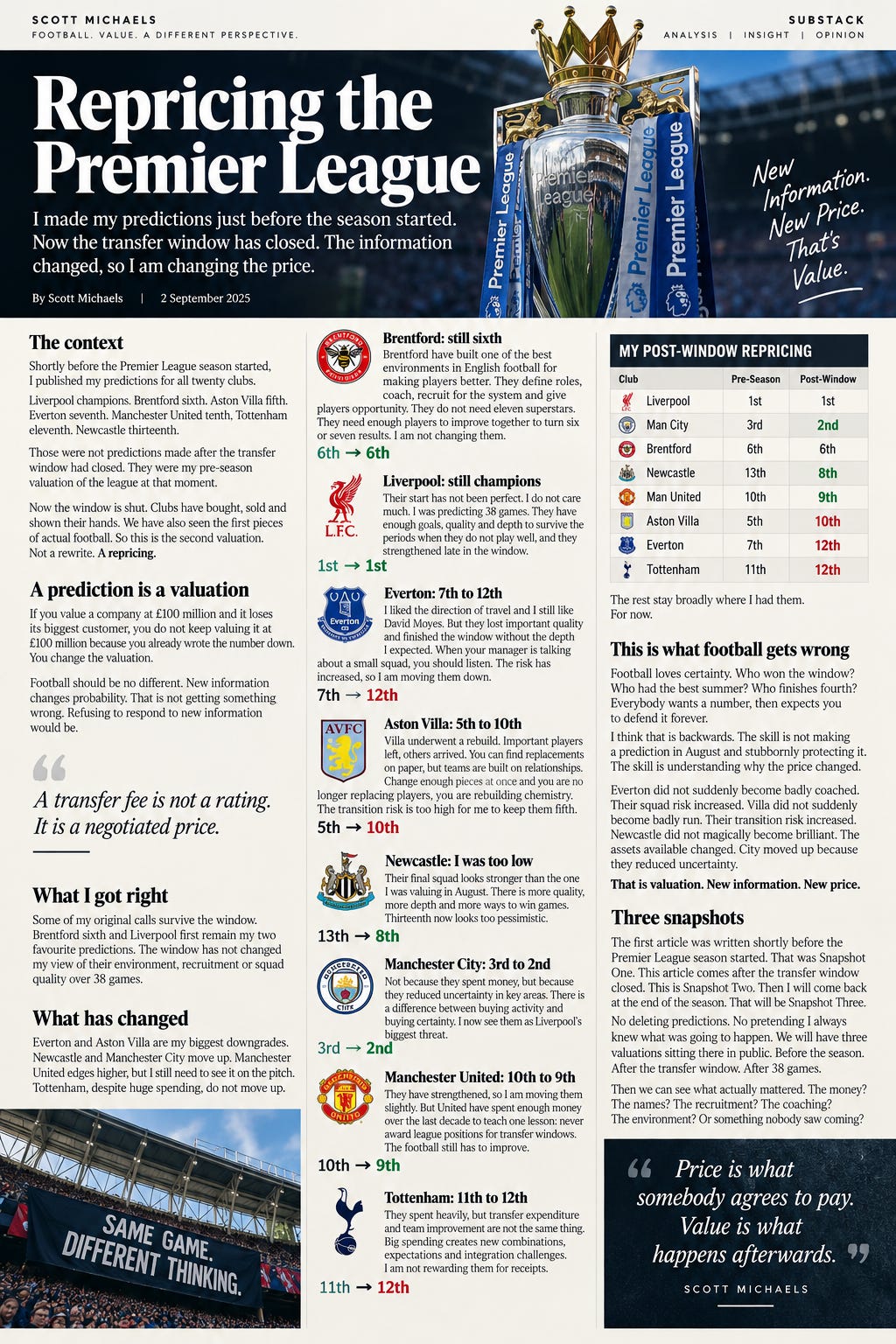
My post-window repricing
So these are the calls I am putting on record now.
Liverpool: 1st → 1st
Manchester City: 3rd → 2nd
Brentford: 6th → 6th
Newcastle: 13th → 8th
Manchester United: 10th → 9th
Aston Villa: 5th → 10th
Everton: 7th → 12th
Tottenham: 11th → 12th
The others stay broadly where I had them.
For now.
Because I don’t want to change predictions simply for the sake of producing a different table.
There has to be a reason.
This is what football gets wrong
Football loves certainty.
Who won the transfer window?
Who had the best summer?
Who finishes fourth?
Who gets relegated?
Everybody wants a number.
Then they expect you to defend that number forever.
I think that is backwards.
The skill isn’t making a prediction in August and stubbornly protecting it until May.
The skill is understanding why the price changed.
Everton didn’t suddenly become badly coached.
Their squad risk increased.
Villa didn’t suddenly become badly run.
Their transition risk increased.
Newcastle didn’t magically become brilliant.
The assets available changed.
City didn’t move upwards because somebody showed me their spending total.
I think they reduced uncertainty.
That is valuation.
New information.
New probability.
New price.
Three snapshots
And this is where this exercise becomes interesting.
The first article was written shortly before the Premier League season started.
That was Snapshot One.
This article comes shortly after the transfer window closed.
This is Snapshot Two.
Then I’ll come back at the end of the season.
That will be Snapshot Three.
No deleting predictions.
No pretending I always knew what was going to happen.
No moving the goalposts in April.
We will have three valuations sitting there in public.
Before the season.
After the transfer window.
After 38 games.
Then we can see what actually mattered.
The money?
The names?
The recruitment?
The coaching?
The environment?
Or something nobody saw coming?
Because when I wrote the original article, I said the Premier League had forgotten how to value footballers.
I still believe that.
Maybe more strongly now.
Some of this summer’s expensive transfers will be brilliant.
Some will look ridiculous in eighteen months.
And somewhere, a relatively cheap footballer will suddenly look like a £50 million player because somebody finally put him in the right environment.
That is the part football keeps underestimating.
Price is what somebody agrees to pay.
Value is what happens afterwards.