

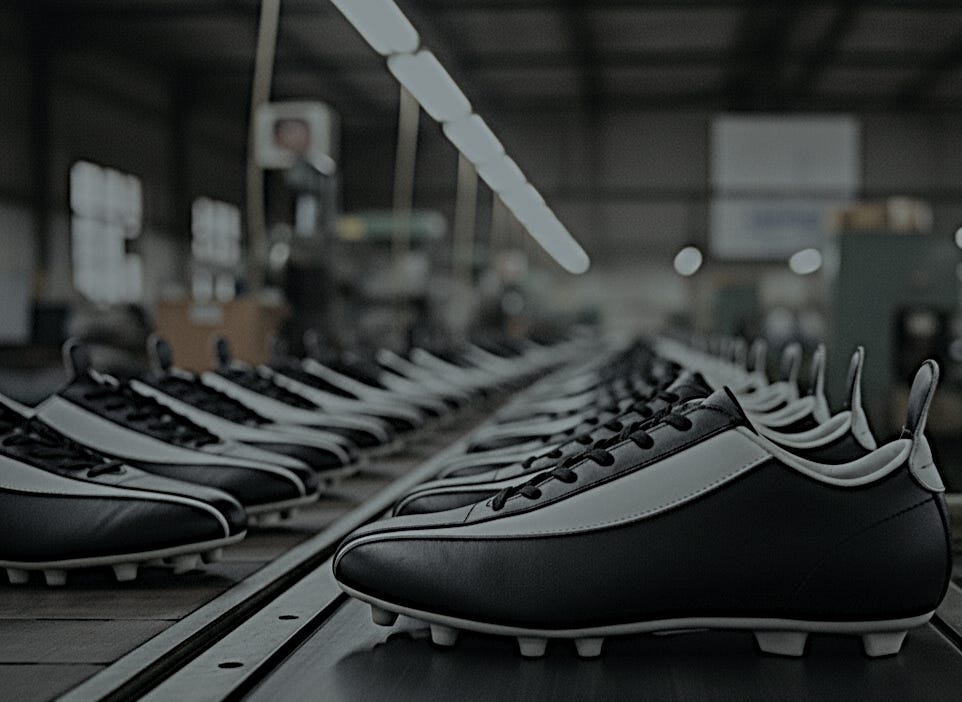
Episode Five Recap — The Moment the Factory Changed
By the time the new clock appeared, Footshape Boot Works was already different.
Orders were increasing. Players were arriving instead of clubs. Attention had shifted from product to people. What had once been a factory built on routine was quietly becoming something else — a place connected to identity rather than output.
The change didn’t arrive as conflict. It arrived as efficiency.
Two men in grey coats began timing the floor. Not looking for faults, but for seconds. The work sounded the same. The machines ran the same. But the silence between noises changed. Time itself became something measured rather than lived.
Mick O’Hara felt it first.
Thirty-two years on the same bench. Same knife. Same rhythm. A craftsman whose value existed in experience rather than speed. When he was called upstairs, nobody believed anything serious would happen. Men like Mick didn’t disappear. They anchored places.
But anchors make movement difficult.
The cutting was reclassified. His role became temporary. He left without anger, without argument, carrying his coat like he already understood something the others didn’t.
The next morning he was gone.
By midday his bench had been replaced by a machine. Cleaner. Faster. Already producing.
The factory continued.
That was the moment everything changed.
Because nothing stopped.
Arty halted production briefly, not as protest but as recognition. Mick had mattered. The men needed to hear it said aloud. Then the line started again, because orders still needed to go out.
That night, Arty began to understand something uncomfortable. Success hadn’t made the factory safer. It had made it useful.
And useful things attracted structure.
Structure attracted ownership.
Protection disappeared.
Episode Five ended with the machine switched off and the factory in darkness — the last moment where stopping something still felt possible.
Episode Six begins when that feeling disappears.
The New World
Football tells itself stories because stories make change easier to ignore.
We talk about loyalty. Mud on boots. Clubs belonging to towns. Players belonging to supporters. The past feels stable because it’s already finished.
The present never does.
Change rarely announces itself. It arrives as improvement. Faster production. Better distribution. More attention. Each step reasonable on its own.
Until one day things look different and nobody can agree when it happened.
Systems don’t ask permission. They move when conditions allow it.
Most people only notice after movement becomes normal.
Before the war, power was local.
Factories belonged to families. Clubs belonged to communities. Authority came from being known. Reputation travelled through memory. Decisions were personal, and therefore slow.
That world rewarded patience.
After the war, organisation replaced personality.
Television arrived. Advertising followed. Sport became something watched as much as lived. Decisions moved away from dressing rooms into offices where nobody wore boots.
Football didn’t stop being football.
It just stopped belonging entirely to the people inside it.
Some men never adjusted. They behaved as if familiarity guaranteed survival.
It didn’t.
There are always people who recognise this earlier than others.
They don’t look revolutionary. They don’t make speeches. They simply stop pretending the old rules still apply.
Ginger was one of them.
He sounded ordinary on purpose. Northern. Unimpressed. Easy to underestimate. But he watched everything. Timing mattered to him. Movement mattered more than loyalty.
“Everyone’s still acting like it’s before the war,” he said once. “Problem is, the war already happened.”
He never said whether that was good or bad.
Only that it was true.
Jimmy belonged to the previous world.
Ownership through relationships. Debt. Obligation. Influence built slowly and defended personally. Power held by men willing to hold it longest.
The new systems didn’t work like that.
They scaled. They standardised. They removed friction. You couldn’t threaten them because they didn’t feel threatened. They only measured output.
Ginger didn’t try to control that.
He positioned himself where it passed through.
Cleaner that way, he said once.
No sentiment getting in the way.
He smiled when he said it, as if it were a joke.
It wasn’t.
Participation
Arty understood the change. That was the problem.
He saw what was happening and told himself he could manage it. Adjust without losing the thing underneath. Keep the factory alive long enough for things to settle again.
So he made reasonable decisions.
He allowed the machine because orders had to go out. Increased output because wages had to be paid. Accepted efficiency because failure wasn’t an option.
Each decision solved a problem.
Together, they created something new.
He told himself he was protecting the factory.
He didn’t notice when protection became participation.
The first sign came quietly.
A delivery arrived late on a Thursday afternoon. New leather. Different supplier. Higher grade. More expensive.
Arty hadn’t ordered it.
The paperwork was already signed.
Ginger explained it simply.
Better margins. Faster turnaround. Future orders secured.
“It keeps us competitive,” he said.
Us.
Arty nodded, because the numbers made sense.
That night he realised nobody had asked him first.
Michelle
One evening, long after the machines stopped, Michelle found him still in the office.
The lights below were off. Only the cutter remained powered, its standby hum filling the silence.
“You’re still here,” she said.
“There’s always something.”
She stood beside him, looking down at the floor.
“They think you chose it,” she said quietly.
Arty didn’t answer.
The space where Mick’s bench had been looked smaller now. Like it had always been meant for the machine.
“I chose keeping the place open,” he said eventually.
Michelle nodded, but didn’t agree.
“Sometimes things survive by becoming something else.”
He laughed once. Short. Tired.
“That supposed to help?”
“No,” she said. “Just what happens.”
She looked at him then, properly.
“You don’t have to pretend you like it.”
For a moment neither of them moved. Not romance. Recognition. Two people understanding something neither could fix.
When she left, the factory felt larger than before.
And emptier.
The Conversation
Later that week, Ginger sat across from him in the pub.
Football played on the television. Nobody watched.
“You’re fighting the wrong thing,” Ginger said.
“I’m not fighting anything.”
“That’s worse.”
Arty frowned.
Ginger drank slowly.
“This isn’t about machines. Everything’s getting bigger. Faster. The old way doesn’t die because someone kills it. It dies because it can’t keep up.”
“And you’re fine with that?”
Ginger shrugged.
“Doesn’t matter if I am. It’s happening anyway.”
He leaned forward slightly.
“You just need to decide whether you want to be part of it or underneath it.”
No threat. No pressure.
Just certainty.
That was what unsettled Arty most.
The Line Keeps Moving
The factory still ran.
The boots still got made.
From the outside, nothing looked different.
Orders arrived on time. Deliveries left earlier than before. The numbers improved. That was what everyone said. Improvement.
Inside, things moved faster than conversations.
Decisions arrived already made. Suppliers already agreed. Timelines already fixed. Problems solved before reaching his office.
The system worked.
That was the problem.
One afternoon Arty walked the floor and realised nobody was waiting for him. The line moved without instruction. Adjustments happened automatically. Men spoke less. The machines filled the spaces where conversation used to live.
For the first time since Footshape began, he wasn’t needed to keep it moving.
He stood there listening to the rhythm. Efficient. Professional.
Wrong, somehow.
At the far end of the line a young lad hesitated over a cut, knife held too tight. The leather split slightly along the edge. Not ruined. Just imperfect.
The kind of thing Mick would have seen immediately.
The lad looked up at Arty.
Waiting.
Arty stepped closer, turning the boot in his hands. He could feel it straight away. A weakness that wouldn’t show now, but might later.
The old instinct rose automatically.
Stop the line. Fix it. Do it properly.
Behind him, the press continued to cycle. Boxes stacked. Orders building toward morning.
The new rhythm didn’t stop for small things.
“How bad?” the lad asked.
Arty hesitated.
One pair out of hundreds.
The order had to go out.
“Leave it,” Arty said finally. “It’ll pass.”
The relief on the lad’s face came instantly. The boot moved forward. Stitched. Pressed. Boxed.
Finished.
Good enough.
The line never slowed.
Across the floor, Ginger glanced over. Not surprised. Just acknowledging something inevitable.
No words passed between them.
None were needed.
The Realisation
Later, when the machines powered down one by one, the silence felt different. Not peaceful. Scheduled.
Arty walked through the empty floor slowly. Mick’s old space no longer looked like a loss. It looked efficient now. Logical.
That disturbed him more than the machine ever had.
For years he had believed the factory survived because he protected it. Because he knew what mattered.
Now it survived because it worked.
With or without him.
He switched off the last light and stood in the doorway.
Tomorrow the orders would go out. The numbers would look good. Everyone would say things were improving.
And they would be right.
That was the part he couldn’t escape.
The new world hadn’t forced its way in.
He had opened the door himself.
He locked up anyway.
Because morning would come, and the line would start again.
And this time, it wouldn’t need asking.