

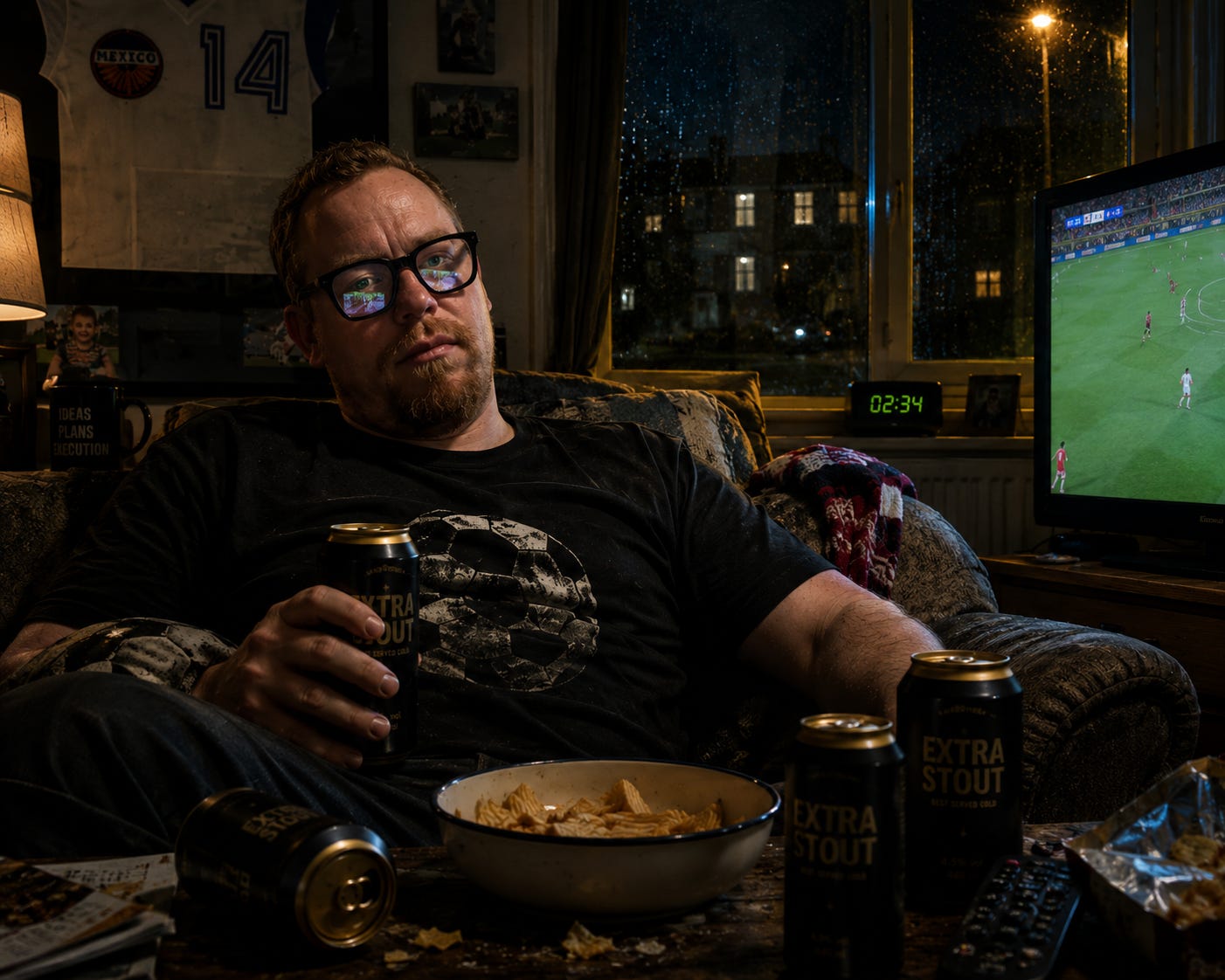
I watched both games.
My wife had picked me up four cans of stout that was reduced to clear from Home Bargains in St Anne’s earlier in the week.
It wasn’t Guinness.
It tasted more like bitter wearing a black coat.
Still, the World Cup only comes around every four years, so I took over the living room, cracked open the first can, and settled in for the opening night.
This is how most of us experience the biggest tournament on earth.
From the sofa.
With cheap beer.
With family wandering in and out of the room.
Then came the opening ceremony.
A ceremony that probably cost tens of millions and somehow managed to look both expensive and pointless at the same time.
Then came the pundits.
Serious faces.
Serious concerns.
Serious conversations about ticket prices, fan access, travel costs and the direction of the game.
All while enjoying the sort of World Cup experience most supporters could never dream of affording.
Football’s biggest problems always seem easier to discuss when somebody else has paid for your hotel.
And that, right there, is modern football in one picture.
The people explaining the problems are often living comfortably inside the system that created them.
The fans are outside paying for it.
Before a ball had even been kicked, Gianni Infantino told everyone to chill and relax.
The funny thing about football is that the people paying the bills are always told to relax.
The people sending the bills never are.
Then football happened.
Three red cards.
Mistake after mistake.
A South African team that waited sixteen years to return to the World Cup and then looked like the occasion had swallowed them whole.
A Mexico side that did not dazzle, but did the job.
A South Korean comeback that reminded everyone what tournament football is supposed to feel like.
Day One was not beautiful.
It was better than beautiful.
It was revealing.
The World Cup does not expose footballers.
It exposes human beings pretending they are not afraid.
South Africa were the clearest example.
Sixteen years.
That is how long they waited to get back.
Sixteen years since Tshabalala smashed that ball into history against Mexico.
Sixteen years of waiting, hoping, rebuilding and dreaming.
Then the moment arrived.
And they froze.
The first touch looked heavy.
The passing looked nervous.
The discipline disappeared.
Yaya Sithole went.
Themba Zwane went.
César Montes went late for Mexico too, but by then South Africa had already lost the plot.
The dream became a mess.
You can call it bottling it.
Plenty will.
But I think it was deeper than that.
South Africa were embarrassing.
There is no softer way to say it.
After sixteen years away from the World Cup, you do not get to turn up looking surprised by the size of the stage.
You do not get to play like the ball is an unpaid bill.
You do not get to lose your head, lose your discipline, lose two players, and then ask people to call it nerves.
Nerves are a heavy touch.
Nerves are a misplaced pass.
Nerves are a goalkeeper kicking one into Row Z.
What South Africa produced was worse than nerves.
It was a team emotionally unprepared for the job.
Sixteen years waiting.
Ninety minutes shrinking.
That is not bad luck.
That is a warning sign.
When I worked around players, one of the biggest signals people looked for was simple.
Can he play under pressure?
Not just can he pass.
Not just can he run.
Not just can he look good in a highlight reel.
Can he still make the right decision when the game gets heavy?
Can he still execute when eighty thousand people are watching?
Can he still think clearly when everything around him is speeding up?
In my experience, that question matters far more than most supporters realise.
The World Cup is the ultimate pressure test.
And on opening night, South Africa failed it badly.
Mexico deserve credit.
They were not spectacular.
They were professional.
That matters.
Opening games are not about romance.
They are about survival.
Nobody remembers possession stats in June if you are on the plane home in July.
Mexico got the points.
South Africa got the lesson.
Then came South Korea against Czechia.
And this was the better football match.
Not because it was perfect.
Because it felt alive.
Czechia looked exactly what you expect from a Czech side at a World Cup.
Big.
Organised.
Physical.
Dangerous from set pieces.
The sort of team that can make a football match feel like hard labour.
When Ladislav Krejčí put them ahead, it felt like the game was settling into a familiar pattern.
South Korea had plenty of possession.
Czechia had the lead.
Tournament football can be cruel like that.
Then Hwang In-beom decided he had had enough.
His equaliser changed everything.
Not just because he scored.
Because he took responsibility.
You could almost feel the belief spreading through the South Korean side.
The game sped up.
The passes became sharper.
The movement became braver.
The pressure shifted.
For a few moments Czechia thought they had regained control.
Then VAR intervened.
Fine margins.
The sort that decide tournaments.
Minutes later South Korea struck again.
Hwang drove forward.
Oh Hyeon-gyu finished.
Game over.
And that sequence told us more about South Korea than the result itself.
They stayed inside the storm.
They absorbed pressure.
They recovered from adversity.
They responded when the game started getting away from them.
South Africa shrank from the moment.
South Korea grew into it.
That is the difference.
Talent matters.
Temperament matters more.
South Africa played like the shirt was too heavy.
South Korea played like the moment belonged to them.
And let’s talk about the kick-off times.
Because I am absolutely knackered today.
I stayed up watching both games and I am paying for it now.
Czech supporters had it even worse.
Their game kicked off at four in the morning in Prague.
Four in the morning.
That is not a football time.
That is a newborn baby time.
That is an airport taxi time.
That is a “what am I doing with my life?” time.
And this is where FIFA needs to get smarter.
Why can these games not be scheduled with more common sense?
Use more early kick-offs in Canada and the northern American cities where the temperatures are lower.
Use the east coast more intelligently for games involving European and South American audiences.
Then use the west coast for matches where the time zones make more sense for Asia, Oceania and the Americas.
It will never be perfect.
A World Cup spread across three countries and multiple time zones is always going to inconvenience somebody.
But it should not feel like ordinary supporters are an afterthought.
The fan setting a 3:45am alarm in Prague matters.
The fan in England falling asleep on the sofa with a bad stout in his hand matters.
The fan dragging themselves into work the next morning matters.
Because those are the people who actually keep this thing alive.
There was another moment that mattered.
The empty seats.
Infantino told everyone to relax about ticket prices.
Then thousands of empty seats appeared during South Korea against Czechia.
Football supporters did not need a financial report to understand what they were looking at.
They were looking at the cost of pricing ordinary people out of football.
A World Cup stadium should never look half-empty because the people who love the game cannot afford to be there.
Meanwhile, more than eighty thousand packed into Mexico’s opener and reminded everybody what football actually looks like when people care.
The biggest lesson from Day One did not come from FIFA.
It came from the fans.
Football’s greatest asset is not a sponsorship deal.
It is a full stadium that actually gives a damn.
That is why Day One mattered.
Not because it gave us a classic.
It did not.
It gave us something more useful.
A warning.
This World Cup is bigger, richer, louder and more corporate than ever.
But the game underneath is still brutally simple.
Can you handle the moment?
Can you keep your head?
Can you make the next pass?
Can you stay human when the whole world is watching?
That is the bit FIFA cannot package.
They can sell hospitality.
They can sell sponsorship.
They can sell opening ceremonies.
They can sell the game back to the people who made it famous.
But they cannot manufacture pressure.
They cannot fake emotion.
They cannot own the feeling of sitting in your living room, drinking stout that tastes like bitter wearing a black coat, watching players from the other side of the world carry the hopes of millions.
That is why football still works.
Even when it is ugly.
Especially when it is ugly.
Because beneath the branding, the fireworks, the speeches and the corporate polish, football is still human.
A bad touch.
A red card.
A comeback.
A family living room.
A supporter shouting at the screen like he has been personally appointed assistant manager by common sense.
That is the real World Cup.
Not the VIP lounges.
Not the opening ceremony.
Not the people telling everyone to relax from the softest seats in the stadium.
The real World Cup is hope.
And hope is dangerous.
It makes grown adults believe.
It makes nations dream.
It makes players carry sixteen years on their backs.
Sometimes they rise.
Sometimes they collapse.
Day One gave us both.
Infantino told everyone to relax.
But nobody relaxes at a World Cup.
Not the players.
Not the fans.
Not the managers.
Not the nations who waited years for one night and then watched it fall apart in ninety minutes.
That is why we keep watching.
Because pressure reveals everything.
Day One revealed fear.
It revealed resilience.
It revealed the absurdity of modern football.
And it revealed that no matter how corporate this game becomes, it still lives in ordinary living rooms, with ordinary fans, drinking ordinary stout, caring far more than the people charging them for the privilege.
The World Cup still belongs to the people sitting on old sofas, drinking cheap stout, caring too much.
Everyone else is just renting space around it.
A final note.
I won’t be commentating on every World Cup game.
There are already enough people doing that.
What I will be doing is reviewing each group once the dust settles.
Who handled the pressure.
Who looked overrated.
Who surprised me.
Who is quietly building momentum.
Who has the mentality to go deep into the tournament.
And who is already showing signs they are going home early.
I am less interested in possession statistics and expected goals.
I am interested in people.
Pressure.
Temperament.
Decision-making.
Because World Cups are not won by the team with the prettiest passing patterns.
They are won by the team that handles the moment best.
My group-by-group World Cup reviews, predictions and tournament rankings will be available on my paid Substack.
Not every game.
Just the stuff that actually matters.