

Previously, in Episode Two
Arty Zee travelled to Glasgow to meet Jimmy McBride, the man who held his late father’s debt like a quiet inheritance. McBride made no threats, only offers. The debt could disappear, but only in exchange for a silent percentage of whatever Arty became. Not the factory. The future.
Arty understood what it meant. Ownership without paperwork.
Back in Leeds, pressure followed. Inspections. Supplier delays. Insurance quietly changing its terms. Nothing illegal. Nothing obvious. Just systems tightening around him.
Then came the call at 02:14.
Footshape Boot Works had been reclassified.
Not a factory anymore.
A brand asset.
And brand assets, apparently, did not qualify for standard fire insurance.
The paperwork was already moving.
Episode Three – The Reclassification
Footshape Boot Works woke before sunrise.
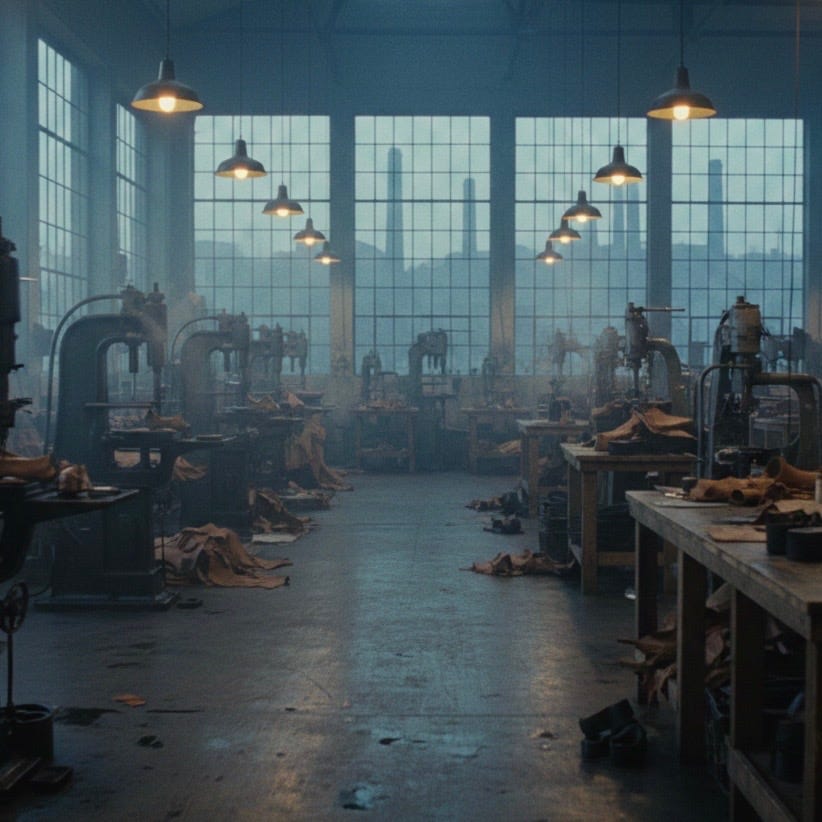
Lights flickered on above the factory floor. One machine started, then another, until the building filled with the familiar rhythm of presses and stitching tables. Leather cut cleanly. Rubber heated and shaped. Glue warming slowly in the cold air. The smell of oil and heat settled into everything.
Real work.
The kind that didn’t pretend to be anything else.
Arty Zee stood on the upper walkway and listened.
His father used to say factories had a heartbeat. When things were right, the sound became invisible. When something was wrong, you felt it before you knew why.
This morning, the rhythm felt different.
Not broken.
Observed.
Ben appeared beside him with two mugs of tea.
“You’ve not gone home.”
“No.”
Ben nodded toward the floor below. “Orders keep coming. Scotland again. Holland. German distributor asking about weight changes.”
That should have felt like success.
Instead, Arty felt exposed.
“They’ve changed the insurance,” he said.
Ben frowned. “Changed how?”
“They say we’re not just manufacturing anymore.”
“What else would we be doing?”
“They’ve reclassified us as a brand asset.”
Ben laughed, waiting for the joke.
Arty didn’t smile.
“If this place burns,” he said quietly, “nobody pays.”
The laughter stopped.
Below them, a press slammed down hard enough to shake the railing. A worker swore as steam escaped from the mould. Normal noise. Ordinary mistakes.
But now Arty heard something else underneath it.
Risk.
Success had stopped meaning safety.
It meant attention.
Roth arrived late morning, rain still on his coat.
“You’re treating this like a debt problem,” he said.
“It started as one.”
“Yes,” Roth replied. “And now it isn’t.”
He placed a folder on the desk.
Inside were newspaper photographs. Not boots. Not factories.
Athletes.
Arnold Palmer walking through crowds in America. Rod Laver shaking hands at Wimbledon. Pelé surrounded by photographers in New York.
Arty frowned. “What’s this got to do with me?”
“Nothing,” Roth said. “Yet.”
He tapped the photograph of Pelé.
“There’s an American behind this. Mark McCormack. Lawyer. Represents Palmer. Tennis players. Now footballers.”
Arty shrugged. “That’s America.”
Roth shook his head slowly.
“That’s next.”
The words stayed in the room.
“Football’s still football,” Arty said. “Clubs. Supporters. Saturdays.”
“For now.”
The inspection came that afternoon.
A council man in a grey coat. Polite. Careful. Measuring distances that had never mattered before. Writing notes about ventilation, storage height, fire access.
Nothing serious.
Nothing immediate.
Just enough to slow things down.
By the time he left, three improvement notices were pinned beside the clock-in board.
Workers barely looked at them.
Arty did.
None of it closed the factory.
It simply made running it harder. More expensive. More fragile.
Pressure without confrontation.
Someone tightening screws slowly enough that nobody could accuse them of doing it.
That night, Arty found himself driving toward Elland Road without planning to.
He’d been coming there since he was young, back when his father repaired boots for local clubs and nobody thought twice about a bootmaker walking through the tunnel carrying leather and studs.
That was where he’d first met Bobby Collins.
Collins didn’t look like a footballer at first glance. Too small. Too solid. But once he spoke, people listened. He cared about boots the way other players cared about tactics. Balance. Weight. Feel.
He’d sit after training turning a pair over in his hands.
“Boot’s wrong,” Collins once told him. “Half a yard slower and nobody knows why.”
Arty learned more in those conversations than from any supplier.
Football, Collins said, was details.
Everything else was noise.
Through Collins, he met Don Revie.
Not formally. Revie didn’t do formal.
He appeared one afternoon in the boot room, watching quietly while Arty adjusted a sole. Revie’s presence filled the space without effort. Leeds didn’t just play football under him. They operated.
“You Ismail’s lad?” Revie asked.
Arty nodded.
Revie picked up a boot, weighed it in his hand.
“Players trust what’s familiar,” he said. “Change too much, they lose confidence. Confidence goes, performance follows.”
He set the boot down carefully.
“Football’s about control,” Revie added. “Lose control, and someone else takes it.”
At the time, Arty thought he meant matches.
Now he understood he meant everything.
Inside the ground, lights still burned. Late training. Preparation. Routine. A world built on trust and repetition.
That was the football Arty understood.
Not paperwork moving quietly in offices.
Not insurance being reinterpreted.
On the way back into the city, Arty stopped at a newsagent window.
George Best stared back from the front page.
Not scoring. Not celebrating. Just walking through Manchester in a coat that looked too expensive for football, photographers around him, headlines about nights out instead of matches.
Two boys stood nearby arguing, neither mentioning Manchester United. Only Best.
The way he played. The way he looked. The way people watched him even when he wasn’t playing.
That was new.
Players used to belong to clubs.
Now some of them seemed to belong to something else entirely.
Attention.
Arty realised there was nothing different about Best’s boots.
Only that people noticed them.
And once people started noticing, things stopped being equipment.
They became symbols.
The call came the next morning.
The voice was calm. American. Certain.
“Mr Zee. Mark McCormack.”
Arty said nothing.
“I represent a number of athletes you may have heard of. Arnold Palmer. Rod Laver. Recently Pelé.”
“And why are you calling me?”
“Because sport is about to change,” McCormack said. “Not the games. The meaning of them.”
Outside, the presses continued their rhythm.
“You’re in a position most manufacturers aren’t,” he continued. “You’re close enough to players to matter. Far enough from clubs to move.”
Arty watched the factory floor through the office window.
“What’s coming?” he asked.
A pause.
“The player will become bigger than the club,” McCormack said. “And soon people won’t follow clubs. They’ll follow people.”
Silence followed.
Because Arty understood exactly what that meant.
“I’m not asking for anything today,” McCormack said. “Just introducing myself.”
The line clicked dead.
No threat.
No demand.
Just inevitability.
That evening, Arty opened one of his father’s old ledgers.
Names filled the pages. Suppliers. Agents. Club officials. Men who owed favours and men who collected them.
Ismail Zee had built protection through balance. Nobody owed him enough to destroy him. Nobody owned enough to control him.
But this new world wasn’t built on balance.
It was built on scale.
And scale didn’t care about loyalty.
Outside, the machines continued their steady rhythm.
For weeks, Arty had been thinking about survival. About defending what already existed.
Now he understood the mistake.
They weren’t trying to take the factory.
They were waiting for him to build something bigger than a factory.
Something that could be owned.
He closed the ledger and walked back onto the factory floor.
Heat hit him immediately. Noise. Movement. Men working without thinking about markets or ownership or identity.
He picked up a finished boot from the bench. Heavy. Solid. Honest.
For the first time, he understood that changing first meant losing the safety of being small.
“Change the mould,” he told the foreman.
The man frowned. “Which one?”
“All of them.”
“For who?”
Arty looked across the factory, listening to the machines.
“For the next player who matters.”
The foreman nodded, not understanding but trusting.
The presses continued their rhythm.
Only now they were moving toward something none of the men in the building understood yet.
And somewhere far beyond Leeds, the future had already started looking back.
End of Episode Three