

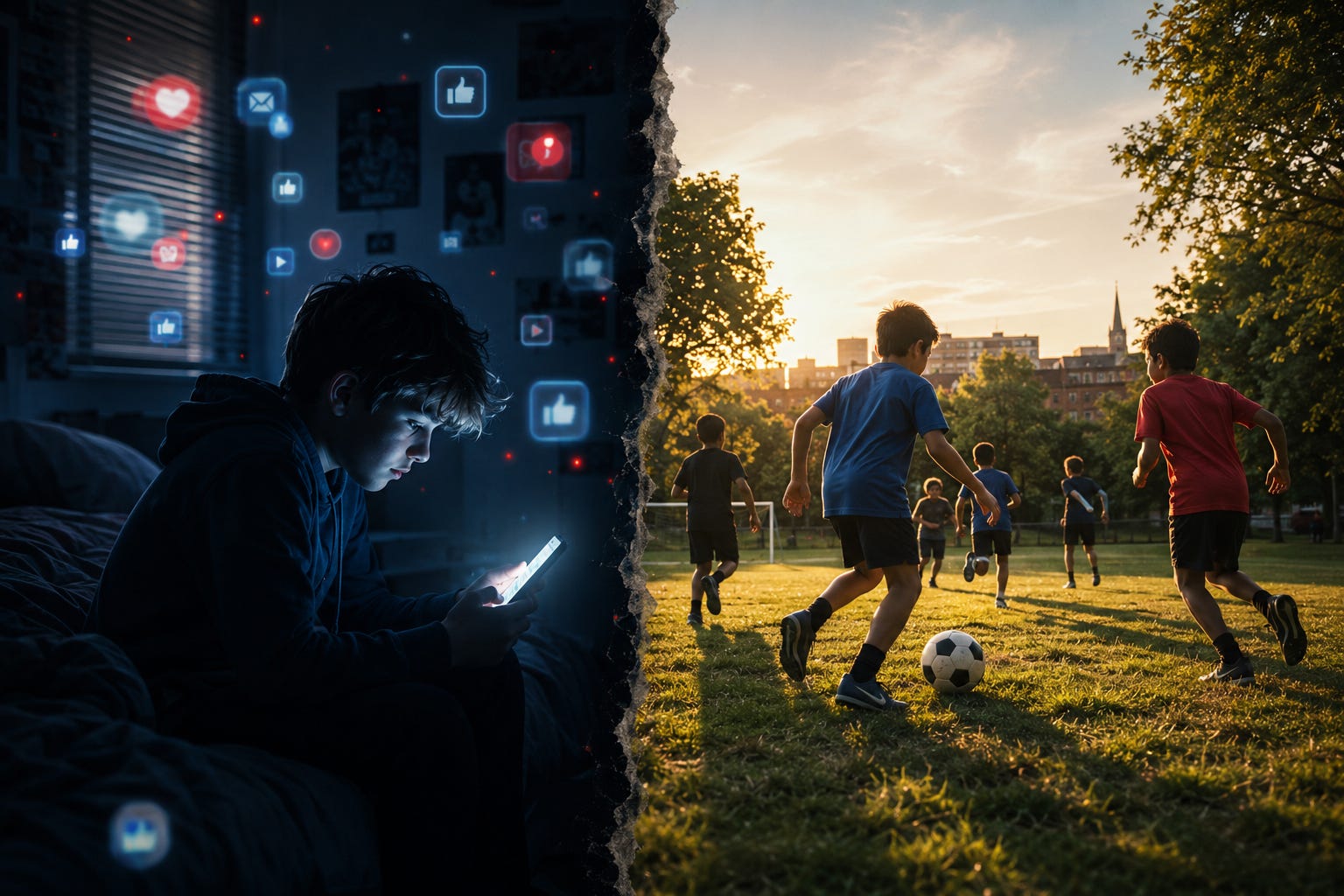
The government wants to ban social media for under-16s.
Good.
Now comes the difficult part.
What replaces it?
Because banning something is easy.
Building something better is hard.
A fourteen-year-old finishes school at 3.30pm.
The youth club closed years ago.
The football team costs too much.
The boxing gym is struggling.
The park feels unsafe.
The bus service was cut.
His parents are working.
There is nowhere to go.
So he goes upstairs.
Closes the door.
Opens TikTok.
And we call that a technology problem.
It isn’t.
It’s a community problem.
For fifteen years Britain built digital playgrounds while quietly closing real ones.
Then we acted surprised when children stopped playing outside.
Screens Filled The Vacuum
Children did not choose screens because screens were better.
They chose screens because screens were available.
A teenager used to have options.
Football.
Boxing.
Youth clubs.
Scouts.
Music.
Libraries.
Friends knocking on the door.
Places to go.
People to meet.
Things to do.
Many of those things still exist.
But fewer.
And increasingly at a cost working families struggle to justify.
The child didn’t change.
The environment did.
Today a child can access the entire world from a bedroom.
That is not because technology won.
It is because community lost.
We didn’t lose our children to technology.
We lost the places that used to compete with it.
But The Apps Are Not Innocent
Let’s not pretend social media companies are innocent bystanders.
They did not simply build platforms and wait for children to arrive.
They built machines of attention.
Infinite scroll.
Notifications.
Likes.
Streaks.
Autoplay.
Algorithmic feeds.
Every part is designed to keep the thumb moving and the brain waiting for the next hit.
That is not an accident.
That is the business model.
The longer a child stays on the platform, the more data is collected, the more adverts are served, and the more money is made.
So yes, Britain failed to build enough real-world alternatives.
But Silicon Valley also built digital environments designed to be difficult to leave.
Both things are true.
We need youth clubs.
We need football pitches.
We need boxing gyms.
We need music rooms.
But we also need serious regulation of predatory algorithms aimed at children.
Because childhood should not be an extraction market.
And attention should not be something corporations are allowed to strip-mine from a child’s developing brain.
To be fair, social media is not all bad.
For some young people it provides friendship.
Creativity.
Connection.
Opportunity.
A sense of belonging.
But when a phone becomes the primary place a child lives rather than a tool they use, something important has been lost.
No app was ever designed to replace a real friend.
No algorithm was ever designed to replace a community.
Football Should Cost Less Than A Phone Contract
Start with football.
The national game.
The working-class game.
The game that built friendships, confidence, resilience and belonging.
Why should it cost hundreds of pounds a year for a child to play?
Why should parents have to choose between groceries and grassroots sport?
Every child in Britain should be able to play football for less than the cost of a mobile phone contract.
A ball.
A pitch.
A coach.
A chance.
That should be normal.
The cost of keeping a child active is tiny compared to the cost of repairing a broken adult.
Every pound spent on prevention saves pounds spent later on crisis.
Mental health services.
Crime.
Addiction.
Isolation.
Unemployment.
The bill always arrives.
Society simply chooses whether to pay early or pay late.
Britain Is Already Spending The Money
The government has started investing again.
Youth programmes.
After-school clubs.
Community projects.
New initiatives.
Good.
But let’s not clap too early.
For years local youth services were cut.
Youth centres disappeared.
Communities were hollowed out.
Volunteers, charities and exhausted parents were left to fill the gaps.
You cannot close the places children belonged and then act surprised when they belong to an algorithm.
You cannot remove the ladder and then criticise people for not climbing.
One funding announcement will not solve this.
One election cycle will not solve this.
This requires a national rebuild.
The Question Nobody Wants To Ask
There is another question worth asking.
If governments decide who can access social media, what comes next?
Age verification sounds simple.
But verification requires identification.
Identification requires data.
Data creates power.
And power has a habit of expanding.
Today the target is social media.
Tomorrow it could be something else.
History is full of systems introduced for one purpose and later used for another.
That does not mean protecting children is wrong.
Far from it.
Children deserve protection.
But adults deserve privacy.
Both principles matter.
Any system introduced to protect young people should be transparent.
Proportionate.
Limited.
Accountable.
Because a free society should be cautious whenever large amounts of personal information become concentrated in one place.
The answer to unhealthy digital dependence cannot simply be more digital control.
A digital ID cannot replace a youth worker.
An age-verification check cannot replace a football coach.
A database cannot replace a community.
The Real Crisis
The real crisis is not social media.
Social media is the symptom.
The crisis is disconnection.
Fewer friendships.
Fewer safe spaces.
Fewer trusted adults.
Fewer affordable activities.
Less independence.
Less confidence.
Less belonging.
Then we wonder why anxiety rises.
Human beings are social creatures.
We were never designed to grow up through glass screens.
People need people.
Children need people.
That has not changed in thousands of years.
Only the technology has.
Build Childhood Again
So yes.
Ban social media for under-16s if that is where the evidence leads.
But do not stop there.
Fund youth clubs.
Build football pitches.
Support boxing gyms.
Support music programmes.
Back apprenticeships.
Open community centres.
Repair parks.
Fund coaches.
Fund youth workers.
Create places where confidence is built before it becomes crisis.
Because children do not need another app.
They need somewhere to go after school.
Someone to believe in them.
Something to belong to.
Children are not asking for much.
A ball.
A pitch.
A place to belong.
A reason to leave the house.
A future worth looking up from a screen for.
The greatest mistake Britain made was believing community could be replaced by technology.
It can’t.
And the next mistake would be believing technology can solve the problems created by the disappearance of community.
Because the future of childhood will not be saved by an algorithm.
It will be saved by people.
Real people.
In real places.
Doing real things together.
Don’t just ban social media.
Build childhood again.