

There is a phrase sitting on page 20 of Manchester United plc’s 2004 annual report that deserves another look.
“Treating fans as customers.”
It was one of the club’s commercial priorities.
United explained that it had collected more than 2.5 million fan records into a customer-relationship database, segmented supporters into groups and used that information to tailor communications, products and services. Old Trafford, catering, the megastore, membership, the internet: Manchester United was learning how to turn extraordinary loyalty into extraordinary commercial power.
Nothing was improper about that.
In many ways it was brilliant business.
But Manchester United was becoming exceptionally sophisticated at understanding the value of somebody who loved Manchester United while remaining surprisingly exposed over something even more valuable:
control of Manchester United itself.
Within a year Malcolm Glazer would own the club.
And that is where I think we have been telling United’s decline from the wrong starting point.
Manchester United did not suddenly become dysfunctional when Sir Alex Ferguson retired in 2013.
2013 was when United discovered how much of Manchester United had actually been Alex Ferguson.
The road there begins almost a decade earlier, with a football agency, a boardroom investigation, two Irish billionaires, 99 questions and one of the strangest characters ever to appear in the ownership history of a football club.
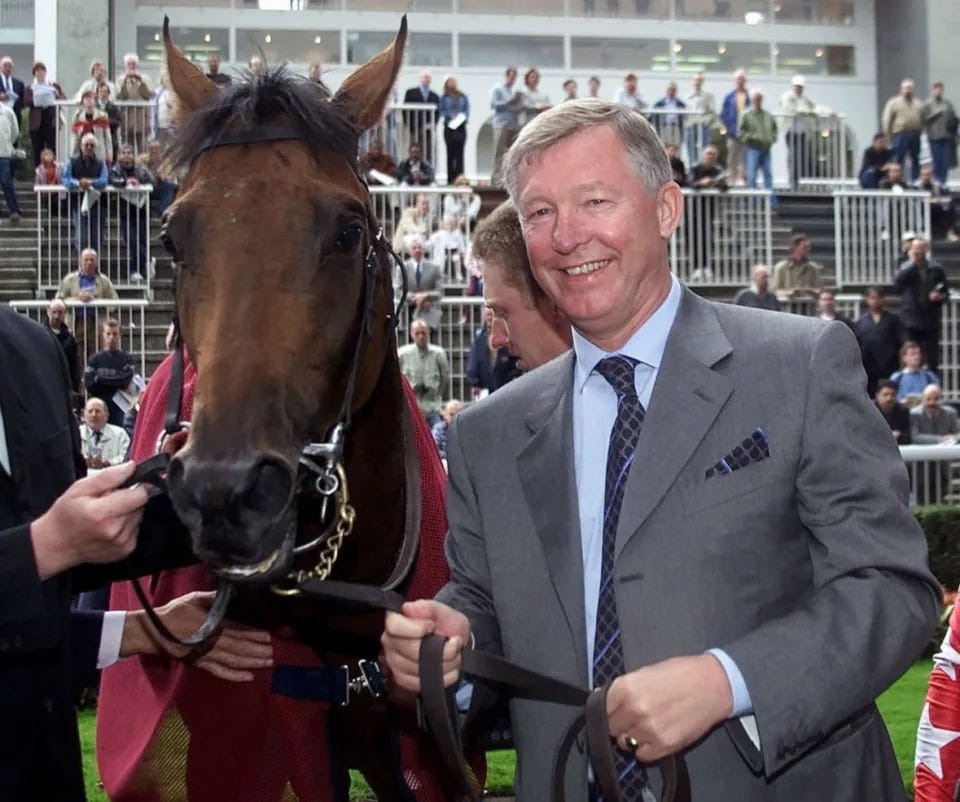
A racehorse called Rock of Gibraltar.
The horse did not cause the Glazer takeover.
It exposed how little protection Manchester United had when powerful relationships changed.
Before the ownership crisis came a governance warning
Ferguson’s greatness is not really in dispute.
That is precisely what makes this difficult.
By the early 2000s he had accumulated extraordinary authority at Old Trafford because he had delivered extraordinary results.
But good governance is not designed only for people you distrust.
Its purpose is to make sure an institution does not have to survive on trust in the first place.
Ferguson’s son Jason became involved in Elite Sports Group with licensed agent Francis Martin and former Manchester United youngster David Gardner. Gardner was already close to David Beckham and other United players. Contemporary reporting described Jason Ferguson, Gardner and Martin as the central figures in Elite.
Elite became deeply embedded around Manchester United footballers.
By May 2004 it represented 13 United players — ten younger players plus Darren Fletcher, Quinton Fortune and Roy Carroll.
And United’s own annual report gives us something better than retrospective newspaper colour.
Page 68 lists the club’s payments to agents. Beside Darren Fletcher is a £100,000 payment charged to the profit-and-loss account. Footnote one then states:
“Darren Fletcher was represented by Francis Martin who was a Director of Elite Sports Group Limited.”
That is Manchester United’s own filing.
Now remove the famous names.
A manager controls selection, development, opportunity and enormous parts of a player’s career.
His son’s company represents footballers working within that operation.
Nobody has to be slipping cash into an envelope for that arrangement to create a problem.
A conflict of interest exists because of what might influence a decision, not because somebody has already proved that it did.
Manchester United eventually recognised that itself.
The club investigated itself
In early 2004 United launched a four-month examination of its transfer activity.
The resulting review covered 21 player transfers between January 2001 and January 2004, with gross fees of £158 million. Four involved no agent. The other 17 generated agent fees equivalent to another 8.5% of the transfer value — approximately £13.4 million. Twelve smaller transactions were excluded on grounds of agent-fee materiality.
The board said its internal approval processes had been followed and that the required transfer, agency and player documentation complied with the relevant football rules.
That matters.
This was not an inquiry that concluded Ferguson had been stealing from Manchester United.
But the review still produced a remarkable response.
United acknowledged “the concerns over the connections between Elite and Sir Alex Ferguson” and said that in future Manchester United would not employ Elite to act for the club.
That was the firewall.
And it tells us more than another decade of conspiracy theories ever could.
Manchester United itself believed the relationship needed separating.
The firewall was also incomplete.
United would no longer appoint Elite on its side of a transaction.
Elite could still represent a footballer sitting on the other side of the table.
Lawful.
But hardly a complete untangling of the network.
The review also disclosed transactions that explain why scrutiny had become so intense. United paid intermediary Mike Morris £750,000 in connection with Jaap Stam’s move to Lazio. In the £2.3 million Tim Howard transfer, £700,000 went to Swiss intermediary Gaetano Marotta; United acknowledged that the fee was large as a proportion of the transaction. Contemporary reporting established that £139,000 was subsequently paid by Marotta to Morris, who was closely associated with Elite.
There is no evidence in those findings that Ferguson personally received that money.
The more important fact is less sensational:
Manchester United had allowed family, agents, players and managerial authority to overlap sufficiently that the club’s own board decided the boundaries needed redrawing.
And then the people asking the questions became the people Ferguson was fighting.
Rock of Gibraltar
John Magnier and JP McManus were not outside agitators.
Through Cubic Expression they controlled 28.89% of Manchester United.
Magnier had also been Ferguson’s friend.
Then came Rock of Gibraltar.
Ferguson believed his interest in the champion racehorse entitled him to valuable breeding rights. Magnier disputed that interpretation. Their relationship collapsed into litigation.
Under normal circumstances it would have remained a private fight between extremely wealthy men.
Except one of them managed Manchester United.
The other, alongside McManus, controlled the largest block of Manchester United shares.
The conflict moved inside Old Trafford.
Magnier and McManus used their shareholder rights aggressively, submitting the famous 99 questions about transfers, agents, Ferguson’s arrangements and United’s corporate governance. Contemporary coverage identified a series of transactions they wanted examined.
Nobody should pretend their motives were neutral.
The questions arrived in the middle of an acrimonious dispute with Ferguson.
But motive does not determine whether a question is legitimate.
United subsequently investigated its practices, changed procedures and erected the Elite firewall.
The horse did not create the governance problem.
It gave powerful shareholders a reason to lift the floorboards.
But even that was not Manchester United’s fundamental vulnerability.
For that, go back to 1999.
The takeover United stopped — and the takeover it couldn’t
In 1998 BSkyB agreed to buy Manchester United for £623 million.
It was blocked.
The Monopolies and Mergers Commission examined the proposed transaction, and Trade Secretary Stephen Byers rejected it in April 1999. The particular problem was the relationship between BSkyB’s position in football broadcasting and ownership of one of the country’s most commercially important clubs. Competition concerns gave government a legal route to intervene.
Six years later Malcolm Glazer acquired Manchester United.
The Office of Fair Trading’s Red Football Ltd / Manchester United plc decision, published on 4 August 2005, is one of the most revealing documents in the entire story.
During its consultation, the OFT recorded receiving:
“some 1700 representations from concerned third parties.”
Those submissions raised the way the shares had been acquired, effects on Manchester United and its local community, collective television rights, ticket-price increases and possible moves towards pay-per-view.
The OFT then explained why much of that could not decide the case.
The method of share acquisition fell outside its considerations.
Many broader public-interest objections were not specified public-interest grounds under the legislation.
Possible ticket-price increases were not enough unless they resulted from a lessening of competition caused by the merger.
Most importantly, the OFT found no relevant horizontal or vertical competitive overlap between Glazer and Manchester United. The transaction was therefore not referred to the Competition Commission.
The decision also records something that looks extraordinary with hindsight: the government had confirmed that it did not propose creating a new public-interest consideration allowing football-club ownership changes to be referred on non-competition grounds.
Put 1999 beside 2005.
That is the gate.
The BSkyB deal triggered a competition problem the authorities could act upon.
The things United supporters feared about Glazer ownership were largely questions the merger regime had not been built to answer.
Supporters were effectively asking:
Will this transaction be good for Manchester United?
The OFT had to ask:
Will this transaction substantially lessen competition in a market?
Those are not the same question.
The law answered the second.
Manchester United would spend the next twenty years living with the first.
Then the decisive block moved
On 12 May 2005, Magnier and McManus sold their 28.7% shareholding to Malcolm Glazer for 300p a share.
Glazer’s offer valued United at approximately £790.3 million. Acquiring the Cubic holding immediately took him to 56.9% — control.
This is where the story often gets distorted.
Rock of Gibraltar did not hand Manchester United to Malcolm Glazer.
Ferguson did not engineer the takeover.
Glazer had already been accumulating shares, and United was a quoted company whose stock was available to acquire.
Magnier and McManus also had the most ordinary reason in capitalism for selling an investment.
They were being offered a profitable exit.
The interesting part is not conspiracy.
It is structure.
They could sell because they owned the shares.
Manchester United supporters might understand the club as inheritance, community and identity.
Corporate law understood those shares as property.
When those two understandings collided, the share register won.
United’s board had already diagnosed the risk
The directors were not blind.
On 28 April 2005 Manchester United said the assumptions in Glazer’s business plan were “aggressive”, the proposed capital structure contained more leverage than the board considered prudent, and there was likely to be “significant financial strain on the business.”
At the same time the board acknowledged that 300p a share was financially fair and that ultimately shareholders would decide whether an offer succeeded.
That is the important mechanism.
The directors could believe an offer was financially attractive to shareholders while simultaneously believing its financing was potentially damaging to the company.
Those propositions were not legally contradictory.
Then the Cubic shares moved.
The takeover followed.
And the financial structure of Manchester United changed dramatically.
BBC Verify’s later reconstruction calculated that gross debt went from about £50 million before the takeover to £604 million afterwards. From 2005 through 2024, it calculated roughly £1.187 billion of cash outflows in interest, net external debt repayments, dividends and Glazer-related fees associated with the post-takeover structure.
That figure needs stating properly.
The Glazers did not pocket £1.187 billion.
Much of it was interest paid to lenders.
Which is exactly why the figure matters.
Manchester United generated money that had to service financing created by the acquisition of Manchester United.
The club had not borrowed hundreds of millions to replace Old Trafford.
It had not borrowed the money to revolutionise its academy.
Much of the burden existed because Manchester United had been bought with substantial borrowing.
That is the structural change supporters were warning about.
Then Ferguson made the story inconvenient
He kept winning.
Not fake winning.
Not PR winning.
Manchester United remained one of the best football teams in Europe.
Five Premier League titles under Glazer ownership.
Another European Cup.
Three Champions League finals.
Cristiano Ronaldo becoming the best player in the world.
Rooney. Ferdinand. Vidić. Van der Sar. Scholes. Giggs.
Any serious account has to hold two ideas in its head simultaneously.
The Glazer financing structure imposed enormous costs on Manchester United.
And:
Alex Ferguson built genuinely brilliant teams inside that structure.
That is what makes Ferguson so important to understanding what followed.
In January 2006, after United signed Nemanja Vidić and Patrice Evra, Ferguson described the Glazers as “excellent new owners” and said they had supported him.
The following day he explained why private ownership could suit him better than the old PLC. Transfer decisions no longer needed to move through the football-club board, PLC board and Stock Exchange machinery. He could get a quicker yes or no.
When asked about the club’s long-term debt, he replied:
“Why should I worry about that?”
That quote is often used as evidence that Ferguson betrayed supporters.
I think the more interesting explanation is simpler.
Ferguson was answering the question a football manager naturally asks.
Can I get players?
Can I control my team?
Can I compete?
Can I win?
Yes.
Supporters opposed to the takeover were asking a different question:
What does Manchester United look like twenty years from now?
Ferguson needed United to function on Saturday.
Supporters expected their children to inherit it.
Different clocks.
Manchester United mistook Ferguson working for Manchester United working
Ferguson’s post-2005 success was not camouflage in the sense of being false.
It was camouflage because his genuine excellence reduced the urgency of solving problems beneath him.
United had become dependent on an exceptional man.
He was manager, institutional memory, cultural enforcer, squad planner, talent judge, authority figure and continuity machine.
Modern elite clubs spread those functions across football executives, technical directors, recruitment teams, data departments and coaches.
Manchester United had Ferguson.
It worked magnificently.
Until it didn’t have Ferguson.
That is why 2013 did not break Manchester United.
2013 removed the scaffolding.
Suddenly the organisation had to demonstrate that it could choose managers coherently, recruit to a consistent philosophy, manage wages, structure football leadership and recover from mistakes without one extraordinary figure knitting everything together.
What followed was not purely an ownership failure.
United also made bad football decisions.
Managers with incompatible ideas inherited squads built for somebody else.
Recruitment lurched.
Contracts became difficult to unwind.
Football structures changed repeatedly.
Huge amounts were spent badly.
The Glazers did not personally choose every bad midfielder.
That distinction matters because otherwise the prescription becomes childishly easy:
change the owner and Manchester United automatically become Manchester United again.
No.
The ownership structure reduced United’s margin for error.
Operational incompetence then repeatedly consumed what margin remained.
Ratcliffe inherited both problems
Sir Jim Ratcliffe did not create the 2005 structure.
Nor was his investment another version of Malcolm Glazer’s leveraged takeover.
Under the transaction agreed on 24 December 2023, Trawlers Limited purchased shares and committed to subscribe for $300 million of new equity in Manchester United — $200 million at closing and another $100 million subsequently — with the investment associated with infrastructure at Old Trafford.
INEOS was also given substantial responsibility for football operations.
And Ratcliffe inherited a business with genuine cost problems.
The results now show some of the effect of his restructuring. In the nine months to 31 March 2026, Manchester United recorded an operating profit of £37.660 million, compared with an operating loss in the equivalent prior period. Employee costs fell as headcount reductions took effect.
But beneath that operating result, the group still reported £55.700 million of net finance costs and a net loss of £14.234 million for the nine-month period. Those figures come from United’s own interim filing.
The cost-cutting therefore cannot be dismissed as theatre.
But nor can executive decisions escape scrutiny simply because the accounts are improving.
United disclosed £14.5 million of exceptional costs connected with the departures of Erik ten Hag, his staff and Dan Ashworth; BBC reported that £10.4 million related to Ten Hag and his staff and £4.1 million to Ashworth’s hiring and departure after only months in the job.
After Ruben Amorim’s departure, United disclosed a further £6.3 million write-off relating to the cost of bringing him from Sporting and a provision of up to £15.9 million for potential future settlement payments to Amorim and his coaching team. That £15.9 million is a maximum potential liability, not money already paid.
That contrast is legitimate.
United may genuinely have needed to reduce its ordinary cost base.
But if small savings matter, large reversals at the top matter more.
Ruthlessness is not the same thing as getting the decision right in the first place.
Ratcliffe runs football. The Glazers still control the company.
This is perhaps the most misunderstood part of modern Manchester United.
Ratcliffe is neither merely a powerless minority shareholder nor the straightforward owner supporters sometimes imagine him to be.
Manchester United plc is incorporated in the Cayman Islands and listed in New York.
It has a dual-class share structure.
Each Class A share carries one vote.
Each Class B share carries ten votes.
United’s 2025 Form 20-F records that trusts and entities controlled by Malcolm Glazer’s six descendants held 67.91% of Manchester United’s voting power. INEOS held 28.95%.
Then read the actual agreement governing the relationship.
The document is the Governance Agreement dated 24 December 2023, entered into between Manchester United plc, Trawlers Limited and the Glazer parties named in Schedule A.
Its structure distinguishes between a Majority Holder and a Minority Holder and gives INEOS important rights and protections. United’s later 20-F explains that, while the Glazer parties remain Majority Holder, the agreement can also allow a qualifying full sale to drag the Trawlers parties into selling their holdings, subject to the agreement’s conditions. INEOS also holds certain consent and tag-along rights.
So two different kinds of power coexist.
INEOS has substantial operational authority over football.
The Glazer structure retains decisive corporate voting power.
That is not semantics.
It means the people publicly charged with fixing Manchester United’s football operation are operating inside a constitutional structure they do not ultimately dominate.
After twenty years of protest about ownership, Manchester United did not replace its ownership settlement.
It inserted another powerful operator into it.
That may work.
But it is reform within the structure, not replacement of the structure.
English football finally built part of a gate
There is one enormous difference between 2005 and today.
The Football Governance Act 2025 created a statutory framework for football regulation that did not exist when Glazer bought United.
The Act gives the Independent Football Regulator responsibilities around financial sustainability, ownership and governance. It also introduces specific heritage protections. A regulated club cannot materially change its crest or predominant home-shirt colours without establishing majority fan support, and moving the relevant team away from its home ground requires regulatory approval based partly on financial sustainability, heritage and supporter consultation.
The statutory guidance goes somewhere even more interesting.
In discussing rights that might otherwise amount to significant influence or control, it expressly gives the example of:
“a veto right held by a Supporter’s Trust to protect the key interests of the club’s fans (such as a ‘Golden Share’).”
So a supporter golden share is no longer merely romantic pub talk.
The regulatory framework expressly contemplates one.
But that does not mean Manchester United can simply bolt 50+1 onto itself tomorrow.
The existing company is Cayman-incorporated, NYSE-listed and dual-class. The Glazer Class B structure produces 67.91% of current voting power. The Football Governance Act does not automatically cancel those voting rights or retrospectively unwind the Glazer takeover.
A truly powerful United-specific constitutional lock would therefore require either the controlling shareholders agreeing to accept additional constraints or Parliament going further than the existing legislation.
And that is probably the most expensive lesson of the last twenty years.
It is much easier to protect control before you lose it than to negotiate protection back afterwards.
The line in the 2004 accounts now reads differently
Go back to where we started.
Treating fans as customers.
Manchester United was right about one thing.
Its supporters were extraordinarily valuable.
What ordinary corporation has customers who stay for sixty years?
Customers who pass loyalty to their children?
Customers who will continue buying after decades of disappointment?
Customers who can be angry enough to protest outside the building on Saturday and still care desperately whether the business succeeds on Sunday?
That loyalty built Manchester United’s commercial power.
But it also creates an unusual weakness.
A normal consumer can walk.
A football supporter often cannot.
If Tesco loses you, Sainsbury’s gains you.
A Manchester United supporter does not generally respond to a price increase by becoming a Liverpool supporter.
That makes football loyalty commercially priceless.
It should also create a higher obligation on the people controlling the institution that monetises it.
In 2005 about 1,700 representations reached the competition authorities over Glazer’s acquisition.
Many of the concerns were not rejected because they were proven foolish.
They simply sat outside the legal question the OFT had been empowered to decide.
Twenty years later English football has finally begun writing some of those concerns into law.
But Manchester United still lives inside the corporate structure created before those protections existed.
And Ferguson already proved something United should never forget again:
you can win while the structural problem underneath you remains unresolved.
If Ratcliffe makes United efficient, good.
If the next manager wins the Premier League, celebrate it.
If United win another European Cup, put the trophy in the cabinet.
But none of those things answers the question that survived 2005, Ferguson, the Glazers and now INEOS:
When the interests of Manchester United and the interests of the people who control Manchester United diverge, who actually has the power to protect Manchester United?
Twenty years after Rock of Gibraltar bolted through the story, that remains the question worth answering.
Source note: The principal documentary record used here is Manchester United plc’s Annual Report 2004 — including p.20, “Treating fans as customers”, and p.68, the Darren Fletcher/Francis Martin disclosure ; Manchester United’s May 2004 transfer review as released to the Stock Exchange and reproduced contemporaneously ; the Office of Fair Trading’s Red Football Ltd / Manchester United plc decision, published 4 August 2005 ; Manchester United’s April 2005 board statement concerning Glazer’s leverage and financial strain ; the Governance Agreement dated 24 December 2023 between Manchester United plc, Trawlers Limited and the Glazer parties ; Manchester United plc’s 2025 Form 20-F ; United’s FY2026 financial disclosures; and the Football Governance Act 2025 plus the government’s statutory guidance on significant influence or control.