

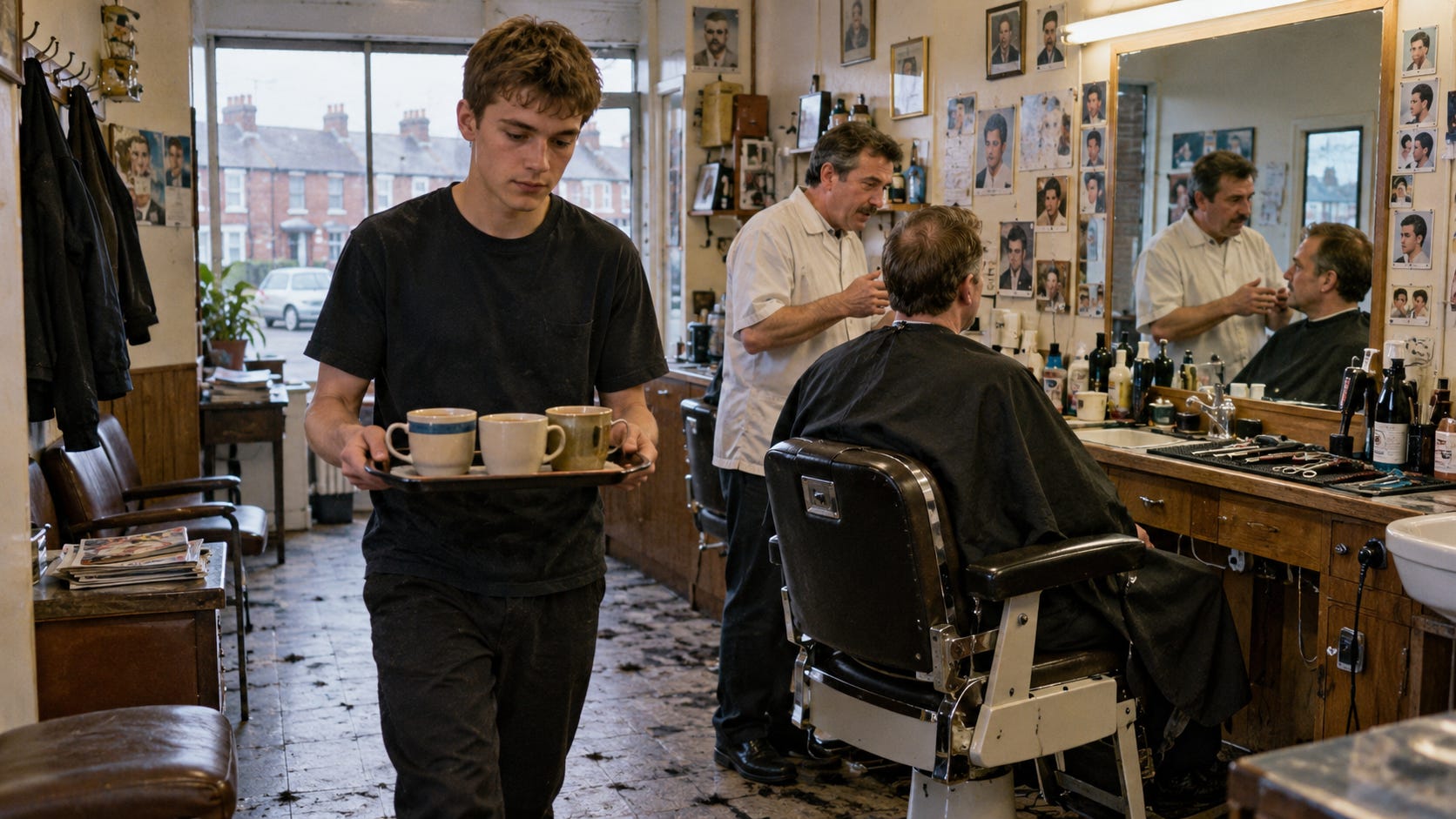
In the late 1990s, I was learning to cut hair and making brews.
I struggled with parts of the training. I was learning a trade, finding my feet and trying to work out where I fitted in. But one piece of advice stuck: I was there to solve people’s problems.
Years later, I am still discovering how much that lesson explains.
A customer sits in your chair with something they want to change. Their hair will not sit properly. They cannot recreate the style at home. They know how they want to feel but struggle to explain what they want to see in the mirror.
Your first job is to understand them.
You listen, ask questions and use your judgement. Then you have to do something useful with what you have learned.
The customer has to live with the result after you put the scissors down.
That is a serious responsibility hiding inside an ordinary working day.
The problem survives the argument
I think about that lesson when I watch politicians argue.
Too often, the interview becomes a competition to defend a position, expose an opponent or avoid conceding a point. You finish watching knowing who landed the sharpest line, with no clearer idea of how anything will improve.
Meanwhile, somebody is still waiting for a home, an appointment or a bus that turns up.
Their problem survives the argument.
Disagreement matters. Bad decisions need challenging. Powerful people need questioning. Sometimes fairness requires a fight.
But the fight needs a purpose beyond keeping itself alive.
In a salon, explaining why another hairdresser is worse will only get you so far. Eventually, you have to help the person sitting in your chair.
I would like more of our public life to carry that expectation.
Defending your position can become the problem
Winning an argument can become a defensive exercise.
You protect your position. You collect reasons why your original answer was right. New information becomes something to defeat.
I recognise that in myself. Persistence has helped me build businesses. Stubbornness has also kept me defending ideas when I should have been asking better questions.
Solving a problem requires initiative. That is what I mean by going on the offensive: making the call, testing the product, finding the person who can help and accepting responsibility for the next step.
It also means accepting that someone else might have a better answer.
If I care about the outcome, I have to be willing to use it. Insisting that the solution must prove I was right all along gives everybody another problem to deal with.
Teach the purpose with the skill
I would like more trainees to hear that lesson, whatever trade they enter.
Learn the technique. Learn the standards. Understand whose life your work is supposed to improve.
For a hairdresser, that includes what happens at home. Can the customer manage the cut? Do they understand how to style it? Have you recommended something useful, or simply added something to the bill?
Sometimes the answer is a product. Sometimes it is showing someone how to use what they already own.
A business needs to earn money. I want the customer to have a good reason to be pleased that it did.
That judgement matters beyond the salon. Helping people buy appropriately, use things properly and avoid unnecessary purchases can reduce waste. Taking responsibility for the usefulness of our work would make us better neighbours as well as better businesses.
It is a modest principle with demanding consequences: start with what people need, then examine whether you actually helped.
Hairbond had to earn its place on the station
grew from my experience behind the chair.
I wanted to create a premium British professional hair care brand for barbers and hairdressers. Products they would be proud to use and comfortable recommending.
Performance mattered. So did fragrance, packaging and the experience of using the product. Those things come together when a professional finishes a haircut and the customer sees the result.
If they want to recreate it at home, the recommendation has a purpose. You can explain what you used, how much they need and how to apply it.
That is where Hairbond has to earn its place.
The jar can attract attention. The product has to justify the next purchase.
Stylo connected the memory with something you could wear
When I brought back into the market, I saw value in a different kind of connection.
Football memories belong to people. A ground brings back the person who first took you there. A pair of boots recalls the player you copied in the playground. A shirt can carry an entire Saturday.
I wanted to reconnect people with Stylo’s heritage, independent style and the particular cool of 1970s football.
Competing with multinationals means giving someone a reason to choose you. I cannot pretend to have their budgets. I can make deliberate choices about design, identity and the stories worth bringing back into view.
But heritage brings responsibility. I did not create Stylo’s original history. My job is to respect it and make something worthwhile now.
The memory starts the conversation. The product still has to earn its price.
Give the artists a stage
That same thinking now shapes the project in Southern California.
I want to connect creative soccer, player personality and entertainment. I want to find players who make people lean forward.
The disguised pass. The change of direction. The moment of invention that makes strangers turn towards each other in the crowd.
I see art in that. Timing, rhythm, courage and expression.
Numbers help us understand performance. Coaches need evidence and teams need structure. My concern is what happens when the fear of a mistake becomes stronger than the desire to create something.
An imaginative pass carries risk. Taking on a defender means sometimes losing the ball. If safety is always rewarded and invention punished, what might we be training out of the player?
I want to look in amateur leagues and overlooked communities across Southern California. Give players a fair audition. See whether the right environment can turn their ability into something a team and an audience value.
Rejection alone proves nothing. Neither does a brilliant highlight clip. We need to judge whether creativity holds up under pressure, whether a player can work with teammates and whether coaching can improve their decisions without removing their individuality.
That requires people who can recognise both the gift and the work it needs.
The promoter has to deliver
I see myself as a promoter.
Dana White and Eddie Hearn are reference points for the craft of making an audience care: introducing personalities, building anticipation and creating an occasion people want to attend.
Football already has enormous promotional power at the top. I see an opportunity to bring more attention to players beyond that spotlight.
Let people meet the players through their stories. Give them introductions worth arriving early for. Build music and atmosphere around expressive, competitive soccer. Make a first-time visitor feel welcome and give them someone they want to see again.
The competition must remain authentic. The audience should understand the rules, and the players must decide the result on the field.
I can promote the possibility of a brilliant moment. I cannot guarantee one.
A ticket is a promise about the care we put into everything around that uncertainty.
Someone buying it gives us an evening of their life. They arrange transport, bring their children and choose our event over everything else they could have done.
That deserves respect. So do the players, through fair terms, proper care and a meaningful opportunity. Their stories cannot substitute for treating them well.
Let the result challenge the idea
Aztecs is a proposition I intend to prove. It needs the necessary rights and permissions, suitable venues, funding and people who can deliver.
Calling football boring will not establish that we offer something better. The audience gets to decide.
If people watch the clips but do not attend, we need to understand why. If they come once and do not return, we need to listen. If our format gets in the way of the creativity we promised, we need to change it.
I cannot build a philosophy around solving problems and then become offended when somebody points one out.
That is the standard I want to hold myself to.
I was making brews and learning to cut hair when I first heard the lesson. It now connects the professional choosing a product, the supporter choosing a shirt, the player seeking an opportunity and the family choosing an evening out.
Understand what matters to them. Make something useful. Pay attention to what happens next.
That is what I want Matchmaker to mean.
Somewhere in Southern California, there may be a player with a gift that has never found the right stage.
I want to help find them, put the right people around them and give an audience the chance to see what they can do.
When that player receives the ball and the crowd leans forward, the argument can wait.